When a group of women met for a brunch in February 2022 to celebrate their charity’s launch—promising free medical care, donations, and well drillings—no one suspected they were plotting Morocco’s largest financial fraud in recent history.
They called it Group Al Kheir.
“You give them 1,800 MAD, and in a few months, you’d get back 10,000 MAD,” said Redouan Saidaoui, a lawyer from Tangier working directly on the case.
This unconventional twist on Daret, a money-trading circle popular in Morocco, seemed like a golden ticket for many struggling to make ends meet. Yet, hesitation lingered in most minds—investing in a mysterious group felt risky, especially during tough financial times.
But Youssra and Karima, the alleged brains behind Group Al Kheir, worked hard to ease their fears. The pair were often seen at charity events where they were lauded for their generosity—in one video, Youssra proudly oversees aid deliveries to victims of the Al-Haouz earthquake, in another, the group is applauded for funding a wedding for an underprivileged couple.
These charitable acts, often carried out in partnership with well-known associations, only further bolstered Group Al Kheir’s positive reputation.
“They built wells, donated to the poor, and even funded surgeries for people who couldn’t afford them,” recalls one victim. “We all believed they were good people.”
But, religious concerns over riba (usury) still arose. So, to soothe members’ worries, Youssra visited the Superior Council of Oulemas in Tangier.
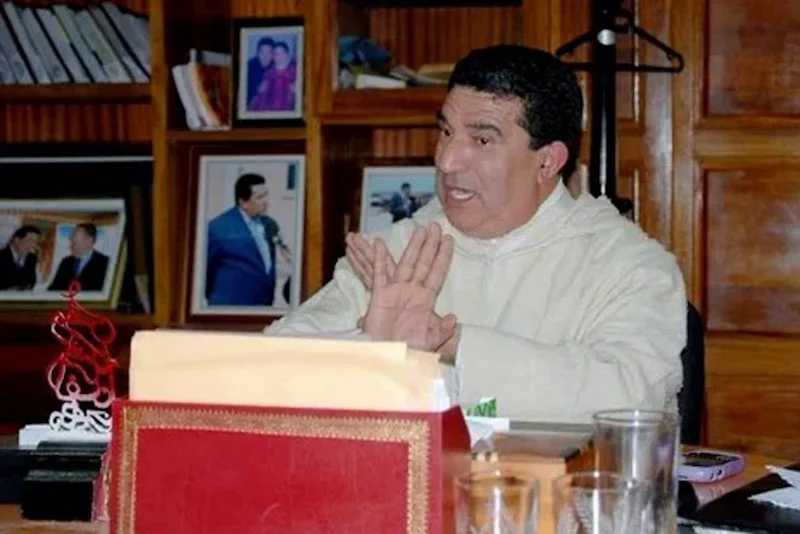
Nestled near Mohamed V mosque, she filmed herself entering the Council, and with a faint sigh, she asks the security guard who she can speak to for a Fatwa, a religious verdict.
She is then directed to a small office, where a singular table and two opposite chairs sit at the center. The video ends abruptly when a man, clothed with a white Jelbab sets foot inside the room. Youssra starts a new video as she’s leaving the Council, stating that the man didn’t allow her to film inside. But, “rest assured, he said that this is halal, you have nothing to worry about.”
Youssra even follows up with a voice note she allegedly recorded while talking to the “same Council member”, who reaffirmed that the scheme did not involve Riba.
A representative from the Oulemas Council speaking to Hespress EN could not verify the conversation between Youssra and the council member, or confirm the identity of the man speaking, but was adamant that the Council would not endorse her requests.
“That is the voice note I used to convince people to join us,” says Zineb, one of the many victims of the scheme. But there is no way of knowing how Youssra described her organization, nor to confirm the identity of the man speaking.
Still, this effort coupled with Imams speaking in favor of the group due to their good deeds, eased many religious worries. Step one was then completed.
But perhaps what truly propelled Group Al Kheir into the spotlight was that members did receive their promised returns— at first. Videos began circulating online, showing stacks of cash in brown envelopes, with women thanking Youssra and Karima for their generosity.
“I won’t lie, we did earn money during the first year. One million then seven million. That’s what led me to trust the group completely. I even swore upon the Qur’an that they weren’t scammers to people who hesitated to join,” says one of the group’s members.
With religious figures backing them, the group operating in plain sight— with their names, home addresses, bank accounts, and faces well known to the public— and most importantly the money flowing in, no one had any reason to suspect Group Al Kheir.
But then, a street fight happens.
On September 30, a physical altercation broke out between two women in Tangier. A common enough occurrence that passersby didn’t think much of it. That is until the police arrived, uncovering the tip of a much larger scheme. One of the two women detained was Karima, and the other was a member of the group Al Kheir demanding her money back.
“All victims were standing on the precipice of a catastrophe, and Karima’s arrest opened the floodgates,” says Saidaoui. Anxious discussions spread in WhatsApp groups and Facebook posts, as news of Karima’s arrest, alongside her husband and nine other individuals began to make headlines. Slowly, victims realized they had been deceived by false promises.
Since September 2023, no one received their promised returns. “Later, the money will come later,” the group’s ‘admins’ would reassure the members. But this was just one of the many lies told by Group Al Kheir.
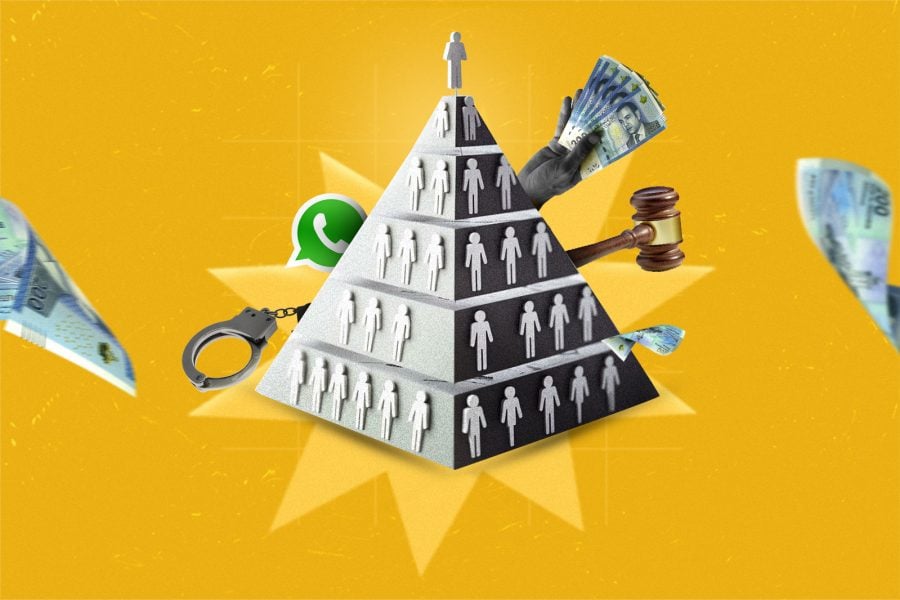
The group operated primarily through WhatsApp groups, where ‘admins’ managed the flow of new members. At the top of the pyramid were Youssra, the president, Karima, the director, and Siham, who was rumored to be running operations abroad.
Below them, a hierarchical structure of “fixed admins,” “top admins,” “middle admins,” and “lower admins” managed countless members, most of whom were women, but not exclusively.
After the initial success of the 1,800 MAD investment, the group introduced new conditions: each new member had to recruit two others, who in turn recruited more, expanding the members’ base exponentially. Youssra, in a leaked voice note, confirmed that she was the mastermind behind this money system, and, alongside Karima, the one who controlled the entire fund.
What they were running was a classic pyramid scheme—illegal under Moroccan law, as legal expert Assila Yassine points out. “This operation is not just a financial fraud, but an economic and social crime that is severely punished by law No. 31.08,” he says in a statement to Hespress. Article 53 prohibits any sale or provision of services based on the temptation to obtain financial gains, resulting from an exponential increase in the number of people participating, which is exactly what the Group Al Kheir was doing.
“They preyed on people’s vulnerabilities and manipulated them through religion with the slogan Din wa Dunya (this life and the next),” says Assila.
The beginning of the end
Towards the final months of the operation, Group Al Kheir was akin to a speeding train with one inevitable destination— total collapse.
The group required only 1000 MAD to join now, and they introduced larger investment “packs,” promising astronomical returns: 1.26 million MAD to earn 3 million, 5 million to earn 20 million, or even 40 million to earn 100 million. To calm fears, they also set up a “guarantee fund,” where 4,400 MAD was deducted from each investment to cover losses in the worst-case scenario: the group falling apart.
Admins discovered that the “guarantee fund” had already vanished. Hafsa, one of the group’s “lower admins” recalls the beginning of the end.
“In May, we were called to an urgent meeting, and they told us the guarantee fund had been stolen back in January. But Karima assured us we could continue without it and promised to double the money in a few months. She asked if we still wanted to move forward, and we agreed.”
With the knowledge that the money was essentially gone, the group still recruited people who invested exorbitant amounts of money.
One victim from Spain who spoke to media angrily called out the admins. “I invested 3900 euros in June because my friend convinced me to join. Why didn’t anyone tell us that the group was falling apart?”
Karima’s arrest only exposed the rot festering within the group. A leaked voice note from a “fixed admin” urged members to avoid mentioning Karima’s name in investigations and to shift the blame entirely onto Youssra, who remains at large, revealing the group’s internal disarray.
The victim’s lawyer says the number of complaints exceeds 1,000, but the true number of victims is staggering—over a million people from all over the country, including expatriates abroad. One victim speaking before the court in Tangier, described how she and her family in Belgium had invested a million dirhams each. “My friend showed me proof of all the money she earned with the group, so I blindly trusted her. We never imagined for once that this entire thing was a fraud.”
The scale of the scheme is staggering: an estimated 72 billion centimes were stolen.
“These numbers sound impossible, but they’re based on complaints received by me and my colleagues in Tangier,” says Saidaoui. “We’re not talking small amounts—each complaint involves losses exceeding 150 million centimes. One alone reported a 2 billion centimes loss.”
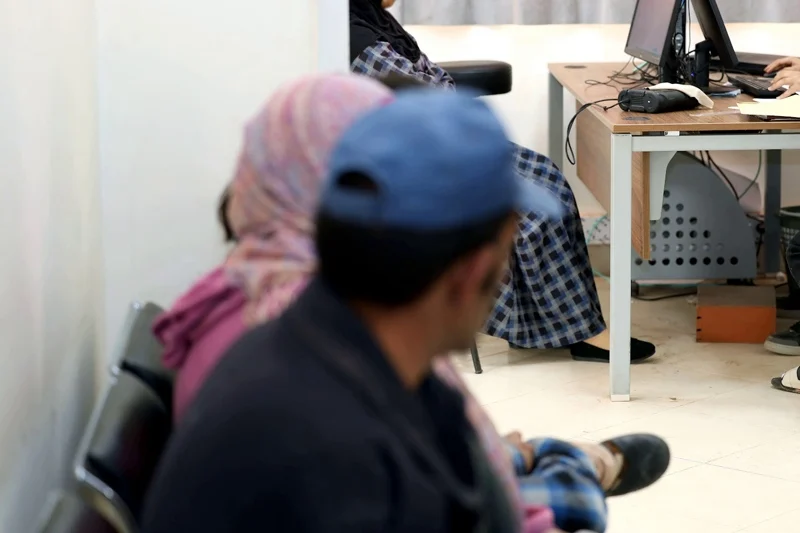
Protests outside Tangier’s court have become a daily sight. Victims, often covering their faces with scarves or large sunglasses, gather in the hope of justice, but more urgently, to reclaim their lost money. Their stories are harrowing—many had scraped together every dirham to their name, only to see it vanish. “I joined to pay off a loan for my son’s surgery,” one woman says. “But now my money is gone.”
A widow, trembling as she spoke, says, “I have orphans. I worked tirelessly, day and night, to save 2 million dirhams. Now it’s all gone.” Another victim, in tears, laments, “I sold my gold, took a loan, and invested my husband’s hard-earned savings—six years of work. But they’ve destroyed us. We can’t sleep, we can’t eat.”
The victims span all walks of life—teachers, government employees, and even doctors. “They knew exactly how to target every corner of society,” one victim reflects. A sentiment echoed by Saidaoui who describes the group as a virus, infesting every Moroccan household.
For many, the fallout extends beyond their personal losses. They are now facing pressure from friends and relatives they recruited into the scheme, all of whom are also demanding their money—which they simply can’t get back.
“I recruited people who sold their sheep, others who handed over their hard-earned savings. I now owe them 70 million dirhams,” says one victim, whose voice shakes with each uttered word, “People are banging on my door. How can I face them?”
When asked if the victims will be compensated, Lawyer Saidaoui cites the case of ‘Hibat l’Iirth,’ another pyramid scheme exposed months earlier, where victims eventually received compensation through the seizure of the perpetrators’ properties. Legal expert Assila explains that while the legal process may take time, the law mandates that the perpetrators must return the stolen funds.
A recent suicide of one of the group’s admins weighs heavily on the victims. Unable to cope with the pressure to return the money, she took her own life, leaving behind two children.
On August 5, the City Court of Tangier held its first hearing in the case. By August 11, a second hearing brought the victims face-to-face with the suspects, reportedly focusing on how the operation was managed and the distribution of funds, as authorities worked to untangle the complex web of this affair.
Local authorities also intensified their search for the remaining suspects—namely Youssra, the scheme’s ringleader, and other ‘fixed admins’ closely tied to her, as the number of detainees has risen to 13, including 10 women and 3 men.
In a related case, the owner of a Tangier kindergarten who ran a similar pyramid scheme was sentenced to three years in prison on August 11, signaling a glimmer of hope for the victims of Al Kheir’s evil.




add your comment
Terms of publication : Not to offend the writer, people, sacred things, or attack religions or the divine self, and refrain from racist incitement and insults.