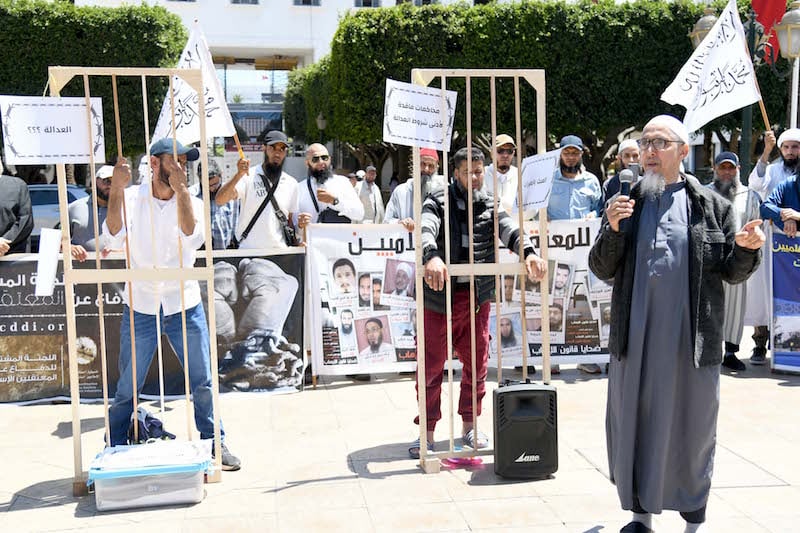
On the 20th anniversary of the May 16 Casablanca terrorist attacks, families of the detainees resumed their call for the implementation of the March 25, 2011 agreement that the committee claims it signed with the state at the time.
This year’s attacks anniversary once again shed light on the dormant conflict the families maintain with official, as parties continue to contest the realities behind the alleged “agreement,” discredited, forgotten and abandoned by officials today.
Last Tuesday, the Joint Committee for the Defense of Islamist Detainees held a protest in front of the Moroccan Parliament in Rabat to attract attention to the signing of an agreement with the government.
The agreement was facilitated by Mostafa Ramid, former Minister of Justice, Hafid Benhachem, General Delegate for Prison Administration and Mohammad Sebar, General Secretary of the National Council for Human Rights.
Abderahim Ghazali, a spokesperson of the Joint Committee for the Defense of Islamist Detainees, confirmed the existence of the deal in an interview with Hespress EN.
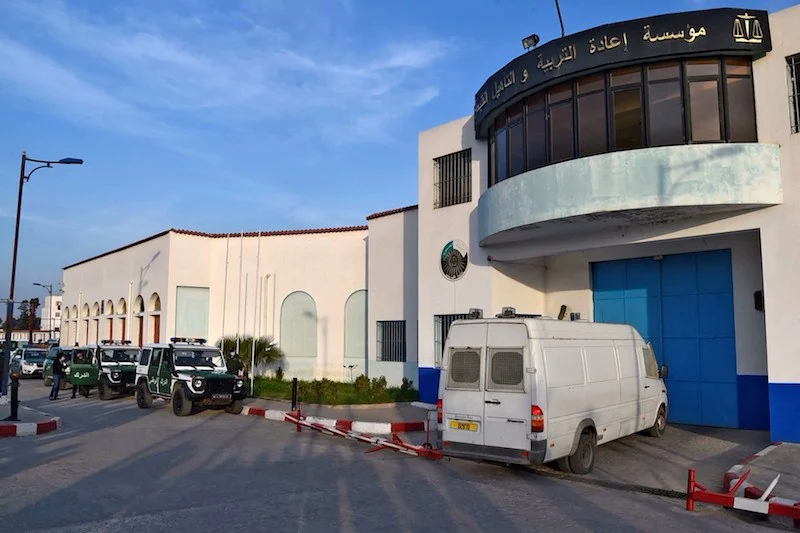
The March 25, 2011 accord took place in the wake of the state’s repeated arrests of extremism suspects, which sparked protests in the Sale jail and other detention facilities across the country.
314 jailed extremist prisoners had staged a protest on the jail’s roof and threatened to commit suicide in the prison.
Ghazali confirmed to Hespress EN that discussions took place between the state’s representatives, the prison administration, and the committee’s representatives, in the presence of Mostafa Ramid, then Justice Minister, who was speaking on behalf of the Karama Forum for Human Rights.
“The Moroccan government initially began implementing the 25 March deal but quickly abandoned it,” according to Ghazali.
The state “recognized at first the grievances of the Islamist detainees, and committed itself, in accordance with the March 25 agreement, to releasing the detainees in installments and within reasonable deadlines, and to adjudicating the cases brought before the courts,” Ghazali tells Hespress EN.
The Karama Forum for Human Rights, a collective that tackles various human rights issues, issued a statement following the meeting, the same document on which the Joint Committee for the Defense of Islamist Detainees relies to confirm the existence of an agreement with the state, to speed up the judicial processes of the detainees, and release those who served their sentences.
Parties reached the agreement after discussions between state authorities and the detainees’ representatives, and it calls for “a comprehensive solution to the file through specific mechanisms and within a specific time frame.”
The agreement included a number of judicial benchmarks that the committee advocating for the detainees demanded, including expediting judgments, reviewing all files that have exhausted all appeals, handling cases fairly and swiftly, and launching the amnesty procedure at the first national gathering.
However, the head of the National Council for Human Rights, Muhammad Sebar, denied that any agreements had been signed between the parties in question.
Sebar informed Hespress that the contract’s signature on March 25 had not taken place.
“A prisoner does not leave jail except when the sentence is finished or if he benefits from a pardon, or in the event of death or an escape. We as an institution concerned with the defense of human rights do not promise anything to anyone,” according to Sebar.
Mostafa Ramid refrained from responding when contacted by Hespress EN for more information regarding the 25 March agreement, and its legal standing.





add your comment
Terms of publication : Not to offend the writer, people, sacred things, or attack religions or the divine self, and refrain from racist incitement and insults.