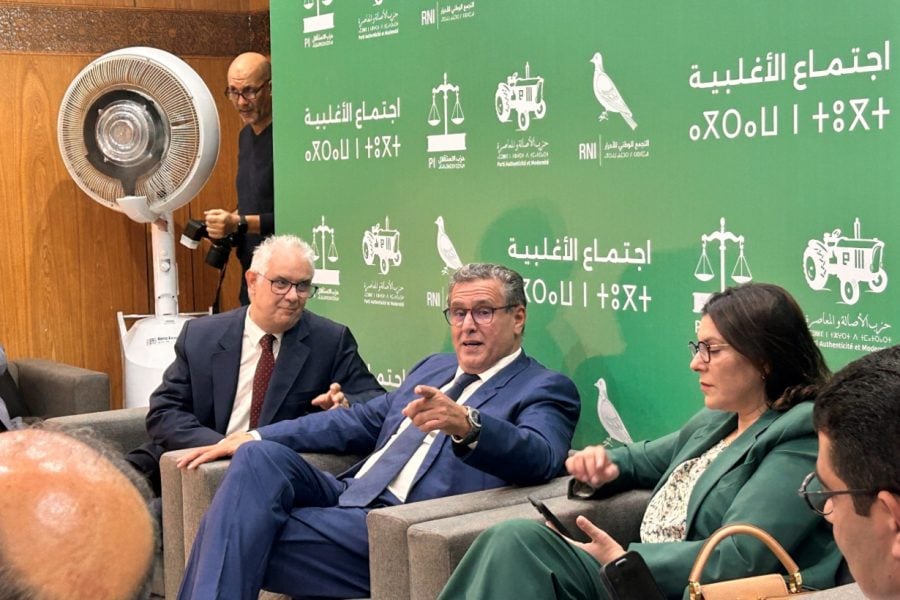
Three parties have shared Morocco’s government since 2021, but their ministries have produced very different records.
The indicators below are meant to show what changed during the coalition’s first term, while keeping in mind that ministries do not operate alone and that drought, global prices, population growth and wider government policy can shape the results.
For this piece, we picked two ministries held by the RNI, two by PAM and one by Istiqlal, matching the balance of portfolios the three parties took in government in 2021.
We then focused on the ministries that matter most in everyday life – finance, health, employment, higher education and water – and tracked what happened to a few hard indicators in each since the coalition took office.
RNI: Stability on paper, pressure at home
The RNI’s two major economic and social portfolios improved key figures, but not all of those gains were felt by households.
At Finance, the government went through the inflation shock of 2022-23 before bringing price growth sharply back down. At the same time, the debt ratio rose during the shock years and later came down, while growth recovered and public investment remained high.
The improvement in inflation should not be treated as the work of the Finance Ministry alone. The international energy and food shock had a major role in the initial deterioration, while Bank Al-Maghrib’s monetary policy was central to bringing inflation back under control.
But the Finance Ministry did play a role in cushioning households and managing public finances through the shock. In 2022, the government increased compensation spending to keep prices of butane gas, sugar and soft wheat flour from rising as sharply as international prices. It also mobilised more than DH40 billion in additional spending to support household purchasing power and businesse
By 2025, Morocco had returned to low inflation while maintaining substantial investment and social spending.
And while the numbers look strongest on paper, Moroccan households still feel worse off. That distinction matters for the RNI’s Finance record because lower inflation means prices are rising more slowly, not that the prices households faced during the inflation shock have gone back down.
Moroccan households were still judging the economy by their grocery bills, disposable income and ability to save, even as the headline indicators began to improve.
HCP’s surveys found 87% of households said their living standards had deteriorated in 2023, while more than 90% said in 2024 that they did not expect to be able to save over the following year.
The disconnect between the headline figures and daily life also shows up in the healthcare sector.
The number of doctors in the public sector increased over the period, while the number of people per doctor and the number of people per public hospital bed both moved down.
In practical terms, that means the public system had more medical capacity relative to the population than it did at the start of the period.
The government pushed ahead with the expansion of mandatory health insurance. The IMF says health-insurance coverage reached 88% of the population in 2025, compared with 42% in 2021.
But access is not the same as quality. The IMF’s 2026 review says Morocco still faces shortages of medical personnel, regional disparities and weaknesses in infrastructure, while public spending efficiency remains a concern.
Setting the numbers aside, the current government term saw doctors, nurses and medical students taking to the streets over conditions they say are still falling short.
Medical students spent much of 2024 boycotting classes, clinical training and exams, citing shortened training, overcrowding and the quality of their practical education.
Patients and residents have protested over long waits, shortages of medicines and equipment and the state of public hospitals. The 2025 protests around hospitals in several cities brought those complaints into the open, showing the gap between the figures and what patients encounter when they actually seek care.
PAM: Education grew, but jobs lagged
PAM expanded access to higher education, but the labor market failed to keep up, leaving the government with more students entering universities and too few jobs waiting for them.
Morocco’s public universities took in more students between 2021 and 2025, and the number of new entrants also increased.
At the same time, the number of students per permanent university teacher fell after peaking early in the period. That points to an improvement in staffing relative to the student population, even as universities continued to absorb growing demand.
The ministry itself reported that higher-education enrollment has been rising steadily and that the overall enrollment rate among 18- to 22-year-olds continued to improve.
The problem is that more students entering university does not automatically mean better outcomes once they leave it.
The IMF says Morocco still faces weak learning outcomes, regional inequalities and a mismatch between some university fields and the skills demanded by the labor market.
That matters even more when the same government’s employment figures are brought into the picture.
The labor market did not improve at the same pace as university access. Unemployment remained high, while youth unemployment moved in the wrong direction across the period.
HCP says the recovery in job creation became stronger in 2025 while the IMF still describes job creation as one of Morocco’s most pressing economic challenges.
The PAM-led Economic Inclusion Ministry increasingly responded with employment programs and, by 2025, a new employment roadmap bringing several ministries into a common strategy.
The ministry’s initiative shows a shift toward treating employment as a central government priority. But the outcome indicators have not caught up with the policy effort: youth unemployment remained high and women’s participation in the labor market remained weak.
Istiqlal: More dams, more desalination, same water problem
Water is probably the portfolio where the government’s biggest infrastructure push met its most difficult natural constraint.
The basic access indicators improved. More households gained access to an improved water source, the share without such access declined, and the proportion of households not connected to the public drinking-water network also fell.
Morocco went through several consecutive years of drought, putting pressure on dams, groundwater and agricultural water supplies.
The government responded by speeding up projects that had been planned before the current coalition, while adding new desalination plants, dam interconnections and water-transfer projects.
By 2025, the government was describing desalination and inter-basin transfers as central parts of the response to the country’s water stress.
New dams entered service, major projects linking river basins moved forward and desalination capacity expanded.
The government said that desalinated water had become a major source of drinking water for parts of the Casablanca-Settat region and fully supplied Safi.
But the fact that Morocco had to speed up these projects is itself a measure of how serious the problem became.
Water security remains vulnerable to rainfall, and improved household access does not mean Morocco has solved the wider question of reliable supply for cities, farms and industry.
Istiqlal’s Nizar Baraka has overseen an acceleration of infrastructure and diversification of supply, but much of the pressure comes from a drought cycle that no minister can remove.
The infrastructure push has not fixed the deeper problem. Agriculture still uses nearly 90% of the country’s water, while the OECD says low water prices encourage overuse and that infrastructure alone will not solve the shortage.
Groundwater is also being pushed beyond sustainable levels, while water losses and limited wastewater reuse leave much of the pressure unresolved
So while the ministry has moved to build new sources of water, it has been slower to fix the leaks, pricing, groundwater depletion, wastewater reuse and regulatory gaps that determine how efficiently that water is managed.
So, did the coalition deliver for Moroccans?
Five years into the coalition, the record is mixed. Across finance, health, higher education, employment and water, the government expanded investment, access and capacity, but improvements in headline indicators have not always translated into better conditions for households.
The common thread is a gap between what the government built and what citizens experienced. The coalition has delivered major programs and infrastructure, but inflation, unemployment, pressure on public services and water scarcity remain difficult problems to solve.





add your comment
Terms of publication : Not to offend the writer, people, sacred things, or attack religions or the divine self, and refrain from racist incitement and insults.