Since the human being fulfilled his need for protection and seclusion, by resorting to caves as shelters, he did not hesitate to express his concerns and questions through inscriptions (drawings, scribbles, engraved traces…) in order to control the interactions of the universe and try to discover them with a view to overcoming the constraints of life, without distinguishing between the natures of his actions and practices.
From inside these inscriptions (drawing), the existence of symbols and signs was established, until a means of communication was created, that embodies the chemistry of the primitive language that is not devoid of knowledge. It also created a means of signification, welding the relations between time and space (given that time inhabits the space). If painting (like photography and sculpture) is one of the arts that are based on space, as spatial arts (opposed to music and poetry, for example, as arts based on time), how can it evoke the temporal dimension? In other words, how can painting work on the concept of time and monitor it?
To answer this question, I would like to talk about the works of the artist Abdelkarim Elazhar, which translate the relation between time and space using an exceptional expressive combination; it is a translation that is based on reducing the language of the visual, mostly derived from the images of the living. As the graphic dimension intensifies, it tends to fragment, simplify and stylize the visual reality until it is transformed into icons, signs, and symbols …It is as if Al-Azhar, in opposition to development and modernity, continued to descend to the beginnings, to the initial times, to create meanings that emulated and still emulate the universe in its various manifestations.
Empowered by the expressive energy carried by the symbols, the artist penetrates into the essence of the present day, the modern, and the daily, with the speed of its pace and his tension, and with the attractiveness of its magical fascination and his admiration, and with his anxiety that is marked by the slippage of time and its eternal continuity….from one painting to another, the spaces are generated through deconstruction and reconstruction, and the drawing champions the repetition of the monistic body, that is subject to permanent movement-based multiplicity. The situations take shape in a rational sequence that employs the principle of alternation, to make the body, as the main symbolic image, a container for that “Life” that emphasizes recording the effect of time, through the appearance and disappearance of the body, through presence and absence: absence to the point of presence, and presence to the point of absence.
Elazhar’s spaces are organized squares, lined up on the vertical and horizontal planes. A number of them are hollow, leaving only blackness, and darkness, simulating nothingness. Oftentimes, it is permeated and inhabited by one body, reduced and ramified, in a continuous movement, changing its positions from one square to another, appearing and quickly disappearing, leaving behind the traces of its path. The arrows that were operational in directing and destroying it appear, and so do the numbers that replace and represent him. These arrows and numbers are representational, referring to the labyrinths of spaces and times that lead to loss.
That is because the numbers that are too specific in their determination have become the embodying mirror of contemporary man, as one that is reduced to numbers: birth number (date of birth), identity number, job number, passport number, phone number… residency number, grave number (date of death). With this numerical determination imposed by progress, contemporary times paint human life and history, and draw its beginning and end. And between the beginning and the end, the hands of the clock come with its frenzied rotation, to double the presence of both arrows and numbers, and to practice the successive folding of the instantaneous and expected time.
Through its architectural construction of specific spaces, Elazhar presents and represents the symbolic body stripped of its humanity, the body that knows itself only within the small squares, the narrow spaces imposed by his marginal status defined by the law of contemporary life and the constraints of systems (the pressures of what is political, economic and social). In any position, the body seems imprisoned between the ribs, trapped, even as it moves, it metamorphosizes, trying to relieve its pain, and worries and overcome its failure. He is like a number trapped inside a forgotten record book, until he becomes the number itself.
The treatment of light in the paintings focuses mainly on the model of the body, to build its individuality, and loneliness, and to highlight its excessive isolation. Therefore, the sources of light (windows) position themselves in such a way as to determine the degree of clarity of the body, and the way it is represented in different situations: the scattering of light in the light misleads the vision. The vision in this sense is based on a specific intentionality, so that the body is emptied of its features and details, and preserves only the intensity of its shadow, so that nothing remains of its entity except the ghost that is carved by the strong light.
As such, the light becomes a support that holds up the symbol, weaves and shapes it. However, this body as a mere ghost, despite its simplicity, agility and dwarfism, is a body bearing an inner force based on the modularity of its reduction, and on the richness of its expression that is fraught with direct allusions. So, it is a provocative, exposed body, constantly proclaiming its agility and dynamism. It is an instigating, dramatic body (eliminating the phantasmagorical and sensual side) because it is a metamorphosed body, not in the sense of strict metamorphosis, but in the sense of transformation in appearance, character and circumstances, as the signifier of the myth, since its very beginnings, until its transformation into a commodified body in the commodified culture of advertising.
The substance in Elazhar’s painting is monochromatic, synonymous with water, transparent, stainable and fluid, aiding in the fluidity of spaces and bodies, in formulating the transparency of light, in achieving the specific details and standards in the differences between the degrees of light. It is from these competencies that the ink derives its value in the work of Elazhar (Chinese ink). Even in cases of color diversification, colors have no option but to borrow the advantage of ink, so they are watercolors that exude their transparency very smoothly and enable the composition of harmonious and strong contrasts at the same time.
From the overwhelming darkness, and out of nothingness, the architecture of the framed, abbreviated worlds that are subject to vertical and horizontal cuts, is created; these are stratified upwards, where times are sequenced and take their visual form through the vitality of signs and their volatile representations… until these worlds are finally completed through the cohesion of their parts and overall surroundings, and through the gaze of the viewers, arousing their imagination, interpretation and travel through the memory of times.
These works, for which the artist has been known since the beginning of the 1990’s, continued to generate and reproduce forms in the direction of an open horizon, a rational horizon that respects the rules of logic. In order to attribute the third dimension of depth to his paintings, the squares (surface representations) are transformed into cubes (embodiment) featuring the same signs and symbols, and emphasizing the treatment of light and shadows in a way that makes the light snatch the eyes, and forces them to enjoy a sudden reappearance of light.
Hence Elazhar’s constant insistence on presenting his clocks and windows, along with numbers, arrows, and signs, in a stratified composition that reflects the social and cultural face of the system, according to a new order organized around the preconceived ideas of a person or group, embodied in a book of a special color, that regulates work and the pattern of life and death… All are subject, in the view of Elazhar, to the system of stratification, with an upper and lower formation, which limits the freedom of the person as a body and an entity. It is a kind of alienation of the self, or rather an abstraction of the self, transforming it to a number, a job, or a consumer of ideas, instructions, and things.
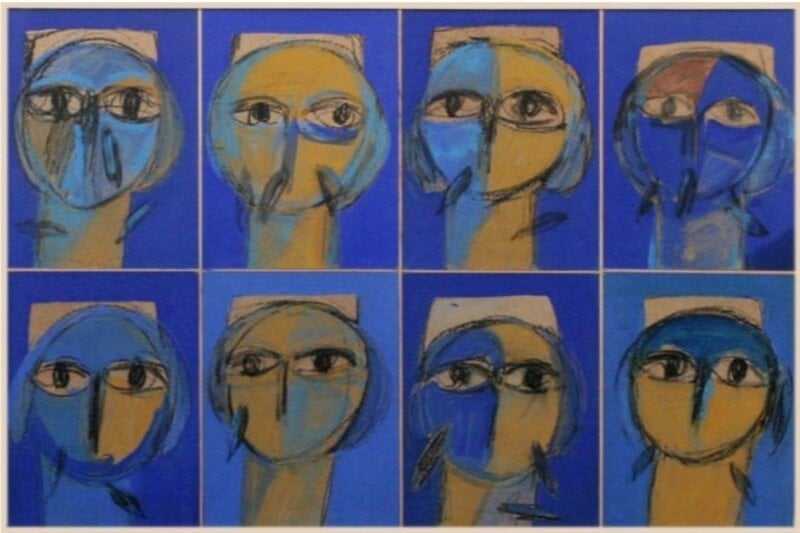
Today, all that remains of the body is the face that draws its oval shape inside the square’s envelope, with a great level of framing. The very complexion is repeated, being reproduced like masks that change their skin only through the rhythm of light, working to erase the appearance of the lips as if they embodied their mute state, where silence is the hallmark of the ambient atmosphere… And in exchange for the erasure of the mouths, the openness of the eyes doubles, to tell with a strong gestural act, to the extent of equaling pronounced speech, posing in parallel to the speech produced by the tongue. The eyes provoke as well, insisting on confronting the gaze with a direct, continuous gaze, the sharp look that raises questions and engages in the questioning of the past, the present, and the future.





add your comment
Terms of publication : Not to offend the writer, people, sacred things, or attack religions or the divine self, and refrain from racist incitement and insults.