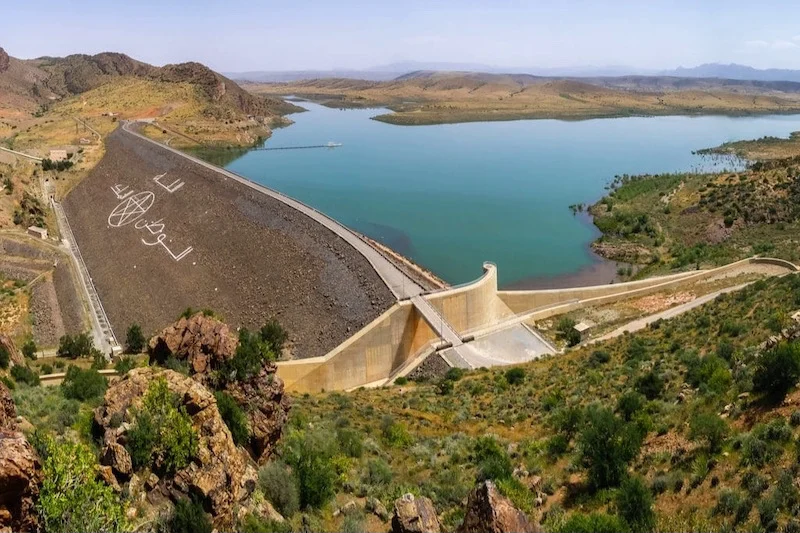
Morocco’s water situation has improved sharply over the past year, with the national dam-filling rate nearly doubling from 32.5% on Oct. 5, 2025, to 65.3% on the same date this year, according to the latest data from the Ministry of Equipment and Water.
Total dam reserves reached 11.12 billion cubic meters on Oct. 5, compared with 5.45 billion cubic meters a year earlier — an increase of 104%, according to data published on the ministry’s “Maadialna” platform.
The increase amounts to roughly 5.67 billion cubic meters, giving the national water system a significantly larger reserve than it had at the same point last year.
The improvement, however, has not been entirely linear. The national filling rate slipped from 66.6% on Sept. 14 to 65.3% on Oct. 5, according to the same data.
The national figure also masks significant differences between Morocco’s river basins, with reservoirs in the north and center generally recording higher levels while others remain below the national average.
Sebou basin leads in reserves
The Sebou basin currently holds the largest volume of stored water, with its dams 77.3% full and holding 4.15 billion cubic meters — more than one-third of Morocco’s total dam reserves.
The Al Wahda Dam was 80% full, while filling rates reached 94% at Allal El Fassi, 98% at M’Dez on the Sebou River, 90% at Sahla, 87% at Bab Louta, 74% at Idriss I and 73% at Bouhouda.
Kansara was 63% full and Sidi Chahed 61%.
The Bouregreg basin also recorded a high overall filling rate of 76.1%, with reserves of 1.12 billion cubic meters. Tiddas was 89% full, Tamesna 77% and Sidi Mohamed Ben Abdellah 70%, while Malah stood at 56% and El Hamra at just 5%.
In the Loukkos basin, the overall filling rate reached 76%. Several major dams recorded high levels, including Kharroub at 89%, Dar Khrofa at 88%, Tangier Med at 87%, Chefchaouen at 76%, and Cherif Al Idrissi at 85%.
Oued El Makhazine was 67% full, Nakhla 56%, April 9, 1947, 68% and Ibn Battouta 37%.
Lower levels in other basins
The Oum Er-Rbia basin recorded an overall filling rate of 57.7%, with reserves of 2.89 billion cubic meters.
Al Massira was 39% full, compared with 80% at Hassan I, 100% at Sidi Driss, 79% at Bin El Ouidane, 77% at Ahmed El Hansali and 66% at Moulay Youssef.
Elsewhere in the basin, Daourat was 67% full, Sidi Said Maachou 81%, Timinoutine 38% and Ait Messaoud 61%.
The Moulouya basin recorded a filling rate of 56.3%, with reserves of 395.2 million cubic meters. Oued Za reached 100%, while Tamalout stood at 68%, Hassan II at 56% and Mohamed V at 22%.
The Souss-Massa basin remained below the national average, with a filling rate of 46.5% and reserves of 336.1 million cubic meters.
Moulay Abdellah was 83% full, Sidi Abdellah 66%, Aoulouz 56% and Youssef Ben Tachfine 46%. Dakhla stood at 31%, Abdelmoumen at 32% and Mokhtar Soussi at 10%.
The figures highlight the continuing geographical imbalance in Morocco’s water resources, despite the substantial year-on-year increase in national reserves. Managing available supplies between drinking water, irrigation and economic activities remains a key challenge.
Desalination expands alongside dam reserves
The increase in dam reserves comes as Morocco continues to expand its use of non-conventional water resources, particularly seawater desalination, as part of efforts to strengthen water security and reduce major cities’ reliance on rainfall.
Morocco’s current annual desalination capacity stands at around 420 million cubic meters. The country aims to increase this to 1.7 billion cubic meters annually in the coming years.
The kingdom’s largest desalination plant is expected to begin operations in February 2027, with the facility intended to help supply drinking water to Casablanca and surrounding areas.
Its initial production capacity will be 200 million cubic meters per year, rising to 300 million cubic meters following a planned expansion.
The increase in dam reserves from 5.45 billion to 11.12 billion cubic meters over one year provides greater room for managing national water needs. However, differences between basins and the slight decline in the national filling rate since mid-September mean that managing existing supplies and accelerating desalination projects remain central to Morocco’s efforts to secure water supplies in the coming period.







add your comment
Terms of publication : Not to offend the writer, people, sacred things, or attack religions or the divine self, and refrain from racist incitement and insults.