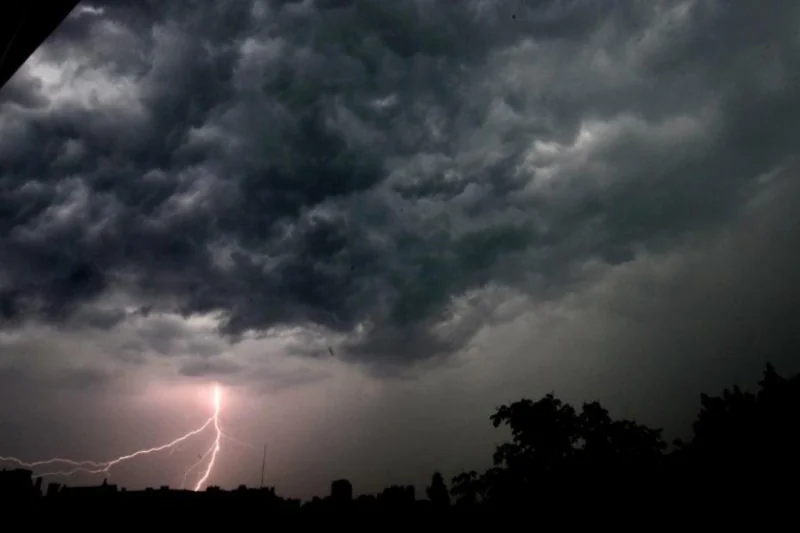
Heavy rain has spread across Morocco this week, bringing up to 40 millimeters of rainfall to parts of the country and prompting authorities in the north to prepare for possible flooding, as national reservoirs enter November holding more than twice as much water as a year ago.
The General Directorate of Meteorology (DGM) extended its orange weather warning on Wednesday with thunderstorms expected to bring another 20 to 35 millimeters of rain to 16 provinces before 11 p.m. Hail and strong winds could accompany the storms.
The latest warning covers much of the northern belt, including Tangier-Assilah, Tetouan, Larache, Chefchaouen, Al Hoceima, Nador, Taza and Taounate, as well as Kenitra, Sidi Kacem and Al Haouz. It follows a wider alert affecting 47 provinces on Tuesday, when the weather system extended across central, eastern and southern Morocco.
By Wednesday morning, Ifrane had recorded 40 millimeters of rain over 24 hours, the highest total among the locations in the latest published measurements. Aïn Chaïr, in Figuig province, received 33 millimeters, followed by El Attaouia with 32 millimeters and Merija, in Jerada, with 30 millimeters.
Khenifra and Tadighoust, near Errachidia, each recorded 29 millimeters, while Zaouiat Cheikh received 27 millimeters. The distribution of rainfall reflects the storm’s reach across several regions, although the daily totals do not indicate whether the rain fell gradually or in short, intense bursts.
The unsettled conditions are also expected to bring snowfall to high elevations in the Middle and High Atlas, alongside colder temperatures in mountainous areas.
Northern Morocco prepares for further rainfall
In Tangier-Tetouan-Al Hoceima, the forecast has prompted authorities to reinforce flood precautions, particularly in areas exposed to overflowing waterways and runoff.
Attention has also turned to the region’s dams, amid concerns that additional rainfall could require changes to reservoir operations.
Sources familiar with water management dismissed reports of exceptional releases from Oued El Makhazine and Dar Khrofa, two important reservoirs in the Loukkos basin.
They said Oued El Makhazine’s discharge of approximately 400,000 cubic meters a day was part of normal operations linked to electricity generation and irrigation, rather than an emergency response to rising water levels.
As of November 3, Oued El Makhazine was approximately 65% full and Dar Khrofa around 80.5%.
The preparations come without confirmed reports of widespread new flooding, casualties or major transport disruption directly attributable to the November 3–4 storms.
Rain arrives as Morocco’s water reserves recover
The latest rainfall comes at a markedly different point in Morocco’s water cycle than a year ago.Official figures published Wednesday showed that the country’s reservoirs contained 11.21 billion cubic meters of water, equivalent to 65.82% of their combined capacity. On November 4, 2025, that rate stood at just 31.12%.
The improvement follows a prolonged period of drought that placed pressure on drinking water supplies, agriculture and reservoir management. It also gives several major basins considerably larger reserves entering the coming months.
The Bouregreg basin was 76.76% full on Wednesday, while Sebou stood at 74.27%, Loukkos at 72.58% and Moulouya at 72.49%.
Souss-Massa remained at 46.29% capacity and Draa-Oued Noun at 38.58%, leaving parts of southern Morocco with far less water in storage than the northern basins.
*SEO tags:** Morocco heavy rain, Morocco weather November 2026, DGM orange alert, northern Morocco flood warning, Morocco dam levels, Ifrane rainfall, Loukkos basin, Oued El Makhazine, Morocco water reserves, Atlas snowfall







add your comment
Terms of publication : Not to offend the writer, people, sacred things, or attack religions or the divine self, and refrain from racist incitement and insults.