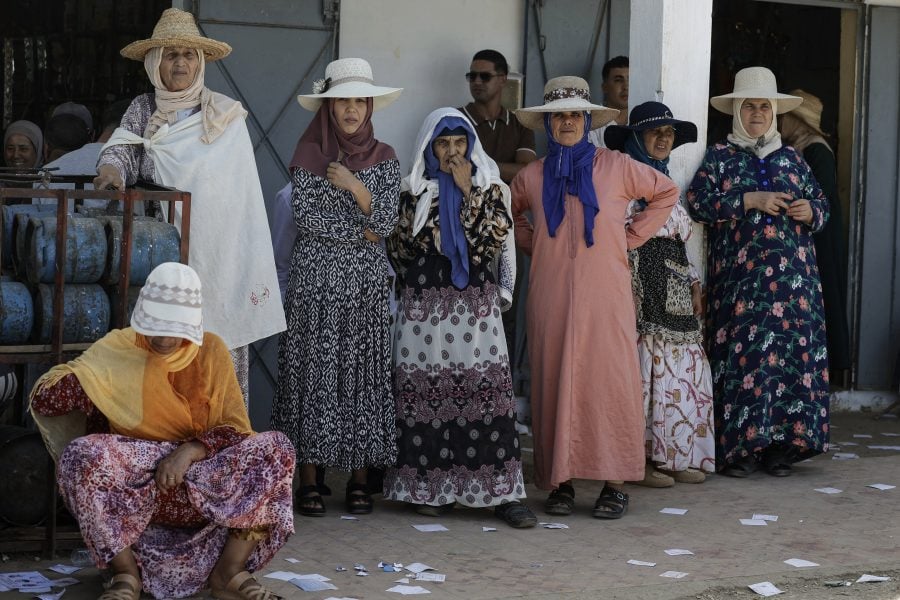
Morocco’s parties have spent the campaign promising more jobs, higher wages, more investment and a bigger industrial economy.
RNI wants to push the minimum wage to MAD 5,000 and keep growth around 5%. PAM is promising at least one million net jobs and has put MAD 350 billion behind its program. Istiqlal is promising higher wages, more investment and stronger domestic production. The PJD says it wants to close the gap between investment, growth and employment, while the FGD-led Left Alliance has put MAD 500 billion behind a five-year program of 431 measures.
The promises differ, but they all have to work within the same economy.
Here are five numbers that help show how much room the next government actually has.
1. Growth: 5% would mean keeping the economy moving faster
RNI and PAM are both targeting economic growth of around 5% a year.
Morocco is not far from that right now. The economy grew 4.9% in 2025, and HCP expects 4.8% in 2026.
But keeping that pace will be harder. HCP expects growth to slow to 3% in 2027, while the IMF expects around 4.5% that year and about 4% over the longer term.
That extra growth is important because PAM is counting on it to help pay for its MAD 350 billion program. The party says MAD 300 billion of that money would come from the extra revenue created by stronger growth and a larger number of taxpayers.
That means growth is part of how the PAM says it will pay for its other promises.
In 2025, agriculture grew 8.2%, while the rest of the economy grew 3.9%. Agriculture can swing sharply depending on rainfall, so the more important question for a five-year plan is whether growth outside agriculture can speed up and stay strong.
2. Wages: MAD 5,000 sounds simple, but someone has to pay for it
RNI wants to gradually raise the minimum wage to MAD 5,000 a month.
The Left Alliance has made a similar promise, but says the minimum wage should reach MAD 5,000 net by 2029. Istiqlal has promised higher wages but has not set the same fixed figure.
For workers, a higher minimum wage means more money in their pockets.
For businesses, paying workers more raises the cost of running a business. Companies can absorb that through higher productivity or stronger sales, but some may also respond by raising prices, cutting costs or hiring more slowly.
If businesses are growing and workers are becoming more productive, higher wages are easier to absorb. If growth is weak, the same wage increase can put more pressure on employers.
The IMF has identified job creation as one of Morocco’s biggest economic challenges and has called for a stronger private sector and labor-market reforms.
So the real question behind the MAD 5,000 promise is not only whether workers can be paid more. It is whether businesses can afford to pay more without reducing the number of jobs they offer.
3. Taxes: PAM wants many workers to stop paying income tax
PAM is proposing a 0% income-tax rate for people earning less than MAD 15,000 a month before tax.
For workers that could mean more money left from their salaries but for the government it means less money coming in from income tax.
Morocco collected about MAD 127.7 billion in taxes on income, profits and capital gains in 2025, although that figure includes several types of taxes.
PAM says it would make up for the lost revenue by bringing more businesses and workers into the formal economy, improving tax collection and generating stronger economic growth.
Morocco has already managed to increase tax revenue through better collection and compliance. But doing that once is different from finding large amounts of new revenue every year.
The Left Alliance wants more progressive taxation, changes to existing tax breaks and greater redistribution.
So what’s at stake here is not simply who wants lower or higher taxes but whether the proposed changes would leave the government with enough money to pay for everything else the parties are promising.
4. Investment: Morocco is already spending billions
All the parties talk about investment, but Morocco is already putting money into roads, railways, water, energy and other major projects, including infrastructure linked to the 2030 World Cup.
Public investment was about MAD 125 billion in 2025. The IMF says major infrastructure projects helped support economic growth that year.
So the challenge here is making sure that the money already being spent creates more jobs, more businesses and more production in Morocco.
That is at the heart of the PJD’s argument. The party says Morocco has invested heavily but has not created enough jobs from that investment.
The IMF has made a similar point, saying unemployment remains high and that Morocco needs a stronger private sector to create sustainable jobs.
There is also the fact that much of the equipment and material needed for the large infrastructure projects is imported. That means investment can increase economic activity while also increasing Morocco’s spending on imports.
5. The deficit: the government has some room to spend, but not an unlimited amount
Morocco’s budget deficit was 3.5% of GDP in 2025, that means the government spent more money than it collected.
The gap is expected to shrink. HCP sees it at 3.4% in 2026 and 3.2% in 2027, while the IMF expects it to move toward 3% by 2031.
PAM is also targeting a 3% deficit from 2027 to 2031. It wants public debt to fall to about 62% of GDP by 2031.
The Left Alliance is more comfortable with a slightly larger deficit, targeting between 3.8% and 4%, while aiming to bring debt down to about 63% of GDP.
Istiqlal has made a number of spending promises but has not published the same kind of overall price tag or detailed financing plan.
All of those promises depend on the same basic condition: stronger growth has to generate enough jobs and tax revenue to pay for them.
If it does, the next government has more room to raise wages, cut taxes and keep investing without pushing debt much higher. If it does not, some of those promises will have to be financed through more borrowing, higher revenue or lower spending elsewhere.


add your comment
Terms of publication : Not to offend the writer, people, sacred things, or attack religions or the divine self, and refrain from racist incitement and insults.