
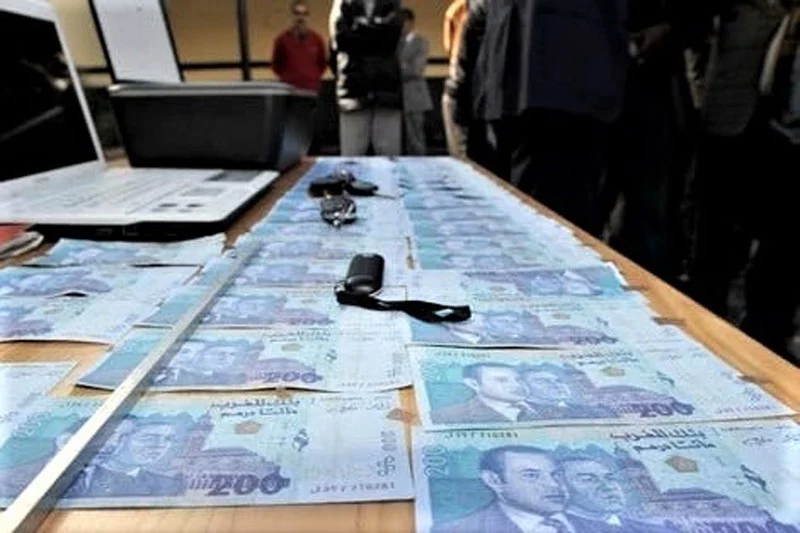
Cash in circulation in Morocco rose to a record MAD 491 billion ($53.8 billion) in 2025, an increase of 18.5% compared with the previous year, according to Bank Al-Maghrib’s annual report.
The central bank said cash represented 28.5% of Morocco’s gross domestic product (GDP) in 2025, warning that the country’s heavy reliance on cash carries significant economic costs, including expenses related to producing, managing and distributing banknotes and coins.
According to the report, demand for cash in Morocco is driven by several factors, particularly activity in sectors where cash payments remain dominant, including trade, construction and public works, as well as certain liberal professions.
The central bank also noted that periods of economic uncertainty tend to increase cash demand as households and businesses seek to hold physical money for precautionary and savings purposes.
It cited the COVID-19 pandemic as an example, noting that cash in circulation increased by 20.1% in 2020, when it reached the equivalent of 26.1% of GDP.
Beyond its economic costs, Bank Al-Maghrib warned that extensive cash usage is associated with higher risks of insecurity, illicit activities and tax evasion, calling for coordinated efforts by all stakeholders to address the issue through a comprehensive national strategy.
To better understand the phenomenon, the central bank conducted an in-depth study in 2025 examining the main drivers of cash usage and identifying measures to encourage greater adoption of digital payments.
The study combined qualitative and quantitative research, including consultations with financial sector stakeholders across Morocco’s regions and advanced economic modeling. It also reviewed existing legal and regulatory measures aimed at reducing reliance on cash.
According to the report, the size of Morocco’s informal economy remains another key factor behind the widespread use of cash.
Bank Al-Maghrib estimates that the informal sector accounted for an average of 34% of GDP between 2021 and 2023, up from an average of 30% between 2009 and 2019.
At the same time, the report points to gradual progress in financial inclusion and digital payment adoption.
The share of Moroccan adults holding a bank account increased to 58% in 2024, compared with 53% in 2020. The number of bank cards reached 22.6 million, while electronic wallets totaled 13.7 million.
The central bank also highlighted efforts to digitize public payments and administrative transactions, including Morocco’s direct social assistance program.
However, it acknowledged that several factors contributing to cash demand remain difficult to quantify, including tax evasion, illicit financial flows and illegal economic activities.
Looking ahead, Bank Al-Maghrib said it plans to expand access to financial services, particularly in rural areas, to strengthen financial inclusion and accelerate the digitalization of government payments, including social assistance, National Social Security Fund (CNSS) services and local tax collection.
The strategy also includes creating a dedicated fund to help merchants acquire low-cost electronic payment terminals, reducing digital transaction fees, maintaining the interchange fee cap at 0.65%, and lowering the cost of instant transfers.
In addition, the central bank plans to launch a unified instant payment platform based on interoperable QR code technology to facilitate domestic and cross-border transactions, while reforming the legal framework governing digital payments and expanding electronic invoicing.






add your comment
Terms of publication : Not to offend the writer, people, sacred things, or attack religions or the divine self, and refrain from racist incitement and insults.