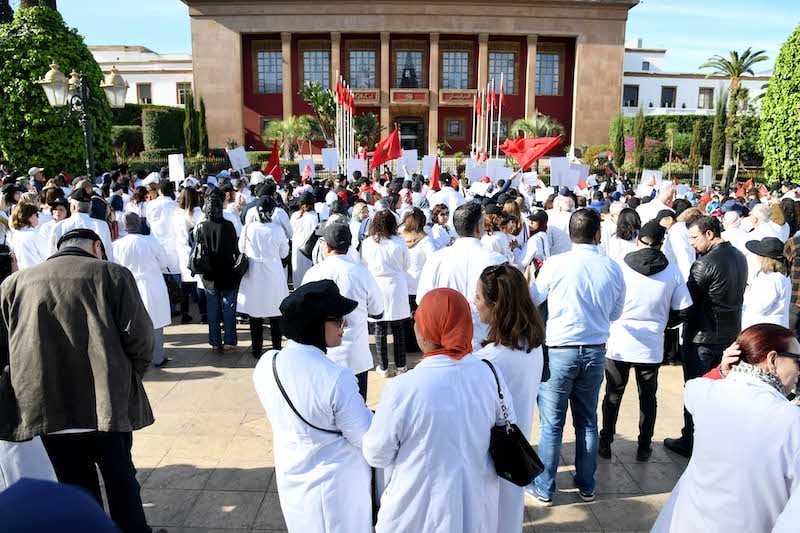
Doctors in public hospitals across Morocco are continuing their strike for a second day, demanding that the Ministry of Health and Social Protection engage in meaningful dialogue over unresolved issues, including the centralization of salaries and professional stability.
The Independent Union of Public Sector Doctors reported that as of Thursday morning, approximately 50% of doctors nationwide had participated in the strike, with certain hospitals reporting up to 90% participation.
The doctors are protesting what they describe as a lack of genuine guarantees in the draft 2025 finance law to maintain their status as public servants. They also voiced concerns over the centralization of salaries, a key issue that they believe threatens their professional security.
Mountadar El Alaoui, the national secretary of the union, said the strike was a response to the ministry’s refusal to engage in dialogue despite numerous calls from the union. “We have no choice but to continue our protests until our demands are heard,” he said in an interview with Hespress.
The strike is part of a broader protest plan, and El Alaoui mentioned that the union’s central committee will meet on Saturday to assess the situation and determine the next steps. He warned that failure to address their concerns could lead to further escalation.
“These protests are organized, but we are also open to dialogue,” El Alaoui added, noting the sensitive nature of their work in emergency and intensive care departments. “We are committed to ensuring the best care for our patients, but we need to have our concerns addressed.”
The doctors also criticized the government’s handling of previous agreements. They claim that despite coordination between health sector unions on salary centralization and public servant status, they were excluded from a July agreement they did not sign. “We no longer represent the health sector coordination; we represent ourselves,” El Alaoui said.
The strike’s participation rates are being closely monitored, with early reports indicating significant support. El Alaoui confirmed that, nationally, the strike had reached a 50% participation rate as of Thursday morning, with some hospitals reporting as high as 90%.
Beyond the finance law, the doctors are also protesting issues such as the lack of salary increases for health sector employees, failure to implement promised promotions from 2011, and the government’s failure to fulfill agreements made in late 2023.
Other grievances include a government retreat from signed agreements, including a general agreement on December 29, 2023, and a protocol between the union and the ministry, which was meant to be implemented by the end of January 2024.
The striking doctors are demanding immediate attention to their concerns, warning that continued inaction could lead to further disruptions in the country’s public healthcare system.




add your comment
Terms of publication : Not to offend the writer, people, sacred things, or attack religions or the divine self, and refrain from racist incitement and insults.