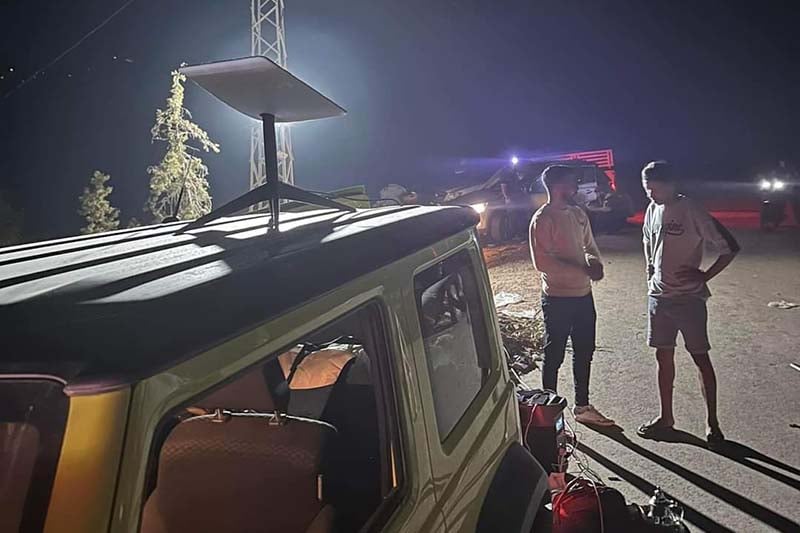
In a remarkable initiative, two young Moroccans have brought rays of hope to the residents of the quake hit region of Al-Haouz by restoring internet access to locals, as the telecommunication challenges arose amid the aftermath of the devastating earthquake that rattled the area with a magnitude of 7.
The harrowing earthquake caused widespread destruction, as many individuals were trapped under the debris of crumbling houses; some of them passed away and others were still waiting for rescue.
Not only that, but the forceful tremors of the earthquake also led to cutting off both the power supply and internet connectivity, plunging the entire region into darkness and utmost isolation.
Taking it upon themselves to the challenges of the power outage and ruined telecommunications, Ali Lakrakbi, a Specialist in electric cars and charging stations, alongside his friend Mounir E. Ammarti, a volunteer, employed innovative technologies to make a difference in the life of a community in distress.
By utilizing batteries and benefiting from Space X’s satellite technology, especially the Starlink network, E. Ammarti, and Lakrakbi were able to bring light to Ifourir, a city close to the epicenter of the earthquake, and restore internet connection.
In an interview with Hespress EN, E. Ammarti said that their inspiring journey began just one day after the earthquake shook the Al-Haouz region. He recounted “When I was in my office attentively monitoring the news, I noticed a man lamenting the disrupted internet connections and telecommunication challenges.”
The video of a man expressing his distress over the severed internet connections was what ignited the spark of the idea to provide all the batteries that E. Ammarti possessed at that time to the service of the distressed community, and people on the ground, be they journalists, volunteers, or Moroccan authorities.
While providing essential supplies such as food, clothing, and tents, was obvious, E. Ammarti and Lakrakbi thought outside the box and worked on the restoration of electricity and internet connectivity.
“I called Ali and told him about the idea of donating the remaining batteries we have in stock. He warmly welcomed the idea, and I subsequently went to his house to pick him up.” E. Ammarti recounted.
Within 48 hours of the earthquake’s devastation, E. Ammarti and Lakrakbi arrived at the place where “the situation was catastrophic”, as he described.
“We found people lying on the ground in open air. Women were preparing meals and kids playing in absolute darkness, even the aids were distributed in darkness,” in a sympathetic voice E. Ammarti described the scene.
In a post on his Facebook page, Ali Lakrakbi shared their achievement and said, “Now, people can reach out to their families; security services and rescue teams can communicate by phone; families who prepare food can benefit from the light.”
Their inspiring initiative has grabbed the attention of many internet users, including Moroccans and Foreigners. E. Ammarti and Lakrakbi received messages, and comments on various social media platforms recognizing their dual commendable effort.
As many Moroccan Internet users applauded their efforts as heroic, E. Ammarti underscored, “I personally perceive this initiative as something normal. We shouldn’t have been the only ones to do it or receive the media’s attention. It wasn’t something extraordinary.”
Their inspiring initiative saw the light of day in Ifourir, a rural commune in Al-Haouz province that falls under the Marrakech-Safi region. They installed LED panels, and established Wi-Fi hotspots in the region, to connect the distressed community to the rest of the Moroccan community and the world as well.
“The initiative was commended by a lot of people and this made us happy. We felt that it was worth the long road that we hit.” E. Ammarti commented on people’s response to the imitative.
“The reaction of the residents was very positive, and people used to queue up to get a chance to charge their phone batteries. The places where LED panels were installed became bustling hubs of activity,” he added.
4 villages have already benefited from their first intervention so far. However, their next step is utilizing solar energy in other distressed communities where the power and internet connection were disrupted.
From their own money, E. Ammarti and his friend have been able to bring hope and light to a whole community in distress. He said, “So far, my friend and I are able to provide the solar panels. We are collaborating with a provider who offers us solar panels at a favorable price.”
Ammarti recounted that the only challenge that they encountered during their inspiring journey was transportation. “The road was devastated. It was a serious difficulty to move from one village to another. It took us a lot of time.”
On his Facebook page, Lakrakbi announced that alongside his friends, he was able to install 180 LED panels so far in the rural areas affected by the earthquake. Each one of them provides light to 3 up to 4 tents.

add your comment
Terms of publication : Not to offend the writer, people, sacred things, or attack religions or the divine self, and refrain from racist incitement and insults.