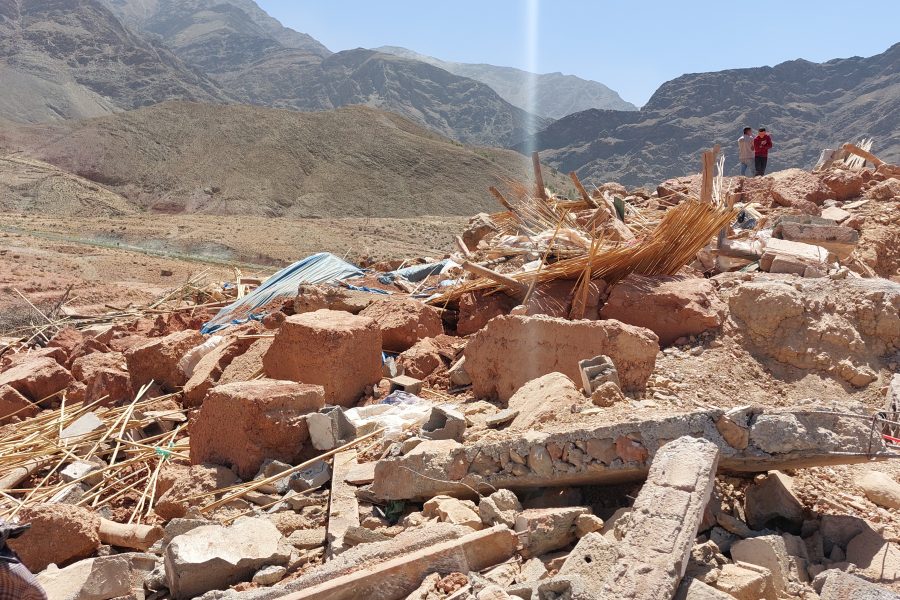
The recent earthquake in Al Houz, Morocco, which buried thousands of Moroccan citizens and destroyed many homes and buildings, revealed the weak infrastructure of the regional buildings and construction policies in some Moroccan regions.
“These areas live in a way that is isolated from the urban and conformist privileges and services that we’re so accustomed to enjoying,” said Jamal Chichaoui, urbanism expert to Hespress EN.
The urbanism expert emphasized the disparity between Marrakech’s infrastructure strategies and territorial preparation plans and those of the rural communities in Al-Haouz, which incurred harsher effects.
“The region of Al-Houz is known for the fragility of its urban structures and the ruggedness of the paths that lead to some of its roundabouts, in addition to the harsh weather of the region and other constraints,” said Abdelkabir Mesbahi, the head of the Al Haouz Regional Youth Council, reported Hespress.
Mohammed Mjahdi, an architect, noted to Hespress EN the specialness of the recent earthquake, which he found “remarkable for several reasons: it occurred in an area that is not traditionally considered a major earthquake risk zone based on the zoning established by the RPS 2000 Version 2011, which is the seismic regulation framework in Morocco.”
“An earthquake is a natural occurrence that puts residential communities and gatherings to test. These southern rural areas have beautiful homes, but the humble lifestyle of the residents is endangered by them.”
Chichaoui addressed the lack of common knowledge of national territorial regulations and characteristics as well as the infrastructure issues in rural areas.
“What makes these buildings particularly vulnerable is that they were constructed without adherence to modern seismic regulations. The seismic design codes and standards found in regulations like the RPS 2000 were not applied during their construction, as these codes primarily target more conventional construction materials and techniques,” explained Mjahdi.
Integrating local materials and construction methods into these solutions could help maintain the authenticity of these buildings while enhancing their earthquake resistance, added Mjahdi.
Morocco was unable to carry out its national territorial preparation strategies. “This earthquake is an opportunity to address the critical problem of inequality and centralization of territorial plans and strategies .”
Now that the country is more than ever reminded of the need for such preparations, Morocco’s infrastructure strategies ought to include the implementation of disaster resilient infrastructure.
Infrastructure resilience is a growingly significant multidisciplinary topic that includes technical, social, and economic components to prepare for, respond to, and recover from disasters.
“Infrastructure is a political issue, and Morocco ought to review the national territory preparation plans,” to properly account for its vulnerable areas, said Chichaoui.
“This unexpected seismic event highlights the need for a comprehensive reevaluation of seismic risks in various regions of the country, as earthquakes can sometimes defy conventional expectations,” said Mjahdi.
The urbanism expert stressed the “specificness of mountains and regions and their detailed characteristics,” which calls for infrastructure designs appropriate for these features. “There is a need for specialist studies in these fields,” the expert continued.
Infrastructure systems, such as transportation, energy, water, wastewater, telecommunications, healthcare facilities, financial systems, educational institutions, and emergency services, are essential for the continuous performance of modern society and the economy in ordinary times and during emergencies,” said the recent scientific paper “Comprehensive Approach to Earthquake-Resilient Infrastructure,” issued on September 6, 2023.
The construction techniques must be appropriate for the geographic features of these spots.
The expert added that in the event of difficulties or calamities, “these areas should be equipped for the possibility of communication with the rest of the national territory.”
In this regard, the scientific publication recommended Seismic fragility curves as a tool to research the local characteristics for a better understanding and consequently assessment of the disaster.
“The use of seismic fragility curves is a typical technique for estimating the anticipated damage to different types of infrastructure due to seismic events. The fragility curve shows, as a function of the intensity-measure (IM) parameter of an earthquake, the likelihood that an infrastructure will reach or exceed a specific damage condition.”
“Resilience is not just about recovery but also about adaptive evolution in the face of disruptions, making it a key consideration for both policy and engineering decisions,” suggested the paper.
Infrastructure maintenance is essential to ensure its longevity, utility, and effectiveness. “It is crucial to find solutions that strike a balance between structural integrity and the preservation of heritage and traditional construction styles,” said Mjahdi.
Infrastructure Practices in earthquake-Prone Countries such as Japan, the United States, and New Zealand, which are susceptible to earthquakes, have well-established infrastructure practices. They have also developed advanced techniques for reinforcing older buildings to enhance their earthquake resistance.
“ Morocco can draw inspiration from these nations in several ways,” said architect Mjahdi, suggesting some measures drawn from earthquake-Prone Countries:
Base Isolation: Japan is a pioneer in base isolation technology, which involves placing flexible bearings or isolators between a building’s foundation and superstructure. This allows buildings to move independently of ground motion during an earthquake, reducing structural damage.
Seismic Dampers: Seismic dampers, such as tuned mass dampers or viscous dampers, absorb and dissipate seismic energy in buildings, reducing swaying and structural stresses.
Bracing and Shear Walls: Older structures are retrofitted with additional bracing and shear walls to enhance lateral stability and resist horizontal forces.
Reinforced Concrete: Extensive retrofitting may involve reconstructing parts of older buildings with modern reinforced concrete techniques to improve overall strength and ductility.
Non-Structural Retrofitting: Ceilings, partitions, and utility systems within buildings are retrofitted to prevent hazards during earthquakes.
Regular Inspections and Maintenance: These countries conduct frequent inspections and enforce maintenance requirements for older buildings to identify and address structural weaknesses.
Education and Public Awareness: Extensive public education campaigns inform building owners and residents about earthquake risks, retrofitting benefits, and preparedness measures.
Rural Construction Protection through:
Building Codes: Many seismic-prone countries have building codes that apply to rural areas, specifying construction techniques and materials that enhance earthquake resilience.
Community Outreach: Governments and organizations engage with rural communities to raise awareness of seismic risks and the importance of safe construction practices.
Traditional Construction Techniques: In some cases, traditional construction methods that have proven earthquake-resistant are encouraged or adapted for rural buildings.
Incentives: Financial incentives or subsidies may be offered to rural residents to retrofit or rebuild their homes using earthquake-resistant designs and materials.
Local Expertise: Training local builders and craftsmen in earthquake-resistant construction techniques ensures that rural buildings are constructed to withstand seismic forces.








It is, in deed, a very challenging issue to address, however, I am confident for we have many many amazing Architects that can be so impressive and talented.