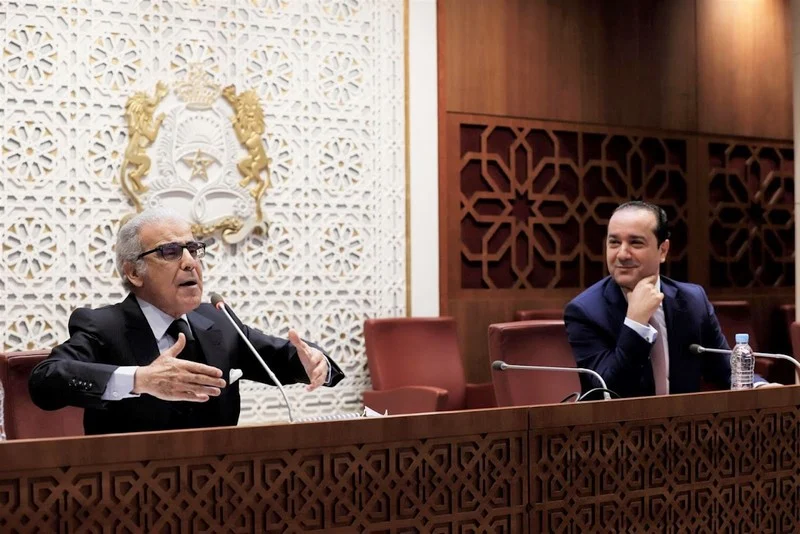
Director of Morocco’s national central bank, Abdellatif Jouahri exposed the failings of public investments in improving the vital social services offered to the public, alleviating unemployment, and countering informal activity, during a closed-door meeting.
The Wali of Bank-Al-Maghrib revealed, in a presentation to the parliament’s Finance Commission, that despite having “high investment rates in comparison with other governments,” the country’s public sectors are plagued with “unproductivity,” as the return on investment remains critically low.
The Kingdom’s investment value reached an average of 32.2% of GDP between 2000 and 2019, as the international average for public investment is a little over 25%, and 29% for lower and middle-income countries.
In the 20 years between 1970 to 1990, the investment rate of Asian countries averaged 30%, prompting Jouahri to state that “Morocco’s rate is similar to that of countries who achieved economic miracles,” such as China, India, and South Korea.
In southern European countries, public investment reached a 25% value of respective domestic GDPs, during periods those countries recorded strong growth.
Both examples Jouahri gave prompt the wali to deduce that “despite the investment effort Morocco provides in quantitative terms, it has not yet been able to achieve its desired economic catch-up.”
Jouahri’s report places Morocco 3rd globally in terms of public investment, and yet, the Kingdom’s investment efforts are not only unproductive, but the majority of the world’s countries invest far less than Morocco, for much more profitable results.
The discrepancy, caused by the low return on investment, leaves many socio-economic issues such as employment unresolved, despite strong monetary flows. Jouahri’s report highlights a paradoxically high incremental capital-output ratio (ICOR), used to measure the effects of public investment on GDP growth.
Normally, the lower the ICOR, the more profitable the investment. But Morocco’s ICOR averages at 9.4 from 2000 to 2019, whereas the average for lower-middle-income countries is around 5.7.
In an objective and shock-inducing manner, Jouahri told MPs present at the presentation that “the domestic economic growth recorded in Morocco will not improve the living conditions of everyday Moroccans.”
Morocco still has a significantly low rate of job creation, incompatible with its ICOR and public investment spending. According to the Wali, the theoretical national unemployment rate should be 25.4%.
Each point of growth between 2000 and 2019 generated less than 21,000 jobs, compared to the expected 30,000 or more, habitually forecast from Morocco’s investment rates and ICOR level.
The national economy, therefore, generated nearly 144,000 jobs annually between 1999 and 2009 and nearly 72,000 jobs between 2010 and 2019, or the equivalent of 108,000 jobs on average over the entire period 1999 and 2019.
“This pace remains insufficient to induce a tangible decrease in unemployment,” stressed Jouahri in his presentation.
The wali continued that “the national employment rate would have been much higher if the activity rate (ratio of the number of active people, employed or unemployed, to the working-age population) was not so low.”
The rate has declined significantly over the past 20 years, from 55% in 1999 to 45.8% in 2019. It also remains low compared to the international average (60.8%), a characteristic that Morocco shares with MENA countries.
If this rate were at the same level as the average for lower-middle-income countries (55.8%), the number of people in the labor force would have increased by 220,000 annually instead of 89,000 and the unemployment rate would have worsened by 16.2 percentage points to 25.4%, revealed Jouahri.
The wali additionally highlighted the main obstacles to business development in the country, citing tax pressure, corruption, and the prevalence of informal activities and workers.
Regarding the burden of wages on the state, Jouahri cited World Bank data, revealing that the level of taxes on income, profits, and capital gains is 32.9% in Morocco, a rate higher than the majority of countries in its category and far higher than some countries such as Jordan (13.2%), Turkey (18.5%), the Czech Republic (16.5%), and Poland (13.3%).
According to 2021 data from international tax and auditing firm KPMG, a tax rate of 31% tax rate is applied to profits over MAD 1 million, making Morocco exceed both the African (27.5%) and the world (23.7%) averages.
When it comes to corruption, Wali cited the Transparency International Corruption Perception Index, which ranks countries according to the degree of corruption perceived in the public sector by experts and economic actors.
According to the index, Morocco has recorded a decline for the 3rd consecutive year to 87th place out of 180 countries in 2021, losing 14 ranks compared to 2018, where the kingdom came 73rd.
In regards to the prevalence of the informal sector, Jouahri mentioned results of a High Commissioner for Planning (HCP) survey conducted in 2013, which estimated the weight of the non-agricultural informal sector at 11.5% of GDP and 36.2% of non-agricultural employment.
The results of two studies conducted by BAM in 2018 and 2020 showed that the unobserved economy (includes underground production, illegal production, informal production, and production by households for their own account) represented around 30% of GDP in Morocco.




add your comment
Terms of publication : Not to offend the writer, people, sacred things, or attack religions or the divine self, and refrain from racist incitement and insults.