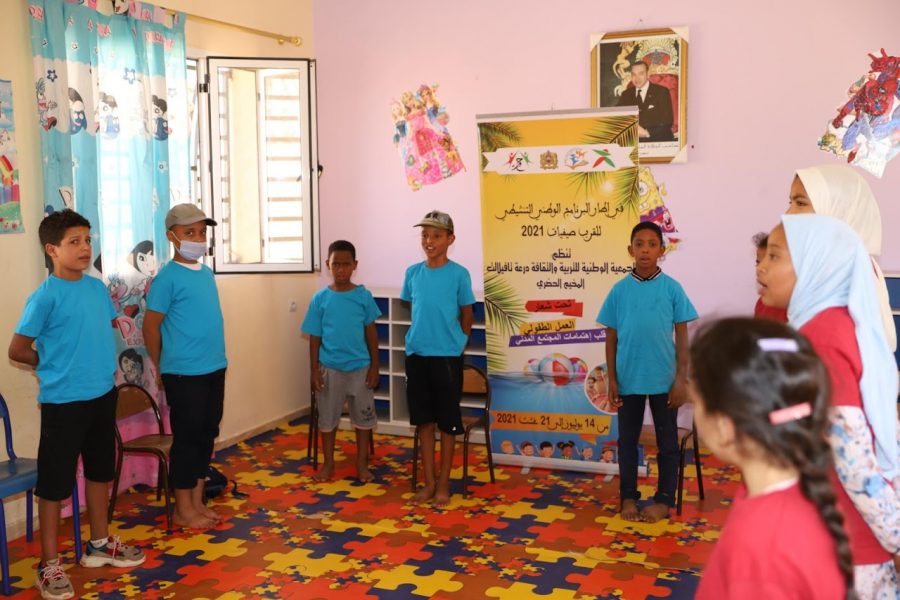
As Moroccan students gear up for a new school year against a backdrop of rising COVID-19 cases, experts say online schooling might be the only option to keep children safe from exposure to the virus, as the Delta variant is sending more children to hospitals.
The spike in new cases comes with the emergence of the delta variant, one month ahead of schools and universities preparing to open for fall classes.
“It is difficult to predict how the next school entry will be,” Hassan El Madi a professor of higher education in Mohammed V University in Rabat told Hespress English.
Morocco recorded last week its highest daily Covid-19 numbers, as the country battles its worst outbreak yet.
The case numbers aren’t the only troubling metric lately: Child cases are also on the rise.
“We began to record children’s infections with the virus and the numbers began to increase, there are cases of children currently in hospitals, and the number is gradually rising,” Doctor Tayeb Hamdi, Vice President of the National Federation of Health told Hespress Eng.
Hamdi explained that when the initial outbreak of the Wuhan Covid-19 strain hit Morocco transmission from adult to child was at 3%, from child to adult at 1.5% and from child to child 1 %. “This is why we allowed schools to open last year.”
Health professionals are faced with a new question this school year: Is the fast spreading, vicious Delta variant responsible for rising infections cases amongst children?
There is not yet enough evidence to conclude that Delta is to blame, but many educational workers would rather not take the risk. “We cannot neglect the health of students despite the fact it will affect their academic performance,” said Professor El Madi.
Virtual learning has become fundamental for Moroccan students throughout the pandemic. But online learning, particularly for students in rural areas, is difficult if not impossible.
Yet sacrifices had to be made putting school friendships and mental health at the back seat, as part of public efforts to help protect the health and lives of families, friends and teachers.
This year will likely see a combination of physical classes and distance learning, said Professor El Madi. He thinks however that ‘it is more appropriate and reasonable to apply only distance education. We cannot push students to the risks of infection,” he said.
“The Ministry of Education is making a great effort to make the school year happen in appropriate conditions. Although it will provide the basic conditions, the danger always remains.”
To curb the danger, doctor Tayeb Hamdi says no time should be wasted in getting already high vaccination rates even higher. We must get to a point where 80 to 85 percent of Moroccans are vaccinated, he said.
“We must go ahead with vaccinating adults, to protect adults first, reduce the spread of the virus, and protect children.”
“Morocco has a large population of children aged 12 to 17 years old, which means that even if we vaccinate adults 100 percent, we will not reach 85 percent of herd immunity, meaning it is necessary to vaccinate children from 12 to 17 years old,” said doctor Tayen Hamdi.
Yet, 85 percent of herd immunity is ambitious, if not impossible, according to the doctor. “Even if we vaccinate adults 100 percent, we will not reach 85 percent of herd immunity, meaning it is necessary to vaccinate children from 12 to 17.”
The country recently expanded its national anti-covid-19 vaccination campaign to 20-year-olds and over, betting on steady vaccination rollout to extend the vaccine jabs to minors ahead of the school year.




add your comment
Terms of publication : Not to offend the writer, people, sacred things, or attack religions or the divine self, and refrain from racist incitement and insults.