Who is the true beneficiary of prolonging this artificial regional dispute and postponing a definitive, comprehensive political settlement? Who gains from keeping North Africa and the Sahel hostage to a state of “no war, no peace” amid cross-border threats?
Is it the adversarial regional actors who have turned hostility toward the territorial integrity of the Kingdom of Morocco into an existential dogma to cover up their developmental failures and recurring internal crises? Or is it the major world powers using UN platforms as arenas to settle geopolitical scores?
Is it conceivable that international peacekeeping mechanisms remain beholden to patterns of blackmail and corruption that deplete the region’s collective security?
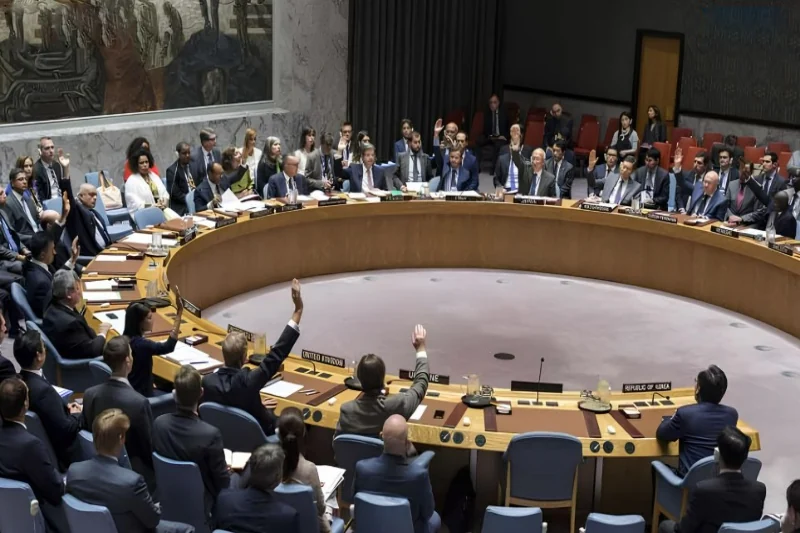
These questions arise with acute urgency following the sharp diplomatic clash in the UN Security Council over the renewal of the MINURSO mandate, where a duel of vetoes led to an institutional paralysis exposing the fragility of the international system, while Morocco advances with steady strides toward cementing its full sovereignty through the dual pillars of legitimacy and on-the-ground development.
The recent veto showdown within the Security Council revealed a qualitative shift in how the Moroccan Sahara issue is handled.
It is no longer a mere technical disagreement over extending the mandate of a UN mission—one initially conceived within a geopolitical context that effectively ended last week—but rather an explosion of a complex web of competing international interests.
Washington, as an influential actor and the penholder of relevant UN resolutions, drafted a resolution strictly anchored in the political realism enshrined by successive Council resolutions since 2007.
This text considers the Moroccan Autonomy Initiative as the sole serious basis for any final settlement and calls for a decisive timetable requiring the actual parties to sit down without evasiveness at round-table negotiations.
In contrast, Russia exercised a direct veto against this direction to counter the Western bloc’s stance and preserve the status quo, prompting a firm US response with a counter-veto that thwarted any attempt to undermine accumulated diplomatic gains.
This deadlock, while its repercussions may seem jarring to some, exposes the multilateral system’s inability to keep pace with profound shifts on the ground and confirms that betting on paralyzing international mechanisms now serves only to fuel chaos and extremism.
Amid this intense international friction, Moroccan diplomacy responded with strategic poise, reflecting the Kingdom’s deep confidence in the righteousness of its position and the enduring strength of its historical and legal legitimacy.
Morocco showed no apprehension regarding the stalled renewal process—as articulated in the Royal Court’s communiqué—proceeding from the unshakable conviction that its sovereignty over its national soil is not a UN grant conditioned on the presence of military observers or the renewal of an organ lacking executive authority.
The moral and political power of Morocco’s stance lies in embodying “legitimacy through achievement” on the ground: the Sahara is witnessing an unprecedented boom today thanks to the New Development Model for the Southern Provinces.
Southern Moroccan cities such as Laayoune, Dakhla, and Smara have ceased to be geographic points of friction, transforming into major economic engines and vital logistics hubs driven by flagship mega-projects such as the Dakhla Atlantic Port, expressway networks, clean energy plants, and green hydrogen ventures.
This transformation is no longer a purely local investment; it forms the backbone of the strategic Royal Initiative aimed at enabling Sahel nations to access the Atlantic Ocean, turning Morocco’s southern provinces into a vital lifeline linking the African continent to global markets and offering a tangible alternative to despair and poverty.
This developmental horizon is reinforced by the African-Atlantic Gas Pipeline mega-project (Nigeria–Morocco), which runs along the West African coast to reach the heart of the Moroccan Sahara and continue onward to Europe.
This route cements the southern provinces as an indispensable strategic hub for continental energy and trade, shifting the region from a mere subject of an artificial border dispute into a strategic lever for broader regional economic integration and stability.
At the level of major powers, an analysis of statements and media discourse reveals clear divergences.
Within the Western bloc, it is emphasized that the US exercise of its influence reflects an irreversible strategic commitment to recognizing Moroccan sovereignty and supporting its autonomy initiative, considering that any attempt to circumvent this path grants rogue actors free rein to destabilize the region.
Across Europe, analyses indicate that Paris, through its explicit stance backing the Moroccanness of the Sahara, now views the Kingdom as a reliable strategic partner safeguarding European interests.
This aligns fully with Spain’s position, which stresses that the stability of the southern provinces under full Moroccan sovereignty is the sole guarantee for the security of the Canary Islands and the southern gateway to the Mediterranean.
Conversely, data concerning the Russian Federation reveal that Moscow is not opposing the Moroccan initiative in its core substance; rather, it uses the file as leverage in its broader negotiations against the Western camp, while seeking to balance its arms and trade interests in the Maghreb, thereby holding the issue hostage to wider geopolitical maneuvers.
This international momentum favoring the Kingdom is not grounded in fleeting political convergences, but reflects a legal and diplomatic reality consecrated by consecutive Security Council resolutions—notably Resolutions 2602, 2654, and 2703.
These resolutions affirmed the primacy and credibility of the autonomy initiative as the sole basis for a solution, while upholding the exclusive format of round-table discussions with Algeria’s participation as a principal and responsible party to the dispute.
This UN track is reinforced by decisive sovereign milestones, inaugurated by the 2020 US Presidential Proclamation recognizing Moroccan sovereignty over the Sahara, Madrid’s historic shift in 2022, and France’s forward-leaning official position articulated in President Emmanuel Macron’s formal letter affirming that the present and future of the Sahara fall squarely within the framework of Moroccan sovereignty.
The security ramifications of this institutional paralysis weigh heavily on regional and international security, particularly regarding counter-terrorism and managing irregular migration flows.
The Saharan belt—stretching from the edges of the African Sahel, battered by military coups and armed jihadist groups, to the Atlantic coast—represents the soft underbelly of European security.
Any instability or attempt to create political or security vacuums will be seized upon immediately by smuggling syndicates, human traffickers, and remnants of terrorist outfits such as ISIS and Al-Qaeda, in addition to their documented links with separatist militias.
Decision-makers in Brussels and Madrid recognize that Morocco stands as an unyielding first line of defense.
Morocco’s firm, legitimate presence—backed by a robust security apparatus, meticulous border surveillance, and a humanitarian, development-oriented migration policy—is what prevents hundreds of thousands of migrants from surging toward Iberian shores.
Any hesitation in bringing this dispute to an end by fully backing Moroccan sovereignty jeopardizes this security balance and inflates the security bill that both the European Union and West African states will ultimately have to pay.
Conversely, the vulnerability of adversarial parties and their exhausting drain on the region are evident in the deliberate perpetuation of the tragedy facing the population in the Tindouf camps, alongside the systematic refusal to permit their official census and registration by the UN High Commissioner for Refugees (UNHCR).
This refusal seeks to obscure actual population figures and maintain a status quo that facilitates the diversion of international humanitarian aid—as substantiated by UN and European reports—exposing how this dispute has been converted into a rent-seeking enterprise to mask the political and economic bankruptcies of its sponsors.
The episode of cross-vetoes demonstrated that the Security Council mechanism in its current form has become incapable of imposing just settlements, and that persisting in treating the Moroccan Sahara question as an issue to be managed and frozen rather than definitively resolved threatens the credibility of multilateralism.
Facts have likewise confirmed that the balance of power is no longer forged solely in UN backrooms, but is dictated by the tangible presence of national sovereignty and the implementation of strategic projects on the ground, where Morocco has settled the issue by establishing an irreversible Atlantic and economic reality.
Through decades of resilience, the Kingdom of Morocco has proven its ability to steadfastly confront the fragility of the international order, transactional influence-buying, and campaigns of disinformation and corruption waged by adversarial parties that squandered their peoples’ resources in opposition.
Morocco chose the path of development, national independence, and diplomatic composure, establishing itself today as a pivotal power capable of safeguarding its full sovereignty and sustaining its central role as an authentic anchor of regional and global security and stability.
In doing so, it affirms that genuine international legitimacy is moving away from the paralyzing formalities of Security Council compromises toward alliances grounded in tangible realities, stability, and on-the-ground progress.



add your comment
Terms of publication : Not to offend the writer, people, sacred things, or attack religions or the divine self, and refrain from racist incitement and insults.