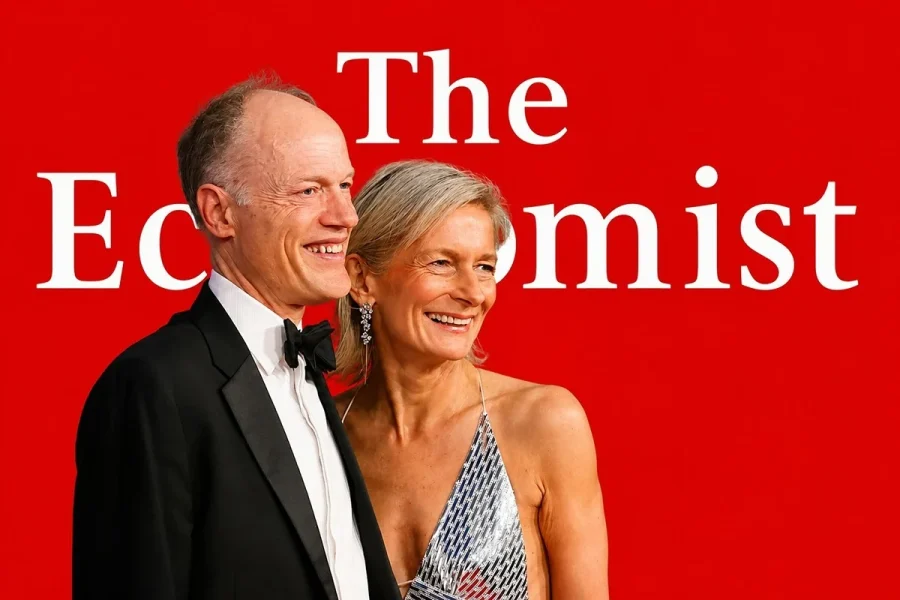
Something like The Economist’s Aug. 8 article on Morocco moves from a security crisis in Ceuta to a broader assessment of King Mohammed VI, his health, private life, succession and the future of the monarchy. What it does not always establish however is the evidence connecting those subjects.
A media institution’s pedigree does not grant immunity from criticism. Information does not become fact simply because it appears in a newspaper or magazine with a long history and considerable influence.
If anything, the opposite should be true: the greater a media outlet’s reach and its ability to shape public opinion and influence political and economic elites, the greater its responsibility to verify and scrutinize its reporting, and to distinguish between facts and interpretation, between what the evidence establishes and what the writer infers from it.
That is why the stature of Britain’s The Economist, overseen by editor-in-chief Susan “Zanny” Minton Beddoes, does not exempt it from the professional questions that can (and should) be asked of any other news organization. This is particularly true when the subject is not a passing government decision, but an article that moves from a specific security incident to a broader portrayal of a country, its king and the future of its political system.
The article The Economist published on Aug. 8 about Morocco and King Mohammed VI raises precisely these questions. Not because Morocco or its institutions should be beyond criticism. The government and public institutions are legitimate subjects of journalism, analysis and scrutiny, and foreign media have no obligation to portray the kingdom positively.
The issue instead lies in the architecture of the article itself, which raises a more fundamental question: Where is the line between an investigation that begins with facts and follows them toward a conclusion, and a narrative that begins with a conclusion and selectively draws on facts to make that conclusion plausible?
That distinction ultimately determines whether the reader is being offered an effort to understand what happened, or being persuaded to accept an interpretation that was chosen in advance.
A journalistic investigation does not, in principle, begin with a closed answer. It begins with a hypothesis that can either be confirmed or disproved. A journalist genuinely searching for the truth does not rely exclusively on sources that validate an initial hunch. They test their narrative against facts that could contradict it and accept that the evidence may lead somewhere entirely different from where they expected to arrive.
When the conclusion is predetermined, however, the role of facts changes. They cease to be material for discovering the story and become a pool from which the most convenient pieces can be selected.
That is precisely the central question raised by The Economist article: Did the magazine’s investigation lead it from the events in Ceuta to King Mohammed VI, or did its portrait of the king come first, with Ceuta, his health, private life, the crown prince, the Sahara and Morocco’s international relations subsequently mined for details that would complete the picture?
Ceuta: Questions without answers
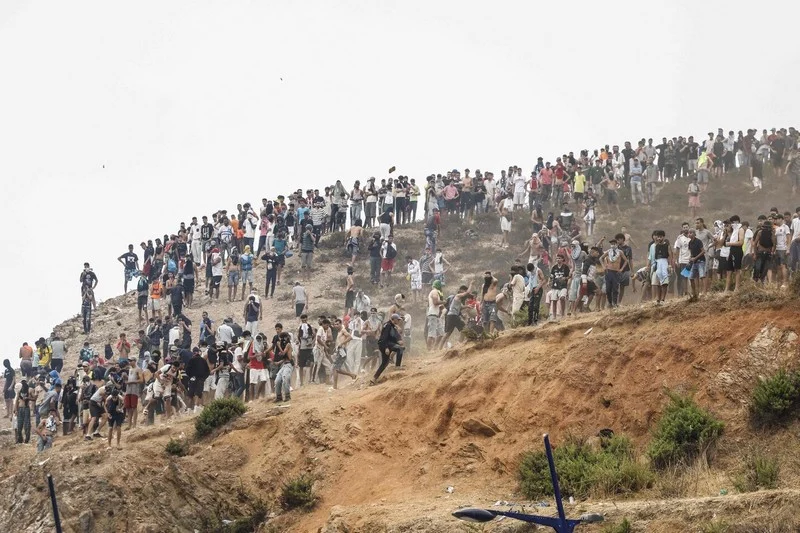
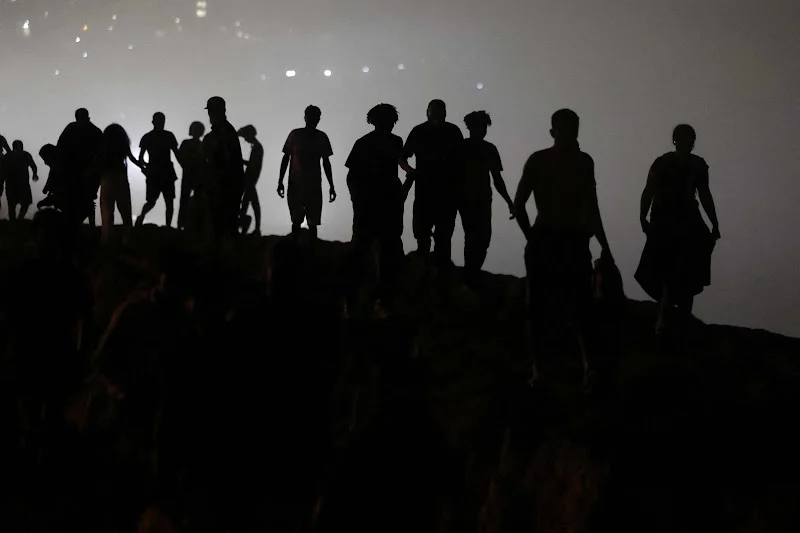
The events in Ceuta could, in themselves, have been the subject of a major investigative report. When large numbers of people move toward an extremely sensitive geographical area within a relatively short period, an investigation should begin by reconstructing the hours and days leading up to the event.
Who issued the first calls? How did they spread? Which accounts and platforms helped amplify them? Why did so many young people and teenagers believe that crossing into Ceuta had suddenly become possible? Was this simply a spontaneous reaction to a rapidly spreading digital rumor, or did networks or other actors contribute to expanding its reach?
What did the Moroccan and Spanish authorities know? What signals had their agencies picked up? Were there early warnings? How did the authorities respond? And what level of coordination existed between the two sides of the border before an online movement became a physical rush on the ground?
These are not peripheral questions. They are the core of the story.
Any investigation into a border crisis should begin by identifying the chain of events and decisions that produced it. Yet The Economist does not linger on that chain. Instead, its lens moves from Ceuta to the Throne Day celebrations and protocol, then from senior officials to the palace, and from the palace to King Mohammed VI. From there, the scope expands further—to his health, private life, relationships, Crown Prince Moulay Hassan, the Sahara, relations with the United States and Donald Trump.
At that point, a legitimate question arises about the article’s real subject.
Was Ceuta the story the magazine set out to explain? Or was it a convenient entry point into a much broader political and personal portrait in which King Mohammed VI was the actual subject?
The problem becomes particularly apparent in the article’s suggestion that officials were so preoccupied during the Throne Day ceremonies with “bowing and kissing hands” that they were not answering their phones. It is a highly effective image from a narrative standpoint: a crisis unfolding at the border, phones ringing, and officials occupied with palace rituals.
But the power of an image is not sufficient to establish a causal relationship between its elements.
It is therefore necessary to know who was trying to reach these officials, at what time, who exactly they were, and whether there are call records or multiple, independent firsthand accounts. It is also necessary to establish that, assuming the officials did not answer, their failure to do so was actually caused by their participation in the ceremonies rather than by some other reason.
The problem is not merely the detail itself. It is the leap from correlation to causation.
An official may have been attending a formal ceremony at the precise moment a crisis was unfolding. But the simultaneous occurrence of the two does not prove that the former caused the poor handling of the latter.
If The Economist has evidence establishing that relationship, explaining the nature of that evidence, without necessarily revealing confidential sources, would make its argument stronger. When the striking image remains but the reader is given no sense of how it was verified, however, it begins to serve a purpose beyond conveying information: It directs the reader’s impression.
And that is precisely where the boundary between investigative journalism and narrative construction becomes blurred.
The Spanish side is equally indispensable to any serious examination of such a crisis. Ceuta is under Spanish administration, and any mass movement toward its border necessarily raises questions about what Spanish authorities knew, whether they detected the calls circulating online, when they understood the potential scale of the movement, how prepared their forces were, how they coordinated with Morocco, whether warnings were exchanged and what mistakes may have occurred on the other side of the border.
Asking these questions does not mean shifting responsibility from Morocco to Spain. It means refusing to assign responsibility before reconstructing the facts.
The failure may have been Moroccan, Spanish or shared. The crisis may even have exceeded both sides’ ability to anticipate it. But it should be the investigation, not the narrative, that leads to one of those conclusions.
The King’s health and the future of the Throne
The article then expands in a way that gradually pushes Ceuta itself into the background. The king’s health and private life, his clothing, vacations and relationships come into view, followed by the crown prince, Moroccan Sahara and foreign policy.
There is, in principle, nothing wrong with a journalist connecting multiple subjects if a clear relationship exists between them and if they serve a hypothesis that can be tested. But simply placing different subjects within the same article does not establish a causal relationship between them.
That makes the function of each element worth examining.
What do the king’s clothes or vacations add to an explanation of a border crisis? What established connection exists between his health and the movement of people toward Ceuta? How does the Sahara issue fit into the same chain of events? Are these genuinely elements the reader needs to understand the story, or were they selected because, taken together, they help construct a particular image of the article’s central figure?
The issue becomes more sensitive when the article turns to King Mohammed VI’s health.
The health of a head of state can become a matter of legitimate public interest when it may affect the exercise of official duties or the functioning of state institutions. But that sensitivity raises the evidentiary threshold; it does not lower it.
When claims of deteriorating health are then linked to an increased public role for Crown Prince Moulay Hassan or to presumed shifts within the governing system, the article is no longer dealing simply with medical information. It is making a major political and constitutional inference.
The reader is therefore entitled to know the basis for that conclusion.
Are there informed medical sources? Did officials with direct knowledge speak to the magazine? Were the claims independently confirmed by multiple sources? Are there tangible institutional developments showing that the king’s health has actually altered the exercise of political authority?
Anonymous sources are not inherently problematic. Political and investigative journalism around the world depends on them. But protecting a source’s identity is not the same thing as turning the source into a black box.
A journalist can protect a source’s name while still giving readers enough information to assess the source’s level of knowledge, for example, by explaining whether the person is a current or former official, someone with direct knowledge of the matter, or whether the account was independently corroborated.
The journalist must also distinguish between what the source says and what the publication itself concludes.
There is a profound difference between reporting that people within certain circles believe the crown prince’s presence is increasing and presenting that increased presence as established evidence of a gradual transfer of power.
Likewise, Crown Prince Moulay Hassan’s growing presence at official events is not, by itself, a medical diagnosis or conclusive political evidence.
It is entirely normal in hereditary monarchies for the crown prince’s representative role to expand as he grows older, for him to participate in national and diplomatic events, and for him to gradually acquire experience associated with his future position.
Moving from the observation of increased public appearances to the conclusion that they are primarily the result of the king’s health requires additional evidence: a tangible change in the nature of the crown prince’s responsibilities, participation in decision-making, or credible testimony from within governing circles.
Without such evidence, interpretation gives the event its meaning rather than the event compelling the interpretation.
Private details about clothing, vacations, hobbies and social relationships are not categorically off-limits to journalism. They may become relevant when directly connected to public money, conflicts of interest or the exercise of power.
But accumulating such details within a single narrative can sometimes serve a purpose beyond informing the reader: It can manufacture a character.
The writer does not need to explicitly tell readers how they should perceive the king. A carefully selected sequence of details, all pointing in a similar direction, can lead readers to reach the desired impression themselves.
That is an effective literary technique. In journalism, however, it demands a question that cannot be avoided:
Why were these particular details selected? And how might the portrait have changed if other equally relevant details had been included?
A quarter-century of rule
If The Economist intended to move beyond Ceuta and offer a broader assessment of King Mohammed VI’s reign, then the standard changes again.
Mohammed VI ascended to the throne in 1999. That means more than a quarter-century of rule, an era that cannot, journalistically, be reduced to a collection of personal or protocol-related details.
This does not mean demanding that every criticism be balanced with an achievement, nor does it mean turning the article into promotional material. It means recognizing that assessing a long political era requires its structural transformations, failures and contradictions to appear within the same frame.
Tanger Med, the expansion of Morocco’s highway network, high-speed rail, the growth of the automotive and aerospace industries, investments in renewable energy, Morocco’s expanding economic presence in Africa and the country’s broader infrastructure transformation are not merely elements of official government messaging that can be discarded without consequence when the subject is an assessment of the kingdom over a quarter-century.
At the same time, no serious assessment can ignore unemployment, social and regional inequalities, shortcomings in education and health care, purchasing power, water scarcity, governance, civil liberties or institutional effectiveness.
The real Morocco exists in the space between these two realities: a country that has undergone significant economic, logistical and industrial transformation while continuing to face profound social challenges.
That contradiction is far more capable of explaining the country than any one-dimensional portrait, whether one of unqualified praise or total failure.
Journalistic bias does not always require publishing false information. Individual facts can all be accurate and still produce an incomplete or distorted picture when assembled selectively.
Journalism creates meaning not only through what it publishes, but also through what it leaves out.
A photographer can take dozens of perfectly genuine photographs of cracks in the walls of a building without manipulating a single image. But displaying only those photographs as though they represent the entire building would still be misleading.
The truth of the parts does not guarantee the completeness of the whole.
Likewise, the existence of a flaw does not mean that highlighting that flaw alone provides an honest representation of the broader reality.
The professional question, therefore, should not stop at whether the details in an article are accurate. It should also ask why those particular details were chosen and whether other accurate facts were excluded because they would have complicated the intended portrait.
The irony is that Morocco is hardly short of issues from which a journalist could construct a powerful critique without resorting to insinuation or speculation.
Unemployment, education, health care, social inequality, drought, water scarcity, purchasing power, civil liberties, the performance of elected institutions, governance and the distribution of the gains from economic growth all provide ample material.
They can be examined through statistics, official documents, budgets, international comparisons, and testimony from citizens, officials and experts. They can produce criticism that is arguably more consequential than any personal portrait because criticism grounded in measurable evidence does not need sensational language to be powerful.
Its strength lies precisely in how difficult it is to dismiss.
That is why criticism of The Economist article should not become an unconditional defense of the king or Moroccan institutions.
A publication that selects achievements while ignoring failures falls into the same methodological trap as one that selects failures while ignoring everything that complicates its narrative.
The demand is not that The Economist like Morocco or praise King Mohammed VI. It is that it apply to its criticism the same journalistic standards that helped establish its reputation.
If it reports a security failure, it should reconstruct the chain of decisions. If it discusses the king’s health, it should explain the degree of certainty behind its information. If it links the crown prince’s increased public role to a political transition, it should provide evidence establishing that connection. And if it seeks to assess a quarter-century of rule, it should place achievements and failures within the context necessary for readers to understand the experience rather than simply pass judgment on it.
The Economist bears an additional responsibility because its name gives its reporting extraordinary reach.
Information published in a major international magazine is routinely reproduced by newspapers, reports and research institutions. With each repetition, a degree of qualification can disappear. A statement attributed to an anonymous source becomes “reports suggest,” and after enough repetition, it can become “widely known.”
In this way, a hypothesis that was never fully established can acquire the status of settled fact, not because new evidence emerged, but because the reputation of the original publication gave it authority in circulation.
The reputation of a media institution should therefore never substitute for evidence. It should be a reason to demand more of it.
What would have changed the story?
Perhaps the fairest question to put to The Economist’s editors is this:
What information, had it emerged during the reporting process, would have made you change your hypothesis?
If the answer is that there was no such information, then the exercise was not based on a hypothesis capable of being tested. It was a conviction searching for evidence to confirm it.
If there were facts that could have changed the conclusion, the next question is whether the magazine actually looked for them.
Did it test the Moroccan and Spanish accounts with the same rigor? Did it investigate the digital networks and online activity that preceded the events? Did it attempt to establish a causal link between palace protocol and the security response rather than merely noting that they occurred simultaneously? Did it test claims about the king’s health and the crown prince against competing explanations?
The issue, then, is not why The Economist criticized King Mohammed VI, nor why it examined his private life, health or Morocco’s system of government.
All of these can legitimately fall within the scope of journalism when there is a demonstrable public interest and adequate evidence.
The real question is how the magazine moved from a specific event in Ceuta to a sweeping narrative encompassing a series of seemingly disparate subjects, and whether the connections between them were actually established or were created by the way the article was structured.
Putting accurate facts next to one another does not automatically make the relationship between them accurate.
Nor does an abundance of detail compensate for an absence of causality.
Ultimately, readers do not need a newspaper that likes the country it covers, nor one that is hostile to it.
They need a media institution that respects their right to know where facts end and interpretation begins; what is known with certainty and what is merely believed; what sources actually said and what editors inferred from their accounts.
Above all, readers deserve enough context to reach their own conclusions.
That is the line separating an investigation from an indictment.
It is also the line separating journalism that examines reality in search of an answer from journalism that searches reality for the evidence needed to support an answer it has already chosen.
A media institution’s reputation, however great, can never substitute for proof.
The essence of journalism remains remarkably simple: We investigate in order to discover the truth, not to select from the truth whatever best fits the story we have already decided to tell.



add your comment
Terms of publication : Not to offend the writer, people, sacred things, or attack religions or the divine self, and refrain from racist incitement and insults.