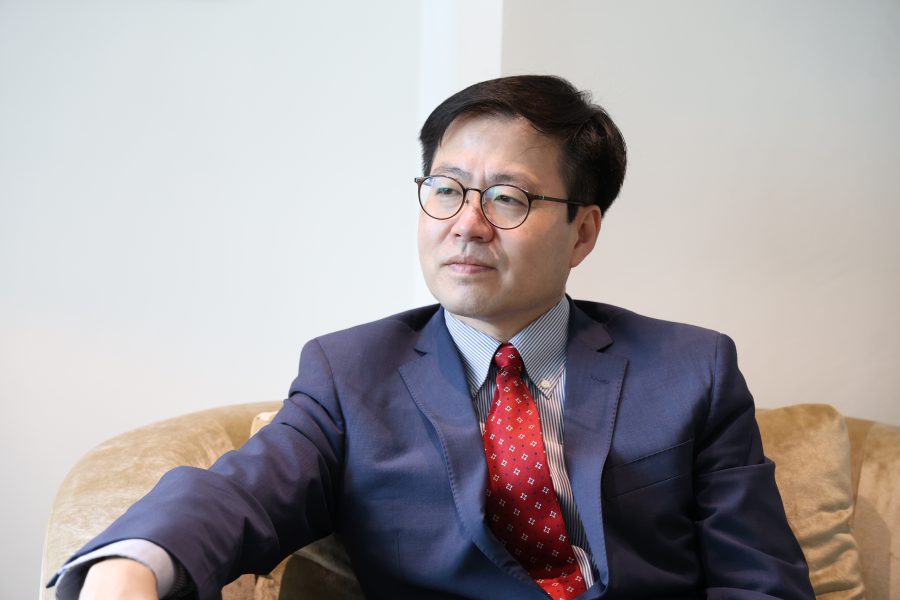
South Korea’s trade minister says his country’s companies cannot compete in Morocco as things stand, a candid admission that is driving Seoul’s push to clinch a free trade deal by mid-2027 and claw back ground lost to regional competitors.
“Korean companies cannot compete under the current environment,” South Korean Trade Minister Yeo Han-koo told Hespress English, saying tariffs on Korean components weaken the case for using Morocco as a manufacturing base for cars, batteries and other goods bound for Europe, while European rivals import the same inputs duty-free.
The deal, a Comprehensive Economic Partnership Agreement, a wide-ranging pact covering tariffs, investment and government procurement, is the only way to level that field, he said.
Chinese manufacturers have spent the past years announcing and building battery projects across the kingdom, while China now trades roughly nine times more with Rabat than Korea does. India has a larger trade relationship, and Japan a more established industrial footprint, leaving Seoul to argue that a CEPA is needed to close that distance.
“We are underperforming,” South Korea’s trade minister said, “and underutilizing this really great potential.” Now Seoul is moving to close the gap, and quickly.
The minister wants the agreement concluded by mid-2027 driven by a deadline that is hard to miss: Morocco is preparing to spend billions on infrastructure ahead of the 2030 World Cup.
Korea’s Hyundai Rotem already won a $1.5 billion contract to supply trains to Morocco’s national railway in 2025, its largest ever, proof, the minister said, of what Korean firms can win in Morocco. “There could be hundreds more.”
“Korean companies, compared to companies from similar or competing countries, are more risk-taking, and faster,” he said. “They move fast. They have a reputation of delivering the outcome on time and on budget.”
The minister said LG Energy Solution was in “serious” talks to build a lithium refinery in Morocco, calling the Kingdom “a strategic location” to serve Europe, North America and the region.
But the obstacle, he said, is cost. Korean firms assembling goods in Morocco often need to import equipment, parts and materials from home, exposing them to non-preferential tariffs that can reach 30% on some lines, while competitors from free trade partners can bring in inputs at lower or zero duty.
Public tenders are also harder for companies from countries without a trade agreement to win, the minister said, a disadvantage that adds to the tariff gap.
“Although we say more Korean companies invest in Morocco, commercially, it’s not viable,” the minister said.
Han-koo, together with Moroccan trade minister, Ryad Mezzour, and Minister Delegate in charge of Investment, Karim Zidane agreed Friday to form a working group and launch formal negotiations before the end of the year.
That would be fast for an agreement of its scope, though Korea has moved at that pace before, concluding talks with Serbia in months and with the United States in about a year.
For Seoul, Morocco’s appeal lies in the markets it can open, offering Korean manufacturers a potential African production base in a continent where the East Asian country has no free trade agreement.
“ So, if Korea can forge this CEPA partnership with Morocco, then I’m certain that many Korean companies could see Morocco as a sort of a hub to target the African continent. So, they will come here, set up all these manufacturing bases, and then expand trade and business with Africa.”
For Morocco, the minister argued, the deal runs the other way as well, creating a route into Asian markets and supply chains through Korea, at a moment when both countries are seeking to widen their trading partners. “Asia is the economy of the present,” he said, encouraging Moroccan businesses to look east as Korean firms look south.
Morocco exported just $61 million in goods to South Korea in 2024 while importing $908 million, according to Morocco-reported UN Comtrade data. The resulting $847 million trade deficit meant Korean goods entered Morocco at almost 15 times the value moving in the opposite direction. Minerals, stone and cement products, ores and seafood accounted for nearly three-quarters of Morocco’s exports, while South Korea supplied electronics, fuel products, steel, machinery and vehicles.
He expects the agreement, once in place, to show results within two or three years: rising trade, more Korean investment, and what he called greater people-to-people exchange between two countries whose contact so far runs mostly to tourism. “We’ll see really concrete outcomes,” he said.



add your comment
Terms of publication : Not to offend the writer, people, sacred things, or attack religions or the divine self, and refrain from racist incitement and insults.