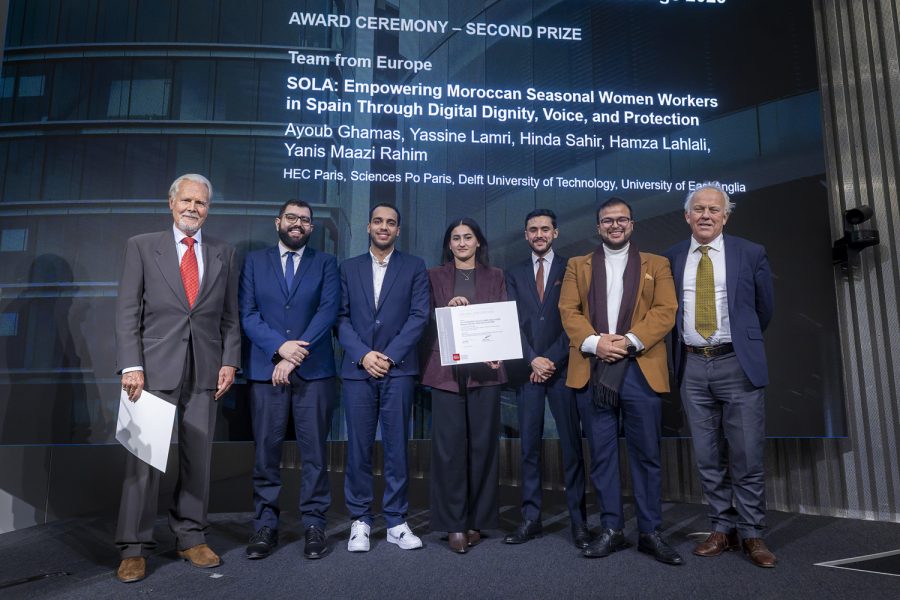
A team of five Moroccan students has clinched second prize at the 2025 Geneva Challenge, an international competition that drew 1,093 master’s and PhD students from 92 countries, for their project SOLA, a digital tool designed to protect Moroccan women working seasonally in Spain’s strawberry harvest.
Their solution comes as over 15,000 Moroccan women travel to Spain each year for the strawberry harvest, employed under a 2001 bilateral agreement, with many facing exploitation, poor housing, wage theft, and harassment.
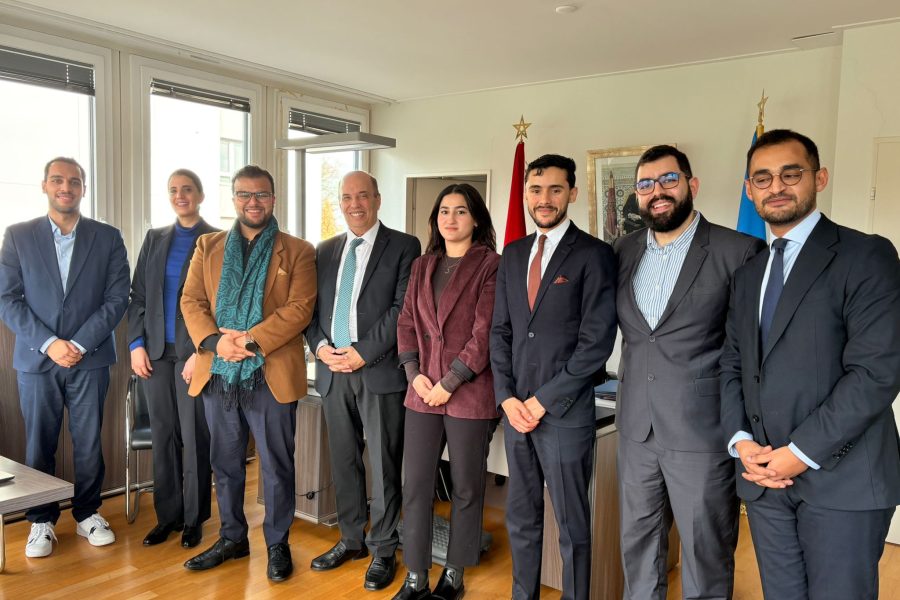
The digital platform, developed by Hinda Sahir, Ayoub Ghamas, Hamza Lahlali, Yanis Maazi Rahim, and Yassine Lamri, helps Moroccan women report abuses anonymously and access support, focusing so far on Huelva, which is known for producing 80% of Spain’s strawberries.
“Once the agreement is signed, there is usually little follow-up or monitoring,” argued team member Hinda Sahir.
For years, women have struggled to be heard, with the Andalusian Union of Workers filing multiple complaints about persistent abuse, often dismissed by farm lobby groups.
This becomes especially concerning as only 0.1% of contracts are fully respected in terms of legal rights, according to their statistics, while many workers endure 12-hour days, often without breaks, the team behind SOLA said.
Many Moroccan women in Spain’s strawberry harvest are tied to contracts they cannot read, creating dependency and vulnerability.
Housing is often substandard, unsanitary, and overcrowded, described by the UN as “among the worst in the world,” and workers also face health and safety risks, harassment, coercion, threats, and deprivation.
Yet, only about 2% ever report abuses, due to a deep-rooted culture of fear, argued the team, allowing exploiters to act with impunity.
The students contacted several Moroccan and Spanish associations, intergovernmental bodies such as the International Organization for Migration (IOM), and several international NGOs, noting that “the issue is part of a wider EU agricultural labor crisis affecting over 100,000 non-EU seasonal workers each year, with similar cases reported in Greece and Italy.”
“If we pilot this project successfully by 2026, we aim to scale it up in 2027 and expand to countries like Greece and Italy, not only to protect Moroccan women but women in general,” said Hamza Lahlali.
The developers said that they designed the platform to be accessible to NGOs, seasonal workers, as well as the public, with voice-based and dialect-specific interfaces that help women overcome literacy and language barriers to safely report abuses and access support.
“Women can simply record a voice note in Moroccan Darija, which will then be automatically transcribed and sent to the relevant NGOs,” said Ghamas.
The tool also includes a digital coordination hub where NGOs can track worker conditions and respond quickly, along with an AI system that predicts labor shortages and compliance risks.
The platform additionally shows exploitation patterns on a live Dignity Map, allowing NGOs to verify reports and act fast to protect workers.
“What used to take four or five months can now be done in a matter of weeks, if not less,” said Ghamas, stressing that, as a team, they “work to build trust between workers and NGOs, reassure them that no one will go after them, and ensure they receive help much faster.”
The team plans to roll out SOLA in four phases from 2025 to 2028. The first phase focuses on co-design workshops, prototyping, and solidifying key NGO partnerships.
The second phase represents the first real-world deployment of the SOLA platform within the Spain-Morocco corridor, focusing on a limited number of farms and workers to allow for intensive monitoring and learning.
The third phase scales SOLA across the Huelva region, integrates AI forecasting and the Dignity Index, and brings more NGOs and civil society partners on board.
The final phase will focus on internationalizing the tool, developing a Localization Kit to replicate it in other European countries with similar seasonal worker programs.





add your comment
Terms of publication : Not to offend the writer, people, sacred things, or attack religions or the divine self, and refrain from racist incitement and insults.