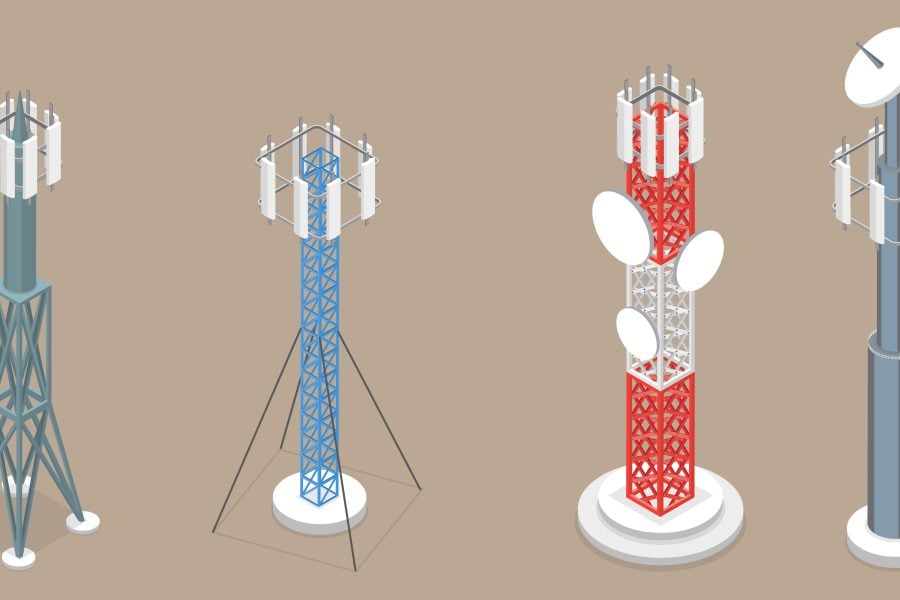
Morocco’s three major telecom operators switched on 5G today, casting the rollout as economic infrastructure meant to boost industry and bridge digital gaps.
The government sees the network as an instrument of competitiveness, a way to make data move as efficiently as goods, as a productive asset for factories, logistics zones and public administration.
Morocco’s export sectors depend on timing: a car part delayed in Kenitra or a container stalled at Tanger Med can ripple across Europe’s supply chains, and 5G’s promise of lower latency and higher reliability fits that logic.
The GSM Association expects mobile-enabled technologies to add 11 trillion dollars to global GDP by 2030, with manufacturing, finance and transport accounting for the largest share.
Private 5G systems in European ports have reported productivity increases of about 20 percent and capital savings near 15 percent compared with Wi-Fi networks, according to Ericsson case analyses.
Those efficiencies, modest in isolation, add up across thousands of terminals and warehouses, and Morocco hopes similar improvements could strengthen its position as a manufacturing and logistics hub for Africa and Europe.
A UK government-commissioned review of broadband studies found that a ten-percent increase in penetration correlates with GDP growth of between 0.6 and 2.8 percent, depending on network quality and cost.
Applying that logic, Morocco’s 5G rollout could add meaningful growth if access extends beyond its cities.
Ericsson’s Mobility Report forecasts that by 2030, about 350 million households worldwide will receive broadband through fixed wireless access, and that more than 80 percent of those connections will rely on 5G.
For towns beyond the reach of fiber, fixed wireless could deliver education, healthcare and administrative services without laying new cables.
That ideal, though, turns on financing. Around the world, governments have struggled to balance revenue and reach. Spain used 163 million euros from European recovery funds in 2024 to subsidize rural coverage. The United States created a nine-billion-dollar fund to extend service to unserved areas.
Morocco’s regulator is using regulatory stability rather than public funds to drive its 5G rollout.
ANRT’s July 2025 licensing round set moderate one-off fees, 900 million dirhams for Maroc Telecom and 600 million each for Orange Maroc and Inwi, alongside coverage targets of about 25 percent by 2026 and 70 percent by 2030.
Operators have since created joint ventures, tying investment to shared assets and long-term returns, but this risks uneven access as operators weigh costs in low-density regions.
ANRT plans to assess operators’ progress after the first operational year, a test of whether private coordination can extend coverage without heavier state support.
Academic modeling published on arXiv puts the global price of universal 5G in developing regions at 1.7 trillion dollars, reducible to half a trillion under policies that simplify permits and encourage investment.
Across Africa, 5G makes up about 1.2 percent of mobile subscriptions and covers around 11 percent of the population, constrained by high handset prices and limited spectrum availability, according to the International Telecommunication Union.








add your comment
Terms of publication : Not to offend the writer, people, sacred things, or attack religions or the divine self, and refrain from racist incitement and insults.