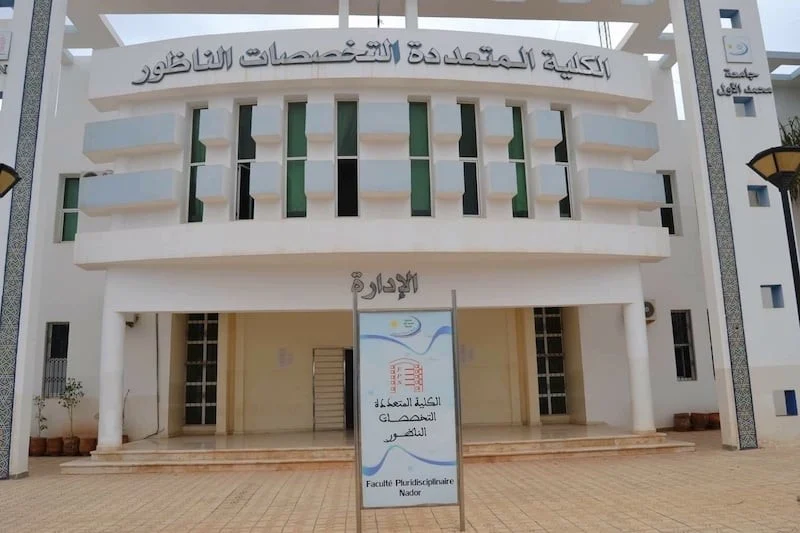
In a significant step toward the creation of an independent university in Morocco’s northeastern region, the Multidisciplinary College of Nador has been officially restructured into four distinct academic institutions, university officials confirmed.
The decision, adopted by the governing board of Mohammed I University of Oujda on April 22 (Resolution No. 11/2025), will see the current institution divided into four specialized faculties: the Faculty of Economics and Management, the Faculty of Applied Sciences, the Faculty of Legal and Political Sciences, and the Faculty of Arts, Languages, and Fine Arts.
This academic reorganization has drawn wide praise from students, faculty members, and civil society groups who have long advocated for the transformation of the college into a full-fledged university. With over 33,000 students enrolled in the 2024–2025 academic year, stakeholders say the move comes in response to both growing academic demand and the region’s development ambitions.
Yassine Zaghloul, president of Mohammed I University, hailed the reform as a strategic response to the Ministry of Higher Education’s modernization agenda, led by Minister Abdelatif Miraoui.
“The division aims to strengthen academic specialization in Nador and improve both the quality of instruction and scientific research,” Zaghloul told Hespress. “It also ensures better access to academic and administrative services for students.”
He emphasized that Nador is the first institution in the country to implement this pioneering reform. The transition will begin in the next academic year, with the university pledging to provide the necessary human, logistical, and technical resources to support the independent faculties.
Ali Azdimoussa, dean of the Multidisciplinary College of Nador, said the restructuring aligns with national higher education reforms and local socio-economic dynamics.
“The plan was endorsed by the college’s governing council and championed before the university board, with strong support from President Zaghloul,” Azdimoussa noted. “It positions the Nador-Driouch region to better leverage major strategic projects, such as the Nador West Med port, the industrial acceleration zone, and the Al Aroui International Airport.”
He added that the initiative marks a structural turning point for the institution, founded in 2005, and will enhance academic governance and specialization across the newly created faculties.
Mustapha Qrishi, a senior law professor at the college, said the move reflects long-standing calls by educators and local stakeholders to address the burdens of managing a rapidly expanding institution under a single administrative structure.
“With over 33,000 students and only about 200 faculty members and limited staff, managing the institution had become an immense challenge,” Qrishi said.
He stressed that the transformation will require adequate infrastructure and staffing. Initial projections suggest the Faculty of Legal and Political Sciences will host around 13,000 students, the Faculty of Arts and Languages about 12,000, the Faculty of Economics 5,000, and the Faculty of Applied Sciences 3,000.
Qrishi called the reorganization a “foundational step” toward the establishment of a full university in Nador, especially as the region experiences rapid urban and economic growth.
“With flagship projects like the West Med port underway, this academic transition could lay the groundwork for a future ‘University of Nador,’ offering the autonomy and academic dynamism the region needs,” he said.








add your comment
Terms of publication : Not to offend the writer, people, sacred things, or attack religions or the divine self, and refrain from racist incitement and insults.