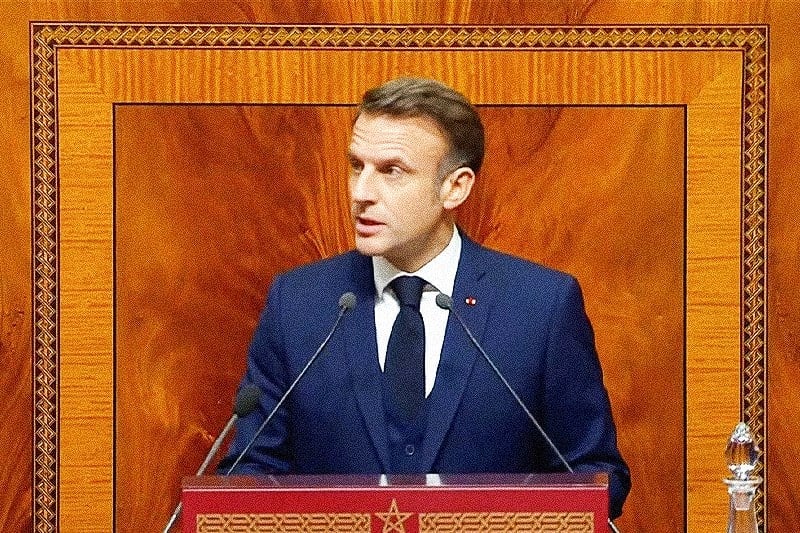
French President Emmanuel Macron’s state visit to Morocco underscores a renewed commitment to strengthening ties across various sectors, especially education, as highlighted in his speech before the Moroccan parliament on Tuesday morning and reinforced by several strategic agreements signed yesterday, with the presence of King Mohammed VI.
Delving into the realm of education, Macron emphasized that since independence, France has remained Morocco’s steadfast partner in the evolution of society, with 44 institutions educating nearly 50,000 students—predominantly Moroccans—from all corners of the kingdom, while also noting that the Moroccan student community is the largest in France.
The document prepared by the Elysée Palace for this historic occasion highlighted that “the French network in Morocco includes 42 schools and over 3,465 teachers, making it the second-largest French school network globally,” and added that “this system has achieved remarkable success, with around 70% of graduates opting to continue their studies in France.”
This is part of the first initiative aimed at enhancing the French education system in Morocco to boost educational standards and advance the overall education framework.
During his speech in the Moroccan parliament, the French President also revealed ongoing discussions about launching a training program for professionals supported by ISART School, coinciding with efforts to establish a video game city in Morocco.
He explained that this initiative is part of a shared vision for cultural and creative industries as a key driver of attraction and employability for youth.
This comes on the heels of the Declaration of Intent signed yesterday, which aims to support and structure the cultural and creative video game industry ecosystem.
The declaration, signed by Mohamed Mehdi Bensaid, Minister for Europe and Foreign Affairs, Jean-Noël Barrot, and Minister of Culture Rachida Dati, seeks to strengthen cooperation by mobilizing French expertise to develop the video game ecosystem in Morocco, with the backing of the Kingdom of Morocco’s Ministry of Youth, Culture, and Communication.
Macron also emphasized the importance of human capital as the crucial indicator of both countries’ capacity to address several challenges, highlighting that “for this reason, education, vocational training, and higher education are prioritized in public policies.”
He underscored the necessity of “making significant investments in training, developing educational systems nationwide, and promoting exchanges across all critical fields,” stating that “this investment is crucial for enhancing our competitiveness in the face of significant challenges posed by major global players striving to dominate advanced technologies and substantial domestic markets.”
For this reason, the French President recalled that his visit to Morocco included “a decision to strengthen academic partnerships in health, digital technology, and agriculture—key areas for food security across both countries and the continent,” emphasizing that the ability to train talent, facilitate mobility, and retain skilled professionals is essential in each of these sectors.
In this regard, a broader agreement centered on higher education, scientific research, and innovation was signed on Monday by Morocco’s Minister of Higher Education, Scientific Research, and Innovation, Azeddine Midaoui, and France’s Minister of Higher Education and Research, Patrick Hetzel, alongside several other agreements in different sectors.
This declaration outlines partnership initiatives across three main areas: supporting university training partnerships, boosting scientific collaboration in priority fields through closer ties with businesses, and improving governance in higher education, research, and innovation by strengthening institutional capacities.
A separate agreement centered on a French-Moroccan declaration of intent for educational cooperation from 2024 to 2026, signed by Morocco’s Minister of National Education, Preschool, and Sports, Mohammed Saad Barada, and France’s Minister of National Education, Anne Genetet, along with Minister of Higher Education and Research, Patrick Hetzel.
This agreement aims to strengthen collaboration in several key areas, including supporting exceptional training, enhancing technical education programs, expanding the network of French educational institutions in Morocco, contributing to Arabic language teaching in France, and revitalizing partnerships between academies.
Also, both countries signed an agreement that establishes a protocol to create a French-Moroccan research center with an African focus—the first of its kind on the continent—signed by Noureddine Mouaddib, President of the International University of Rabat; Antoine Petit, General Director of the National Center for Scientific Research; and Nathalie Drach Temam, President of Sorbonne University.
This center will concentrate on training, research, and innovation in specialized fields such as artificial intelligence, big data, cybersecurity, renewable energy, hydrogen, and social sciences and humanities.
It’s worth mentioning that the second initiative to boost educational standards and advance the education system is supported by the French Development Agency (AFD), which is actively assisting Morocco’s educational strategy. Between 2017 and 2023, AFD provided €80 million to help develop Morocco’s education system and has pledged an additional €130 million as part of the Education Plan 2026.
This funding supports “Morocco’s national plan to modernize and enhance the quality of education across all levels.”
The French President also committed during his speech to “enhancing efforts to promote the natural flow of people for better collaboration in research and business development.”
He noted that “recent initiatives include providing automatic travel visas for Moroccan alumni of French higher education, with a desire to launch a pilot project that fosters collaboration and enriches both nations through shared intelligence and projects.”
This is evident in the third initiative, which is the Franco-Moroccan scholarship program that promotes academic excellence by providing Moroccan students with scholarships to attend France’s prestigious preparatory schools.
These scholarships cover social benefits and waive tuition fees at public institutions, enabling students to access some of France’s top universities.
“France continues to be the top destination for Moroccan students studying abroad, with over 45,000 enrolled in the 2022–2023 academic year—a 13% increase from 2017 to 2022. This growth highlights the appeal of France’s educational opportunities,” emphasizing the official document.
It also mentioned that Moroccan students also lead among international students in France’s engineering and business programs, with over 6,000 in engineering and 8,058 in business schools.
It’s worth mentioning that France and Morocco are collaborating to create a higher education system that addresses the needs of both the country and the African continent, with France supporting Moroccan universities facing rapid student growth and declining faculty numbers.
The goal is to achieve 500 dual degrees by 2030 and to expand the recognition of degrees earned in Morocco by French institutions through inter-university partnerships, according to a media report.
Additionally, the Maroc Université Numérique (MUN) digital platform, launched in 2017, aims to enhance digital education and improve access to resources, ultimately boosting the quality of higher education in Morocco.
Also, France is Morocco’s leading scientific partner, with approximately 13,000 joint publications from 2013 to 2022. The collaboration includes the Hubert Curien Partnership Program (PHC) Toubkal, which focuses on innovative research for sustainable development, and the regional Morocco program, which Morocco has been part of since 2012.


add your comment
Terms of publication : Not to offend the writer, people, sacred things, or attack religions or the divine self, and refrain from racist incitement and insults.