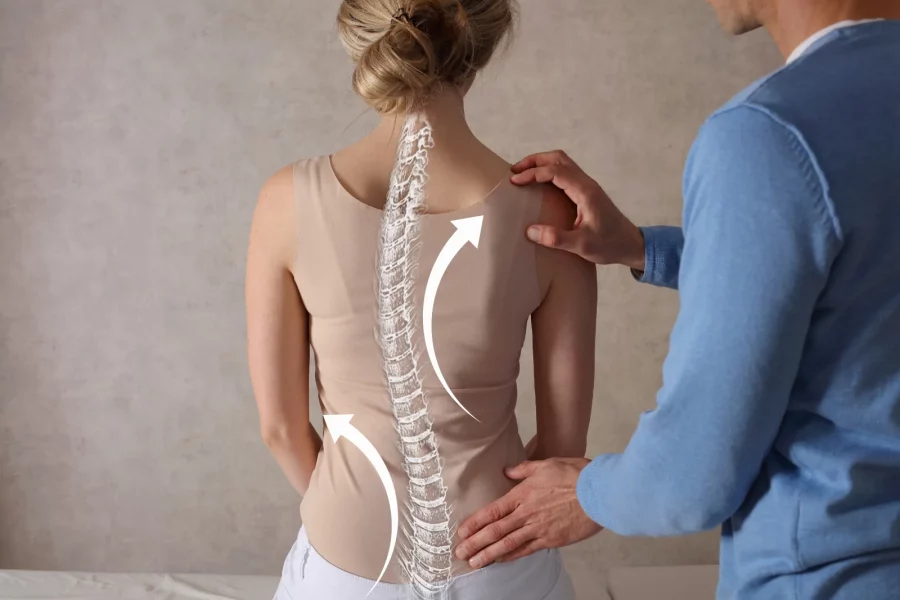
Scoliosis, medically defined as a sideways curvature of the spine most commonly diagnosed in adolescents, poses a significant challenge to many young Moroccans.
Faced with false diagnoses, expensive treatments, inadequate access to proper care, and societal pressures, Moroccan scoliosis patients endure their struggles in silence.
This illness can be witnessed through some visible symptoms, such as uneven shoulders, an asymmetrical waist, a rib hump, leaning to one side, and uneven hips.
To gain insights into their experiences, we interviewed “Scoliosis Fighters,” individuals living with the condition. Among them, two siblings, Badreddine and Wissal Jabri, shared their journey of living with scoliosis and coping with the hurdles that come with it.
It runs in the family, or does it?
“I had severe pain in my back and couldn’t feel comfortable sitting down or standing up,” said Badreddine Jabri, 27, recalling the time he was diagnosed with scoliosis in the first half of 2020 while stranded in Italy due to the Covid-19 pandemic.
His diagnosis was confirmed through X-rays, which are commonly used to detect scoliosis and determine the type and severity of the curvature.
The curve in question happens because the spine twists and curves to a side of the body, which is why on X-rays; it can look like an “S” or a “C” shape.
X-rays might be repeated at regular intervals (often every 6 months or 3 months) to check whether the curve is getting bigger or to monitor the effects of treatment.
Despite being prescribed painkillers and physical therapy, Badreddine’s progress was hindered by the pandemic’s restrictions, compelling him to seek relief through other means, such as regular swimming for hydrotherapy’s potential benefits.
Wissal’s experience was completely different as she first took her symptoms for kidney pain until visiting a nephrologist, who referred her to an Orthopedic.
While she believes that her condition is hereditary, as both she and her brother deal with it, experts clarify that while there might be a familial connection, scoliosis is not directly inherited.
Limited medical support:
Kenza Abboud, an 18-year-old student who learned of her Lordosis, an inward curvature of the lumbar spine, at a young age, stressed that even walking can become a draining activity.
Lordosis is the inward curve of the lumbar spine which falls just above the buttocks. While a small degree of Lordosis is normal, too much curving poses serious health threats. This illness is often associated with scoliosis but is not as common in Morocco.
Kenza highlighted the scarcity of resources to help people diagnosed with her condition, leading her to explore yoga for pain relief and improve her quality of life.
While she plans on seeking proper medical care once abroad, Kenza emphasizes not allowing her condition to define her or limit her activities.
“I try to take it easy on myself and just live with the pain until I’m able to have more medical support,” shared Aida Abboud, Kenza’s 20-year-old sister, who was diagnosed with levoscoliosis, a less common left spinal curve variant.
Her condition makes day-to-day activities painful. However, she has since adopted a more positive outlook, recognizing that her condition does not define her identity.
Common medical treatments in Morocco:
Following my own diagnosis in 2015 with scoliosis, I had little to no choice in what procedures to follow, as Morocco is still not that up-to-date when it comes to treatments for the chronic disease.
Luckily in my case, the diagnosis was immediate, followed by my doctor’s suggestions to have regular physical therapy sessions for three months in hopes of an improvement.
But after those three months my case became progressively worse and I was prescribed a back brace.
To retain your spine in a straighter, unrotated position, the brace is tailored to fit your body. It accomplishes this by applying pressure to the curve’s outside edge. You’ll draw away from this pressure and stand up taller as a result.
I ended up wearing two back braces for four years, 23 hours a day. The brace needs to be modified to accommodate changes in the wearer’s body.
However, Morocco doesn’t even produce braces. Due to the nonexistence of medical specialists that specialize in such things, they can only be created outside of Morocco and brought here for an average cost of MAD 10.000.
Patients with scoliosis must lead extremely healthy lives marked by strong self-discipline, refraining from lifting weights, and maintaining good posture for the brace to function effectively.
This is why wearing the brace requires regular physical therapy sessions. One costs about MAD200 and every patient requires at least three sessions a week.
Besides these treatment methods, if the curves reach high degrees, it requires being operated, a costly operation that necessitates altering one’s life to adapt to its repercussions.
While all over the world, scoliosis is considered a disability and patients are treated with delicacy, in Morocco, society still perceives patients as normal people because the disability is not that visible to the normal eye.
The struggle against this debilitating condition extends beyond the physical difficulties in controlling the spine’s curvature for Moroccan scoliosis patients. In addition to the financial burden of treatment, there is often social stigma and misunderstanding surrounding this disease.
For many Moroccan patients, the high price of scoliosis treatment is a significant barrier in their recovery journey.
The expenses, especially for families with limited financial resources, can quickly become daunting, ranging from diagnostic testing and consultations to bracing and surgical treatments.
Some patients may not be able to afford private healthcare, which leaves them dependent on public healthcare systems that may have lengthy waiting lists and few resources for specialist treatments.
As a result, many people are compelled to postpone or skip necessary medical procedures, endangering their long-term health and well-being.
The societal stigma around disabilities, including scoliosis, persists in Moroccan communities.
The designation of someone as “handicapped” can result in prejudice, exclusion from some elements of society, and negative sentiments, which is the stigmatization of those who are affected by scoliosis is further exacerbated by the general lack of knowledge and education regarding the condition.
It is essential to raise public awareness, improve healthcare support, and promote a more inclusive and compassionate society to properly handle the challenges that Moroccan scoliosis fighters face.



add your comment
Terms of publication : Not to offend the writer, people, sacred things, or attack religions or the divine self, and refrain from racist incitement and insults.