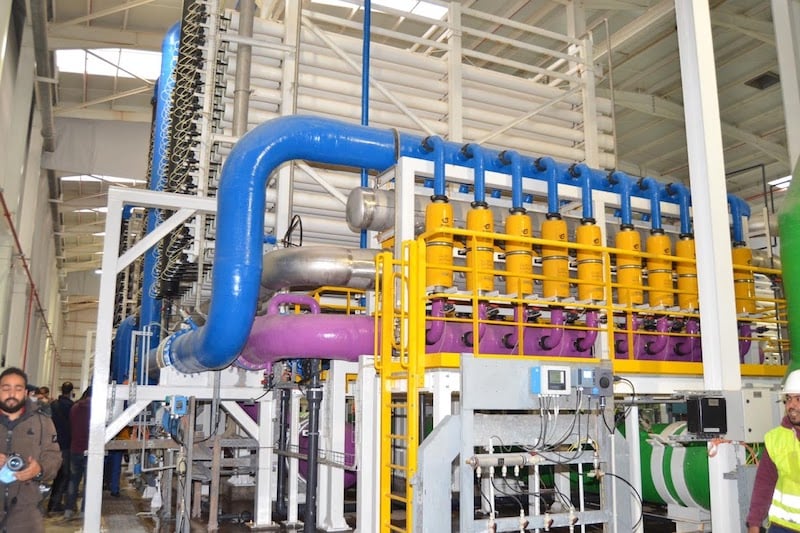
Morocco is the first country to establish innovative projects in this field of seawater desalination in the North African region.
In the MENA region, it is ranked sixth, with a total of $ 2.37 billion invested before.
It is ahead of Tunisia (0.95 billion), Algeria (0.21 billion) and Kuwait (0.13 billion), according to the 2023 edition of the report of BNC Intelligence, it remains, in particular through the establishment of stations in Grand Casablanca, Agadir, Oriental, Laâyoune and Dakhla.
The Middle East and North Africa (MENA) region alone accounts for nearly 48% of the world’s daily desalinated water production, for a total investment of $39.3 billion.
Saudi Arabia leads the way with $14.58 billion invested, followed by the United Arab Emirates ($10.28 billion), Jordan ($4.20 billion), Egypt ($3.26 billion) and Oman ($3.16 billion), then Morocco, Tunisia, Algeria and Kuwait.
In terms of the distribution of investments in desalinated water pipeline projects by country, the United Arab Emirates takes the lion’s share among Arab countries, with a value of $7.88 billion. They are followed by Saudi Arabia ($7.56 billion), Egypt ($3.24 billion), Jordan ($3 billion) and Morocco ($2.17 billion).
The other countries in the region total $1.73 billion in investments.
Morocco’s asset remains its Atlantic and Mediterranean coasts, which allow the implementation of several desalination projects for drinking water use.
But Saudi Arabia and the United Arab Emirates are investing more and for a long time, given the climatic constraints of the region, where the dry and arid weather has pushed early to think of answers.
One of the report’s key projects is the Jafurah project in Saudi Arabia to inject groundwater.
With a budget of $3.2 billion, the plant will be operational by 2027, equipped with reverse osmosis technologies. In the United Arab Emirates, the project selected is Mirfa ($3 billion), which will be operational by 2026 for industrial purposes.
Several others have also been selected for Egypt, Oman and Jordan.
For Morocco, it is the Casablanca station ($1.1 billion) that appears in the report.
Indeed, the document recalls that this is the largest seawater desalination unit in Africa, to combat water shortages in the Casablanca region.
In a context where Morocco is now experiencing the harshest drought in 40 years, the filling rate of dams is at its lowest, while 100% of groundwater is in deficit.
The report recalls that the kingdom has launched a program to install desalination and water purification plants, 11 of which are in service, particularly for industrial use, and 5 others are underway.
In this sense, the Casablanca station is the most important project.
The start of work is scheduled for next June, this unit will have a production capacity of 548,000 m3 per day, the equivalent of 200 million m3 annually.
In other regions, the desalination plant of Chtouka-Aït Baha, near Agadir, has been in operation since January 2022.
In the south of Morocco, in Laâyoune, the unit already in place will be extended to gradually increase its coverage, in order to meet the drinking water needs of all the inhabitants of the city and the surrounding areas.
In Dakhla, the project is expected to be completed in 2025, with a plant with a daily production capacity of 90,000 to 100,000 m3 of desalinated water per day, to be used for drinking water and irrigation of 5,000 hectares of land.
By 2030, Morocco should be equipped with at least twenty seawater desalination plants, with a production capacity of 1.3 billion m3 per year.
53% of this global production will be used for drinking water, 23% for irrigation and 24% for industry.







add your comment
Terms of publication : Not to offend the writer, people, sacred things, or attack religions or the divine self, and refrain from racist incitement and insults.