
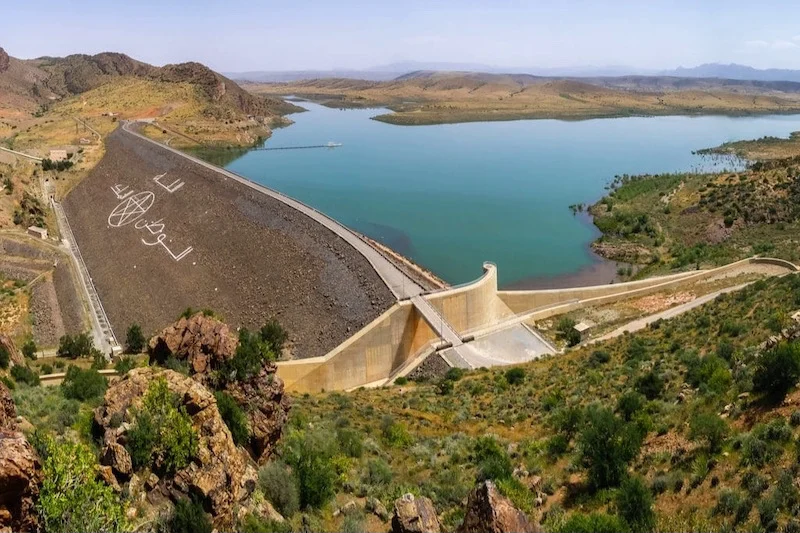
Moroccan dams have shown significant increase in water capacity since the end of February, marking the beginning of a promising agricultural season. With sufficient water reserves, the country is able to stave off the specter of summer shortages that characterized the previous year.
Indicators of the daily status of the major dams in the Kingdom show a tangible and significant recovery in their capacity, according to the numbers and data of the daily bulletin issued by the General Directorate of Water Engineering of the Ministry of Equipment and Water.
As of Friday, March 3, 2023, the total filling rate recorded amounted to 34 percent, with a total national capacity estimated at 5 billion and 479 million cubic meters, compared to 32.7 percent the previous year.
Despite variations in precipitation, the improvement of Moroccan dams would not have been possible without positive atmospheric disturbances contributed to by shifts in weather conditions in Morocco for the past three weeks.
In an analysis of the weather situation during the past weeks, obtained by Hespress from the General Directorate of Meteorology in Morocco, a series of weather disturbances affected the country.
The same source attributed this to the distance of the Assyrian High to the width of the Atlantic Ocean, leaving room for the succession of a series of depressions associated with cold air masses in the upper atmosphere.
According to the analysis of the Meteorological Directorate, the last week witnessed general rains in most parts of the country, especially the north, center, and east of the country, accompanied by significant snowfall in the Atlas and Rif highlands, reaching heights of more than 1,200 meters and ranging between 10 and 50 centimeters.
The “Moroccan Meteorological Service,” told Hespress that rainfall during the last three weeks (from Monday, February 13, 2023 until Thursday, March 02, 2023) reached more than 100 mm in Kenitra, 81 mm in Ifrane, 79 mm in Ouarzazate, 64 mm in Tangier, 59 mm in Safi, 57 mm in Rabat-Salé, 52 mm in Guelmim, in addition to 48 mm in Taroudant and 44 mm in Agadir and Meknes.
In a related context, heavy snowfalls affected the regions of the High Atlas and the southeastern slopes, with heights exceeding 1,200 meters. These are the snowfalls described by the Meteorological Directorate in the latter region as “exceptional.”
Comparison data between the measurements recorded between February 16 and 18, 2023, with the important measurements of snow recorded in the Ouarzazate region during the period 1996-2022 showed that “the measurements recorded in the first period are exceptional in terms of the amount of snow recorded.
This is due to the thermal contrast between the cold air in the upper atmosphere and the moderate, moist air coming from the south, which produced heavy rain in the highlands of the High Atlas and the southeast of the country.





Wow; let’s go to a verry good year. ❤️??❤️??❤️??. We need’t zoooooooooooo.