Morocco is embarking on a new phase in the development of its defense industry, with a national roadmap aimed at building an integrated industrial ecosystem capable of meeting a significant share of the country’s military and security needs while expanding its presence in international markets.
The strategy, presented to King Mohammed VI during a working session at the Royal Palace in Rabat on Wednesday, sets three main targets for 2035: creating 50,000 direct and indirect jobs, meeting approximately 40% of the needs of the Royal Armed Forces and security agencies, and generating 65% of the sector’s revenue through exports.
The initiative, known as the “Morocco Offer,” forms part of the King’s broader vision to modernize the country’s industrial base, strengthen strategic autonomy and develop high-value-added industries. Beyond supplying domestic defense requirements, the roadmap seeks to position Morocco as a competitive producer and exporter of defense and security equipment.
The strategy builds on the country’s existing industrial capabilities, particularly in aerospace, automotive manufacturing and electronics, and aims to extend these strengths into advanced technologies, research and development, and specialized defense production.
From legal framework to an integrated industrial ecosystem
Morocco’s defense industry development builds on an institutional and legislative process launched in 2020, when the country adopted Law No. 10-20 on defense and security equipment. The new royal guidelines mark a shift from establishing the sector’s legal foundations toward organizing its industrial, investment and training structures and setting long-term strategic objectives.
The roadmap seeks to capitalize on Morocco’s industrial, logistical and human resources by developing activities with higher technological value. Its scope covers the entire industrial value chain, from research and development to production, industrial integration, maintenance, testing and storage.
King Mohammed VI called for the swift implementation of the strategy through the establishment of governance bodies, the preparation of a financing plan, the simplification of investment procedures and greater private-sector participation.
Developing specialized national skills is another central component. The roadmap provides for early career guidance, vocational training and the development of qualified professionals, drawing on expertise both within Morocco and among Moroccans living abroad.
The Hassan II Fund for Economic and Social Development will contribute MAD 4 billion to support implementation of the strategy.
Beyond defense requirements, the initiative is expected to generate opportunities for technology transfer, scientific research and innovation, while helping localize technical expertise that could also benefit civilian industries.
Four pillars of the national defense industry
The roadmap is built around four main institutional and industrial pillars designed to coordinate the sector and support its development.
The first involves establishing a dedicated strategic agency responsible for overseeing the national defense and security industry strategy and coordinating its implementation.
The second calls for an industrial holding company to structure investment and industrial partnerships, mobilize public and private capital, and support the emergence of domestic industrial players.
The third pillar involves creating a specialized academy to train qualified professionals and support research and technological development in partnership with industry stakeholders.
The fourth focuses on developing specialized industrial zones. Two new areas dedicated to defense production are planned in Benguerir and Benslimane, complementing existing industrial acceleration zones in Sidi Yahya and Nouaceur.
The planned facilities are intended to create new industrial and technological hubs, expand employment opportunities and strengthen the involvement of different regions in Morocco’s industrial development.
50,000 jobs and export-driven growth
By 2035, the roadmap aims to create approximately 50,000 direct and indirect jobs and enable domestic industry to meet around 40% of the requirements of the Royal Armed Forces and security agencies.
It also targets exports accounting for more than 65% of the sector’s total revenue, reflecting Morocco’s ambition to develop a competitive defense industry with access to international markets.
These objectives build on projects already launched or under development since the adoption of the 2020 legal framework.
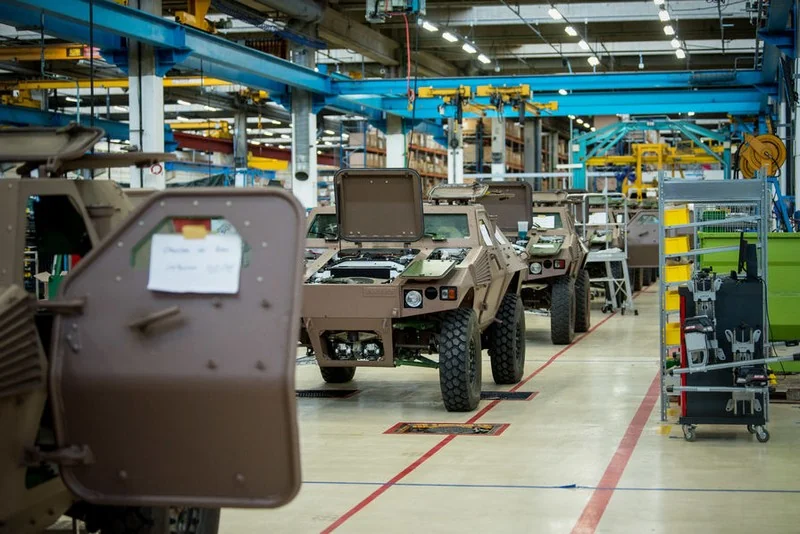
Among them is the production of WhAP 8×8 armored vehicles in Berrechid, alongside the manufacturing of 30mm weapon stations for these vehicles at the Midparc industrial zone in Nouaceur. The country is also developing medium- and large-caliber ammunition manufacturing in Sidi Yahya.
Other projects include the production and maintenance of military drones in Benslimane, as well as research and development activities involving autonomous systems, their integration and counter-drone technologies.
The roadmap identifies several priority areas for further development, including drones and autonomous systems, land and naval platforms, defense electronics, cyberdefense and artificial intelligence.
These sectors reflect the strategy’s emphasis on advanced technologies and industrial applications that can serve both defense and civilian purposes.
Defense manufacturing as a tool of economic diplomacy
The roadmap also carries an international dimension, with Morocco seeking to use its developing defense industry to deepen strategic partnerships, expand industrial cooperation and strengthen its position in global supply chains.
The country intends to build on its existing industrial experience, the expertise of the Royal Armed Forces and its capacity to attract investment and establish partnerships involving technology transfer and industrial integration.
Developing domestic production and export capabilities could also allow Morocco to access new international markets for defense and security equipment.
The strategy therefore extends beyond the creation of a new industrial sector. It reflects a broader ambition to move Morocco further up the global manufacturing value chain by developing high-technology industries, strengthening domestic production capabilities and attracting investment in specialized activities.
By 2035, the government aims to establish a more integrated and competitive defense industry that combines national security requirements with economic development, technological innovation and a stronger international industrial presence.







add your comment
Terms of publication : Not to offend the writer, people, sacred things, or attack religions or the divine self, and refrain from racist incitement and insults.