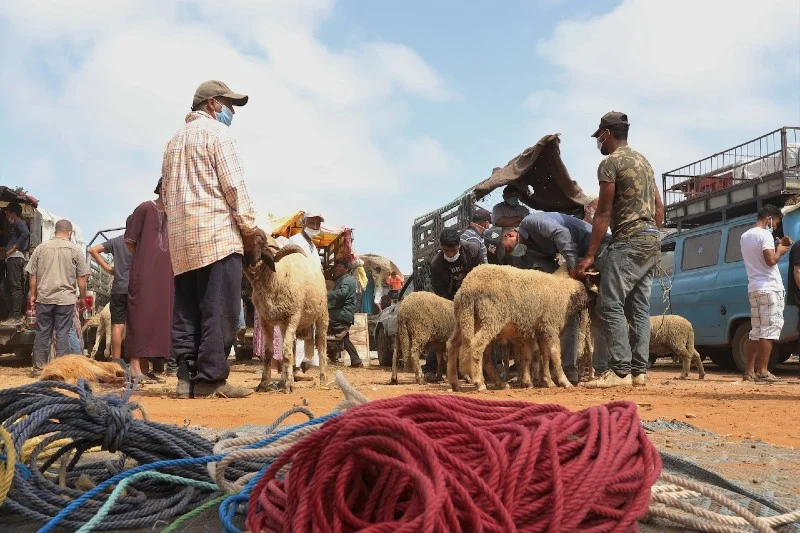
Eid Al-Adha continues to polarize the Moroccan population more than ever, as it approaches amid a turbulent economic climate. Eid Al-Adha has always been a time of religious festivity and sacrifice, impatiently awaited by Moroccans from all walks of life and all socio-economic backgrounds. But as with everything this year, Eid Al-Adha is now shrouded in doubt, making some people question if celebrating this year is within their means.
In an interview with Hespress EN, Hassan Jounaid, a banker from Casablanca and father of two, was categoric: he is not celebrating Eid Al-Adha in 2022.
“I have to look at the big picture here. We are experiencing an unprecedented inflation and a price hike like we’ve never seen. Eid [Al-Adha] entails a lot of expenses that I don’t think I can afford, not under the current circumstances,” he said.
For Hassan, it is imperative to spend money cautiously and save as much as possible. “I remember that in 2018, I was going through a difficult financial situation around Eid time. So naturally, I turned to my family for a loan, and I still celebrated that year knowing that I was indebting myself,” he explained. “It seemed like a normal thing to do at the time. But now, seeing the world in 2022, I think it was very irresponsible.”
Moroccans not celebrating Eid Al-Adha is certainly not something new. In 2013, according to the Moroccan Higher Planning Commission (HCP), 4.7% of Moroccans didn’t celebrate.
This non-celebration is often linked to urban and individual households. Urban households are more inclined not to celebrate than rural ones (5.9% against 2.5%). Individual households are the category least concerned by the sacrifice of Eid Al Adha (46.5%). But, in 2022, even rural households seem to be forsaking the celebration of Eid for more worldly priorities.
Mohammed Ouaâdou is a long-haul taxi driver living in the region of El Jadida with his wife and three kids. “This is my first ever year not celebrating Eid,” he said in an interview with Hespress EN. “I thought very hard about this; it wasn’t an easy decision. My kids want nothing but to celebrate Eid, but I can’t afford it.”
Mohammed has been in a precarious situation since the end of 2020. By April 2022, he was drowning in debt; the money he made from taxi driving wasn’t enough to cover his family’s basic needs. “I can’t afford to put myself into debt anymore. This year has been challenging for me as a taxi driver with gas at its highest and prices rising.”
For Mohammed, being able to fulfill his family’s needs in these trying times is not only his responsibility. “It’s also the Government’s responsibility. They should do something to help poor people and alleviate their situation. I voted for current Head of Government Aziz Akhannouch because I believed his campaign program, but now I see that his speech was no different than any other politicians’ election promises,” he further explained.
“How can they expect a simple taxi driver to live and feed his family under the current circumstances? My situation is not even the worst. I know people who have absolutely nothing and can’t afford anything anymore in my village. How do you expect them to celebrate Eid [Al-Adha]?”
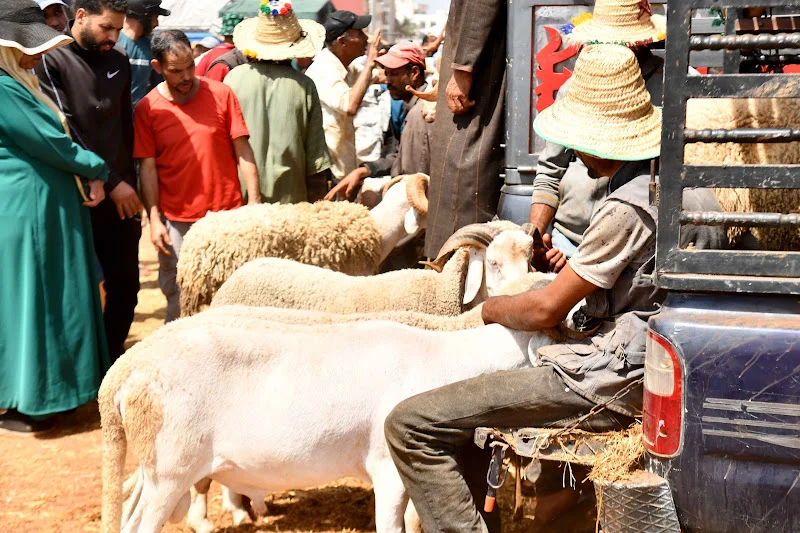
In addition to very high input costs, including barley, straw, and transportation, the specter of intermediaries is also looming over sheep prices. For example, in 2021 (a post-pandemic year also characterized by high prices), sheep prices varied from MAD 50/Kg to MAD 53/Kg, which was still high for some people. This year, intermediaries can go as high as MAD 59/Kg, according to the National Sheep and Goat Association (ANOC).
These intermediaries, whose sole purpose is to buy sheep from farmers and resell them directly to customers, use the global conjecture and the general price hike as excuses to justify their prices and rob hard-working farmers of months of labor.







add your comment
Terms of publication : Not to offend the writer, people, sacred things, or attack religions or the divine self, and refrain from racist incitement and insults.