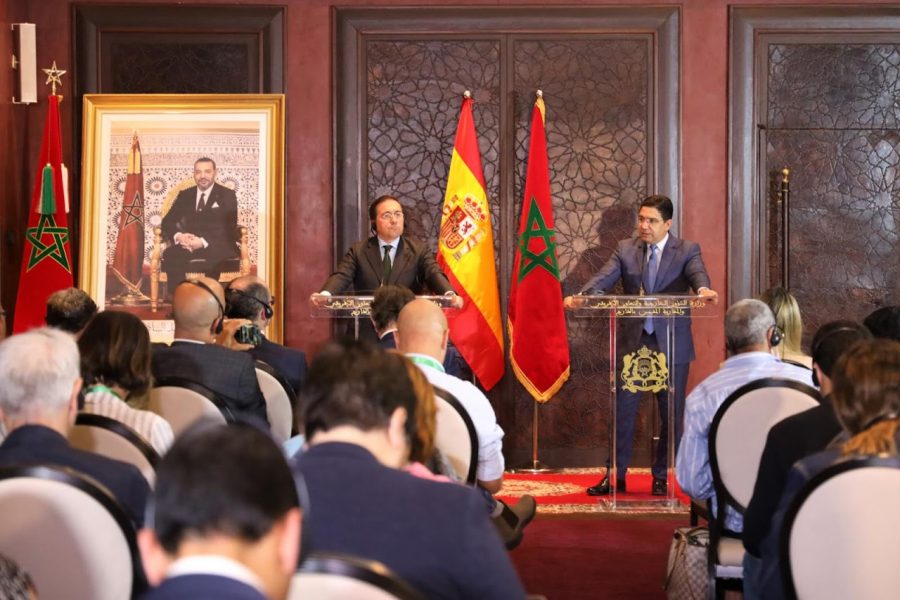
Spanish and Moroccan foreign ministers spoke today of a smooth rollout of the measures previously agreed on to revive Moroccan and Spanish relations. Irregular flows are dropping, maritime links are proceeding at a normal pace, and Operation Marhaba is steadily advancing, the two ministers affirmed in Marrakesh.
Nasser Bourita and José Albares spoke in the first bilateral meeting that brought them together since the agreement to end a two years long diplomatic spat was reached between King Mohammed VI and Pedro Sanchez.
Referring to each other as brothers and friends, the two ministers echod common stances on matters of combatting irregular migration and regenerating legal flows of goods and people between the two nations.
The Spanish minister assured that the two countries are “advancing in the arrangement of the passage of people and goods through the customs of Ceuta and Melilla.” He said the process is taking place “in agreement with Morocco according to the roadmap.”
Although prearranged as part of the roadmap established between King Mohammed VI and Pedro Sanchez, Ceuta and Melilla border crossings have yet to open, leaving the two cities isolated from a Moroccan market and workforce that make up the bulk of economic activity in the enclaves.
As contentions linger around the reopening of the border crossings connecting the enclaves to Morocco, Bourita, though not referring to Ceuta and Melilla by name said Morocco is working to apply all the elements of the roadmap.
Bourita assured that “Spain can count on Morocco as a trustworthy, serious and responsible partner”, and promised to maintain a relationship with the neighboring country based on “consultation and coordination outside of unilateral actions.”
He referred to Spain as Morocco’s ally within the European Union, as the north African nation seeks to secure more funding for border control at the backdrop of repeated alerts by Morocco’s security officials on the insufficient funding received from Europe to manage the toll of unlawful crossings.
Despite the slim financing, Morocco has reduced the number of migrants arriving to the Canary Islands by 70 % in March and April compared to January and February of 2022, according to figures given by Albares.







add your comment
Terms of publication : Not to offend the writer, people, sacred things, or attack religions or the divine self, and refrain from racist incitement and insults.