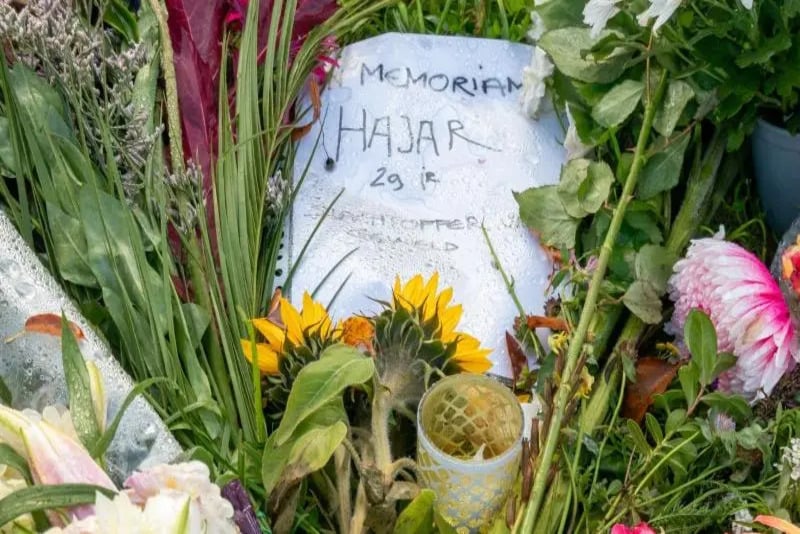
The killing of Hajar, a 29-year-old Moroccan woman whose body was discovered inside a suitcase in an Amsterdam river, has prompted grief and outrage in the Netherlands, with women’s organizations questioning why her death has not drawn greater public attention.
Hajar disappeared on October 4 after she was last seen cycling with a man near Amsterdam’s RAI exhibition center. Her family reported her missing that evening, beginning a search that ended on October 16 when a passerby discovered a suitcase containing her body in the Amstel River.
Flowers and messages of remembrance appeared along the Amsteldijk waterfront, where residents expressed shock at the circumstances of her death.
“I am in shock,” one resident told regional broadcaster NH Nieuws. “I think it is terrible that such a young woman’s life was taken.”
The discovery has resonated particularly among Moroccan-Dutch women’s advocates, who have raised questions about the attention given to victims of violence from minority backgrounds.
“Our daughter, our sister”
Amsterdam women’s organizations Rode Hakken and Saaam initially announced plans for a memorial walk from De Pijp to the RAI exhibition center, near the location where Hajar was last seen alive.
Activist and columnist Yesim Candan said she was angered by what she considered the limited public reaction.
“I miss the outrage,” she told NH Nieuws, suggesting Hajar’s Moroccan background may have influenced the attention her death received.
“If an Annefleur had been found dead in a suitcase, all of Amsterdam would have taken to the streets,” she said, contrasting the response with what she believed would have followed the killing of a woman with a traditionally Dutch name.
Candan, who did not know Hajar personally, described the planned gathering as both a tribute and a demonstration for women’s safety.
She referred to Hajar as “our daughter, our sister,” language reflecting the solidarity organizers sought to build around her death.
The planned memorial was subsequently canceled following consultations with Hajar’s relatives, who requested privacy and time to grieve. Organizers said they respected the family’s wishes and urged the public to give them space.
Suspect detained as family mourns
Dutch police arrested a 23-year-old man on October 20 after investigators identified him as the person seen accompanying Hajar shortly before her disappearance.
The suspect, a Somali national who has lived in the Netherlands since childhood, had initially been questioned as a witness before further investigations led to his arrest.
Dutch prosecutors subsequently announced that he would remain in custody while investigators examined his suspected involvement in Hajar’s death.
The family, speaking through the organization Namens de Familie, said the uncertainty surrounding Hajar’s disappearance had given way to profound grief.
Relatives expressed relief that a suspect had been arrested but asked to mourn and say goodbye privately.
Hajar’s death has also renewed discussion among women’s advocates about violence against women and the visibility of Moroccan-origin victims in Dutch public life, even as her family has chosen a private farewell.








add your comment
Terms of publication : Not to offend the writer, people, sacred things, or attack religions or the divine self, and refrain from racist incitement and insults.