
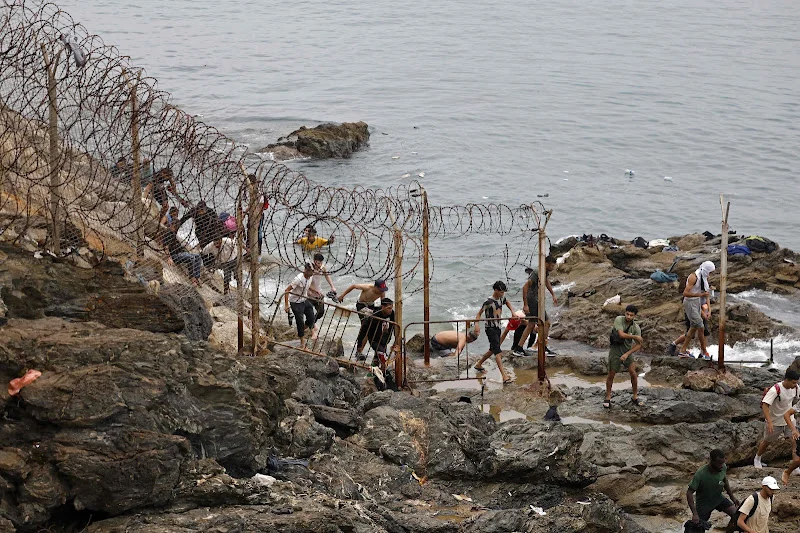
Nearly a week after the migration crisis erupted in Ceuta, figures released by Spanish and Moroccan authorities continue to differ significantly, with no single tally for the number of arrivals, returns to Morocco or migrants still in the occupied city.
Spain’s Interior Ministry says around 70,000 of the roughly 72,000 people who entered Ceuta have already returned to Morocco, leaving about 2,000 migrants still in the city.
Ceuta regional president Juan Jesús Vivas, however, told Spain’s state broadcaster TVE that around 6,000 migrants remained in Ceuta as of Wednesday afternoon and estimated that the total number of arrivals had reached about 80,000.
Vivas acknowledged that authorities were still unable to determine the exact number of migrants remaining in the city, attributing the difficulty to what he described as a “lack of resources in managing the crisis.”
He also questioned why authorities had yet to identify those still in Ceuta or begin expulsion procedures through the Tarajal border crossing, arguing that the delays showed that sufficient resources were not being deployed.
The regional president said the number of unaccompanied minors in reception centers had increased from about 750 to 1,100, leaving facilities operating “2,600% above their capacity.”
He also said Ceuta’s Temporary Stay Center for Immigrants, known by its Spanish acronym CETI, was “completely overwhelmed,” with more people outside the facility than inside it.
Figures changed as the crisis unfolded
The latest estimates add to a series of conflicting figures released since the crisis began on July 30.
Spanish authorities initially reported between 1,500 and 2,000 irregular arrivals over the previous 10 days before reporting that thousands of additional people were crossing into Ceuta by land and sea.
By the following morning, security authorities estimated that more than 40,000 people had arrived in the enclave.
As the influx continued, however, estimates diverged. Spain’s Interior Ministry put the number at between 49,000 and 50,000, while Vivas estimated that around 60,000 people had entered Ceuta.
The figures continued to rise as authorities attempted to assess the scale of the movement.
Spain’s Interior Ministry later said that roughly 72,000 people had entered Ceuta and that around 70,000 had subsequently returned to Morocco.
Vivas has continued to provide a substantially higher estimate, putting the total number of arrivals at about 80,000 and the number of people still in Ceuta at around 6,000.
Morocco reports a lower figure
Moroccan authorities have also provided figures that differ sharply from those issued by Spanish officials.
On Sunday, Morocco’s Interior Ministry said its official monitoring systems had recorded around 40,000 people attempting to reach Ceuta, compared with 1,135 people heading toward Melilla.
The ministry stressed that its figures were based on official surveillance and field data and represented the authoritative count, contrasting them with higher figures circulating in media reports and on social media.
The discrepancy means that the two countries have not publicly presented a common figure for the scale of the movement.
While Spanish authorities have focused on the number of people who successfully entered Ceuta, Moroccan authorities have referred to the number of people who attempted to reach the enclave.
Uncertainty over those still in Ceuta
The differences are particularly significant when it comes to the number of migrants who remain in Ceuta.
Spain’s Interior Ministry says approximately 2,000 people remain after around 70,000 returned to Morocco.
Vivas, meanwhile, estimates that the figure is closer to 6,000.
The difference of several thousand people has implications for the management of reception facilities, particularly those accommodating unaccompanied minors.
Vivas has warned that the pressure on the city’s reception infrastructure has become acute, while Spanish authorities have emphasized the scale of returns to Morocco.
The differing estimates also highlight the difficulty of establishing a definitive picture of the crisis while large numbers of people are moving between Ceuta and Morocco and authorities are simultaneously attempting to identify those who remain.
No unified tally yet
The conflicting figures have become one of the most visible aspects of the crisis, alongside disputes over the circumstances that led to the mass movement and the response of Spanish and Moroccan authorities.
Spanish government figures have evolved from tens of thousands of arrivals in the first hours to an eventual estimate of around 72,000 people entering Ceuta.
Ceuta’s regional government has consistently reported higher numbers, while Morocco has put the number of people attempting to reach the enclave at around 40,000.
The figures are not necessarily measuring exactly the same phenomenon: some refer to people who entered Ceuta, others to attempted crossings, and others to those who subsequently returned to Morocco.
Still, the absence of a unified tally leaves key questions unanswered about the precise scale of the crisis, the number of people who remain in Ceuta and the overall movement of migrants between the enclave and Morocco.
As authorities continue to manage the aftermath, the competing estimates are likely to remain part of the broader debate over how the unprecedented migration surge unfolded and how both sides responded to it.




add your comment
Terms of publication : Not to offend the writer, people, sacred things, or attack religions or the divine self, and refrain from racist incitement and insults.