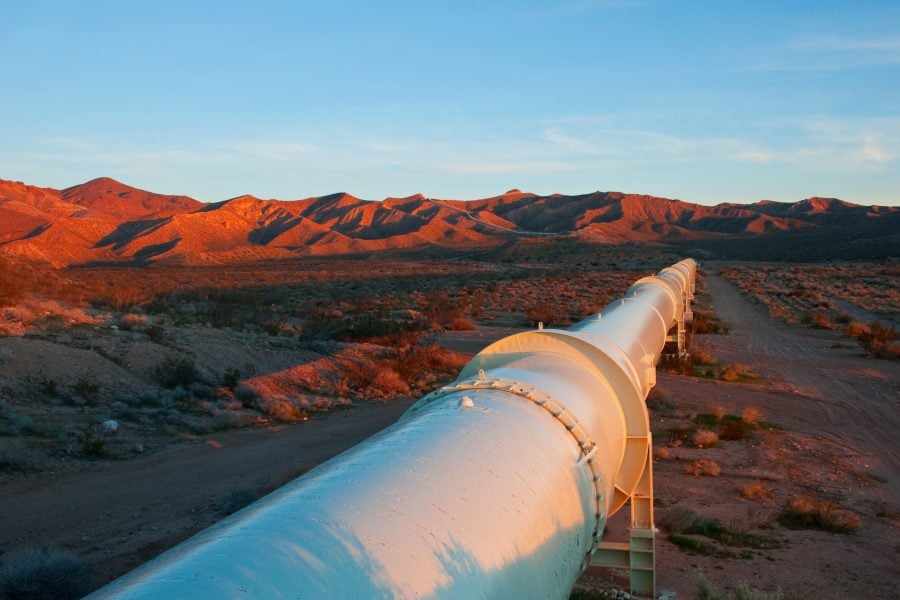
Morocco is seeking financial backing from the Export-Import Bank of the United States and the World Bank for a proposed $26 billion gas pipeline that would transport natural gas from West Africa to Morocco and Europe, according to Bloomberg.
The planned African Atlantic Gas Pipeline is one of the continent’s biggest energy projects and is designed to stretch about 6,800 kilometers (4,230 miles) along Africa’s Atlantic coast.
The pipeline would connect gas fields in countries including Nigeria, Senegal and Mauritania before linking to the existing Maghreb-Europe Gas Pipeline that runs between Morocco and Spain.
Moroccan Ambassador to the United States Youssef Amrani said the government is in talks with both institutions as it looks to secure financing for the long-delayed project.
Speaking to Bloomberg in Washington, Amrani said recent disruptions to global energy markets have reinforced the need for the pipeline, saying that Europe is looking for more reliable and diversified gas supplies.
He did not provide details on the discussions or say how much funding Morocco is seeking from each institution.
A spokesperson for the U.S. Export-Import Bank told Bloomberg that early-stage talks have taken place regarding the project. The World Bank declined to comment.
Momentum for the pipeline grew earlier this month after leaders of the Economic Community of West African States (ECOWAS) signed an intergovernmental agreement formally supporting the project.
Morocco has been promoting the pipeline for years as Europe continues to reduce its dependence on Russian energy and diversify its gas imports.
Recent tensions involving Iran and disruptions to Middle Eastern energy flows have added urgency to efforts to secure alternative supply routes.
Morocco’s state energy company ONHYM and the Nigerian National Petroleum Company are jointly leading the project.
Once completed, the pipeline is expected to carry up to 30 billion cubic meters of gas annually. Half of that volume would be supplied to Morocco, while the remaining gas would be exported to European markets, according to ONHYM.
Construction is currently expected to begin in 2028, with first gas targeted for 2031, provided financing is secured.
Anne-Sophie Corbeau, a global research scholar at Columbia University’s Center on Global Energy Policy, told Bloomberg that coordinating such a large infrastructure project across numerous countries will be challenging.
She pointed to operational problems affecting the existing West African Gas Pipeline linking Nigeria, Benin, Togo and Ghana as an example of the difficulties involved.
Corbeau also questioned whether expanding the pipeline into Europe makes long-term sense as the continent continues efforts to reduce fossil fuel consumption and transition toward cleaner energy sources.




add your comment
Terms of publication : Not to offend the writer, people, sacred things, or attack religions or the divine self, and refrain from racist incitement and insults.