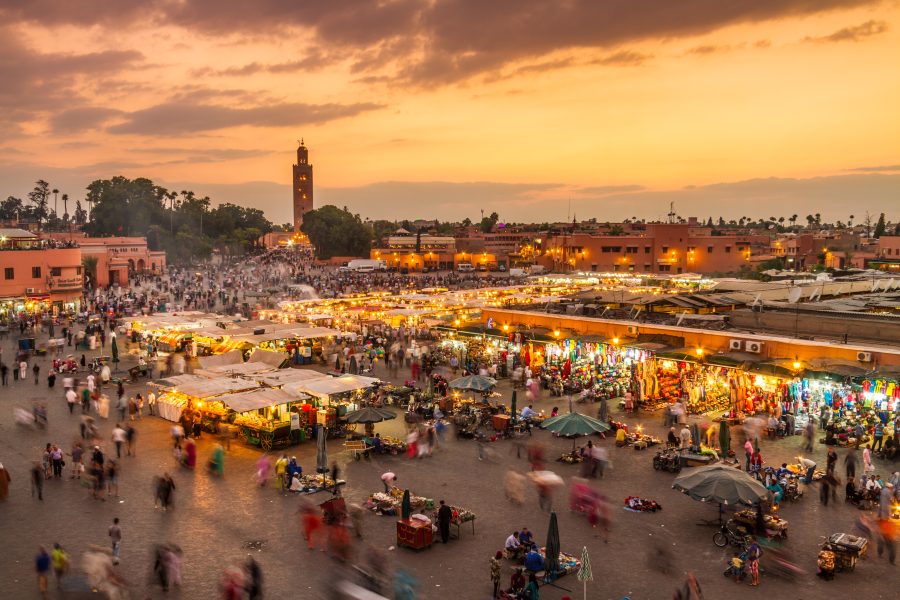
Marrakech continues to lead Morocco’s tourism industry, recording the highest number of tourist arrivals in the country year after year. As visitor numbers surge and demand for authentic cultural experiences grows, the city has entered a new era of tourism expansion.
But behind the economic benefits, many residents say they are paying the price. Rising housing costs, a higher cost of living, increasing pressure on natural resources, and concerns about preserving the city’s identity have become part of daily life for many Marrakchis.
According to Morocco’s Observatory of Tourism, Marrakech welcomed 4.86 million tourists in 2025, generating 13.6 million overnight stays in classified accommodation establishments. The city accounted for 29.8% of all overnight stays nationwide, with an average hotel occupancy rate of 73%.
Abdessadek Qadimi, a national tourist guide in Marrakech and former president of the Regional Association of Tourist Guides Marrakech-Safi, said several factors explain the city’s tourism success.
“Morocco’s location, its history, geography, beauty, its people, diplomacy, football, sports, and security all explain why international tourism is attracted to the country,” he said.
Qadimi believes Marrakech has experienced exceptional growth, particularly after the COVID-19 pandemic, with visitor numbers reaching levels that have begun to strain the city’s capacity.
Still, he says tourism has generated significant economic benefits.
“Businesses have grown and benefited greatly from this expansion, including local commerce and traditional craftsmanship,” he said. “Commercial activity and handicrafts are all part of this positive impact.”
However, the rapid growth has also created challenges for residents, particularly through rising living costs.
“There has been an incredible increase in rents, land prices and housing prices,” Qadimi said.
While tourism has fueled development, he argues, it has also reduced many residents’ purchasing power.
“Tourism creates development, but it makes people, particularly those with lower incomes, lose their ability to live the way they want with the money they have,” he said.
He added that life in Marrakech is becoming “increasingly complicated, sometimes even impossible,” with some residents struggling to remain in the city.
Tourism expert Zoubir Bouhoute agrees that tourism has become a major economic engine but argues that its success should not be measured solely by visitor numbers.
According to Bouhoute, tourism’s real value lies in its ability to generate added value across the local economy, benefiting hotels, transport companies and businesses connected to the visitor experience.
For residents, however, the impact is more mixed.
Alhyane Laila, who has lived in Marrakech for most of her life, said tourism has long affected access to local products, particularly traditional crafts.
“Honestly, having grown up here and spent most of my life in Marrakech, I never really had the opportunity to enjoy the city’s products, especially its crafts, because prices were often exaggerated,” she said.
She recalled that local customers were frequently overlooked in favor of tourists visiting the medina.
“That situation remained the same for many years. However, recently, especially since the pandemic, and perhaps because tourists have become more aware of scams and inflated prices, shopkeepers have started offering more reasonable prices,” she said.
Housing, however, remains one of Marrakech’s biggest challenges.
“The real estate market is a real disaster in Marrakech,” Laila said. “With the arrival of many foreign property owners, prices have become extremely high. Life has become very difficult for people who want to buy a home or simply rent an apartment. I feel the situation is only getting worse over time.”
Ismail Elmohsine, another Marrakech resident, believes tourism has improved services and boosted businesses but says residents have paid the price through rising living costs.
“It has especially benefited tourism-related services such as hotels, transport, commerce and entertainment that serve visitors from around the world,” he said. “Locals have paid the price because many vendors prioritize foreign customers.”
Despite these concerns, some residents believe Marrakech has managed to preserve its cultural identity.
For Laila, the city’s heritage remains its greatest attraction.
“I believe that no matter how many tourists come to Marrakech, the city will never lose its cultural identity because its history and traditions are exactly what attract visitors,” she said.
She even believes some tourists show greater appreciation for local traditions than certain residents.
“I would even go as far as saying that, in some cases, tourists preserve Marrakech’s identity more than the residents themselves. You see them wearing djellabas, traditional slippers and hats, tasting Moroccan and Marrakchi specialties—they truly appreciate the cultural experience Marrakech offers.”
Elmohsine shares a similar view.
“Marrakech has a unique blend of the old medina, which tourists love to explore, and modern districts such as Gueliz and Hivernage, where they find shopping malls and contemporary buildings,” he said. “Marrakech’s culture is deeply rooted in its people. Even if the surroundings change, the culture will remain intact.”
As visitor numbers continue to rise, some observers have questioned whether Marrakech is approaching overtourism.
Bouhoute disagrees.
“Overtourism isn’t about the number of visitors,” he said. “It’s about whether visitor numbers exceed a destination’s capacity to manage their economic, environmental and social impacts.”
“Marrakech is not suffering from overtourism,” he added. “The challenge is to manage tourism better.”
Rather than limiting arrivals, Bouhoute believes authorities should encourage tourists to explore destinations beyond the city’s historic center while investing in public transport, urban mobility and water management, particularly as Morocco prepares to co-host the 2030 FIFA World Cup.
Environmental sustainability, especially water consumption, is another growing concern.
“Water consumption has exceeded normal levels,” Qadimi said. “Tourism always leads to heavy use of natural resources.”
He believes the solution is not to slow tourism but to manage it more sustainably.
“It is necessary, urgent even, to put in place a strategy, not to develop tourism further, but to develop it intelligently.”








add your comment
Terms of publication : Not to offend the writer, people, sacred things, or attack religions or the divine self, and refrain from racist incitement and insults.