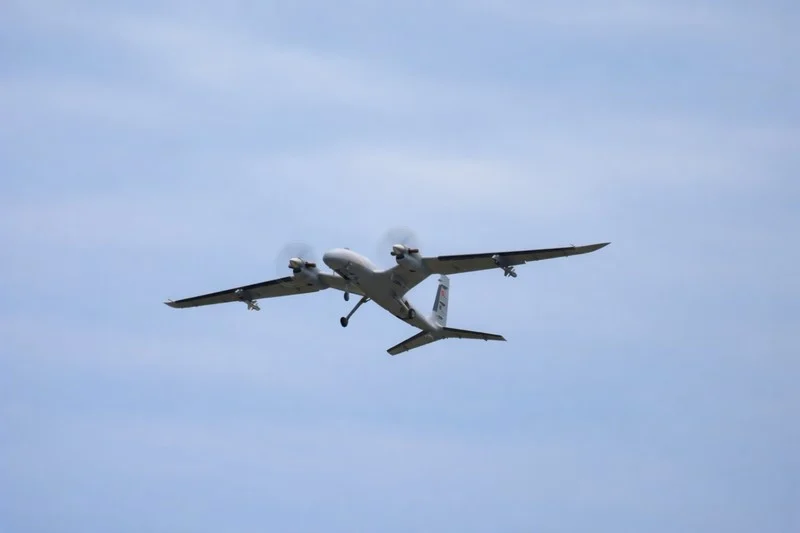
East of the berm, the war Polisario still describes as armed resistance is increasingly being fought under Moroccan drones, turning the Front’s old hit-and-run model into a high-risk strategy for the fighters and commanders sent into exposed zones.
That military reality is now shaping the political reading of Lahbib Mohamed Abdelaziz’s death. The son of former Polisario leader Mohamed Abdelaziz was not only a symbolic figure inside the movement, but also a commander associated with Polisario’s mobile desert warfare doctrine.
Since the collapse of the 1991 ceasefire in late 2020, Morocco has increasingly relied on armed and surveillance drones to monitor and strike targets east of the 2,700-kilometre sand berm that divides Moroccan-controlled territory from areas where Polisario operates.
Analysts at the International Crisis Group and other security researchers have noted that the proliferation of drone warfare has significantly reduced the effectiveness of Polisario’s traditional tactics, which depend on rapid movement by small units using four-wheel-drive vehicles to launch attacks and withdraw before a response can be mounted.
Mebrih Ahmed Mahmoud, a Sahrawi activist and former resident of the Tindouf refugee camps who now advocates internationally on human rights issues affecting camp residents, said Abdelaziz was “pushed toward his death,” arguing that Polisario’s leadership continues to send camp youth to the front under the label of “volunteering,” while “the reality imposes compulsory recruitment that cannot be refused.”
According to Mahmoud, Abdelaziz commanded a light special-forces unit that used rapid mobility to launch strikes before evacuating the area. But that model, once built on speed and desert space, has become increasingly vulnerable in zones watched by Moroccan drones.
He said sending a commander of Abdelaziz’s rank into an area “under the mercy of Moroccan drones” reflected a leadership decision to get rid of him, comparing the case to the death of El Ouali Mustapha Sayed, the founder and first secretary-general of the Polisario Front, who was killed in 1976 during a raid into Mauritanian territory that critics have long described as a reckless operation.
Mahmoud went further, claiming the move amounted to a political liquidation because Abdelaziz was “the only available option” to succeed Brahim Ghali. That allegation remains unproven, but it shows how the drone strike has moved beyond the battlefield into Polisario’s succession politics.
Mohamed El Ghaith Maa El Ainain, deputy head of the Moroccan Center for Parallel Diplomacy and Dialogue of Civilizations, said the Front’s continued military movements in the buffer zone are “absurd and irresponsible operations” that ignore the balance of power on the ground.
The buffer zone refers to the sparsely populated territory east of Morocco’s defensive berm, a fortified sand wall stretching roughly 2,700 kilometres from north to south across Western Sahara. Under the 1991 ceasefire arrangements, large parts of this area were subject to restrictions on military activity and monitored by the UN Mission for the Referendum in Western Sahara (MINURSO). Since hostilities resumed in 2020, however, the region has become the main theatre for Polisario operations and Moroccan drone surveillance, with key flashpoints including areas near Mahbes, Bir Lahlou, Tifariti and the Guerguerat crossing near the Mauritanian border.
He argued that Polisario is sending fighters into a battlefield it can no longer control, while the diplomatic track moves in the opposite direction after UN Security Council Resolution 2797 pushed negotiations around Morocco’s autonomy plan.






add your comment
Terms of publication : Not to offend the writer, people, sacred things, or attack religions or the divine self, and refrain from racist incitement and insults.