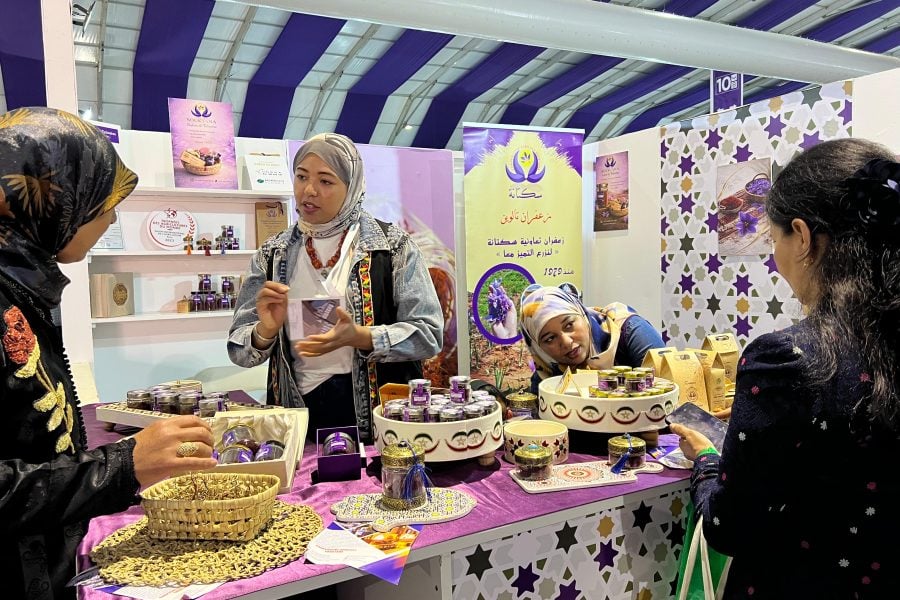
After years of drought and rising temperatures, recent rainfall is bringing relief to Morocco’s saffron growers, with some cooperatives expecting production to nearly double this season.
“We’ve seen an increase in recent years due to the return of rain after a long period of drought,” said Saida Abkhar, head of the Saktana Saffron Cooperative in Taliouine, speaking to Hespress English at the International Agriculture Show.
Production at her cooperative had dropped to around 180 kilograms but is now expected to rise significantly, she said.
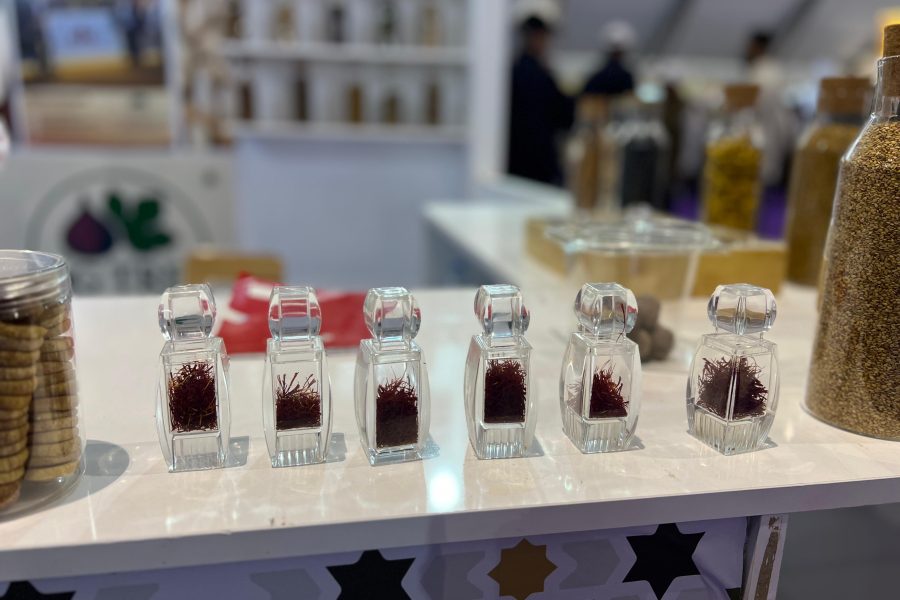
For growers in Taliouine, a town known for saffron cultivation for more than 400 years, the effects of climate change remain visible in both yields and harvest cycles.
Rising temperatures and irregular rainfall have delayed sprouting, disrupted flowering periods and shortened the harvest window.
“Saffron harvesting used to last about a month and a half, from Oct. 25 to early December, but now it lasts only about 20 days,” Abkhar said, noting that the shorter period makes the work more intense as crops mature all at once.
The Saktana cooperative once produced between 300 and 350 kilograms annually, but output fell to about 180 kilograms in recent years. Other cooperatives have lost up to two-thirds of their production, she added.
According to Omar Ibnossalem, head of the Moroccan Interprofessional Federation of Saffron, yields declined from 8 to 10 kilograms per hectare in 2010 to about 3 kilograms per hectare by 2020, before recovering slightly to around 3.7 to 3.8 kilograms per hectare today.
Under the Green Morocco Plan, the target was to reach 4.5 kilograms per hectare, but that goal has not been met, largely due to climate pressures, he said.
Regionally, most saffron production is concentrated in Souss-Massa (52%), followed by Draa-Tafilalet (40%), Béni Mellal-Khenifra (5%), Fes-Meknes (2%) and other regions (1%).
National production remained relatively stable between 2021 and 2024, according to federation data, rising from 7.4 tons in 2021 to 8.8 tons in 2023 before falling to 7.9 tons in 2024.
At the same time, cultivated land expanded from 1,900 hectares in 2021 to 2,400 hectares in 2024. Under the Green Generation strategy, Morocco aims to reach 3,000 hectares and production of 13.5 tons.
“Saffron is now being grown in new regions, including Tinghir, Béni Mellal-Azilal, areas around Meknes, Tetouan and Marrakech, in addition to expanded cultivation in Taliouine and Taznakht,” Ibnossalem said.
Recent rainfall has also raised expectations among growers.
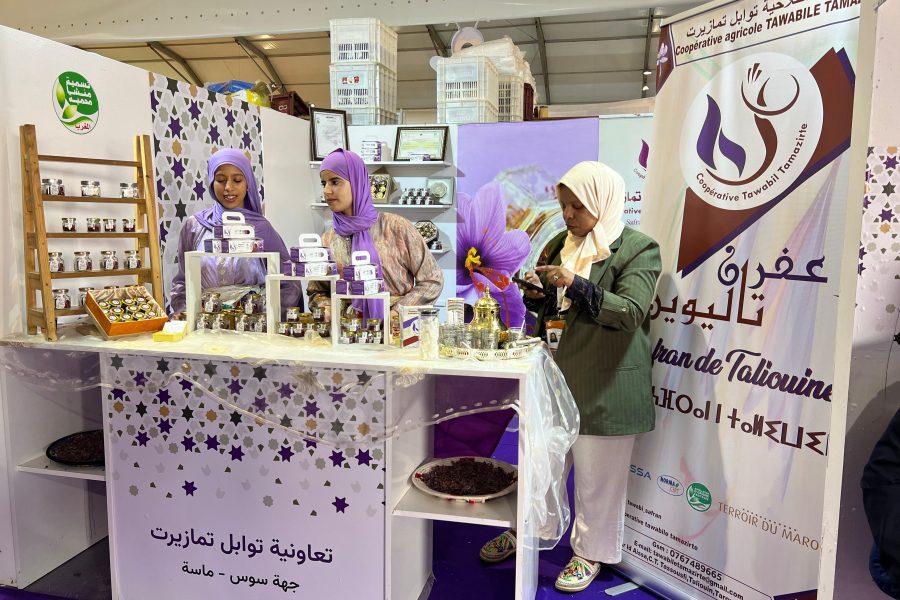
Kabira Arouka, head of the Tawabil Tamazirte Cooperative, founded in 2022 in Taliouine, said two hectares produced 15 kilograms this season. “We hope to produce between 20 and 30 kilograms next year,” she said.
Beyond rainfall, production gains have been supported by improved farming practices, including modern irrigation techniques, land expansion and a shift away from small mountain plots.
Despite being the world’s third-largest saffron producer, Morocco exports only about 5% of its output.
“The country has between 250 and 300 saffron cooperatives, but fewer than 10% are certified for export, meaning most production is sold domestically,” Ibnossalem said.
For the Saktana cooperative, exports account for just 2% of production, while Tawabil Tamazirte exports about 5%, mainly to Europe.
High production costs remain a major challenge. Moroccan saffron is largely produced using traditional methods without chemical inputs, pushing costs above 20,000 dirhams per kilogram before packaging and transport, according to industry professionals.
“Moroccan saffron is more expensive than that from Iran, Afghanistan and other countries, with prices reaching up to 70 dirhams per gram,” Ibnossalem said.
By comparison, Khadija Didi, head of a multinational food export company, said sourcing saffron from Iran or Afghanistan costs between 1.5 and 2.5 dirhams per gram.
“We typically import one to two tons from Iran and Afghanistan,” she said, citing significantly lower purchase prices.
The price gap has encouraged imports from countries such as Iran and Pakistan, creating competition for local producers despite sufficient domestic supply.
“This creates pressure on local producers,” Abkhar said, a concern echoed by Arouka, who pointed to the strong presence of imported saffron in the market.
To protect domestic production, Morocco has raised customs duties on saffron imports from 40% to 60%.
The measure aims to preserve the value of Taliouine saffron as a distinctive local product and prevent imported saffron from being rebranded and sold as Moroccan.
“This is good for us,” Abkhar said, adding that the move should help stabilize prices and support local producers.






add your comment
Terms of publication : Not to offend the writer, people, sacred things, or attack religions or the divine self, and refrain from racist incitement and insults.