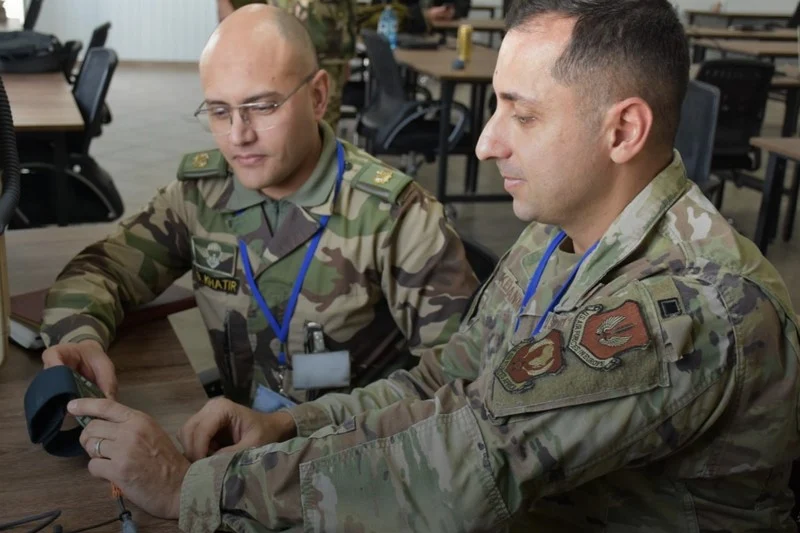
During a Feb. 3 test in Agadir, the U.S. military connected Morocco to Link-16 for the first time which means Moroccan forces can now see the same real-time battlefield picture as American and NATO units during joint operations, and communicate with them directly over a secure, encrypted network.
Link-16 is a military communications system that allows aircraft, warships, and ground forces to share real-time battlefield information such as enemy positions, radar tracks, targeting data, over an encrypted, jam-resistant network.
The system has been the standard tactical data link for NATO forces since the early 2000s and is used by more than 20 countries.
The simplest way to understand Link-16 is to think of it as a classified group chat for the battlefield, except instead of texts, it automatically shares the location of every friendly and enemy unit visible to any connected sensor on the network. Every pilot, ship commander, and ground operator sees the same picture at the same time.
The system was developed by the U.S. military in the 1970s and 1980s and operates in the ultra-high frequency band. It uses a technique called time-division multiple access, which allows dozens of users to transmit on the same frequency simultaneously without stepping on each other’s signals.
Data moves in short, encrypted bursts that are extremely difficult to intercept or jam, which is a critical feature in contested environments where enemies try to blind or disrupt communications.
The hardware that connects a military unit to the network is called a Multifunctional Information Distribution System terminal, or MIDS.
The hardware is roughly the size of a shoebox and plugs into fighter jets, naval destroyers, and ground command posts alike, feeding data into a shared operational picture that updates in near-real time.
Before systems like Link-16, a pilot who spotted an enemy aircraft had to radio that information manually, introducing delay, the risk of miscommunication, and the possibility of friendly fire. Link-16 eliminates that lag.
Link-16 pushes threat data automatically to every terminal on the network the moment a sensor picks it up.
Access is tightly controlled by the U.S. and NATO. Adding a partner country requires government-to-government approval, compatibility testing, and significant hardware investment.
Morocco cleared those hurdles after a $141.1 million U.S. arms sale of advanced Link-16 terminals was approved in 2022.
Morocco has held major non-NATO ally status with the United States since 2004, a designation that unlocks preferential access to American military technology and training.










add your comment
Terms of publication : Not to offend the writer, people, sacred things, or attack religions or the divine self, and refrain from racist incitement and insults.