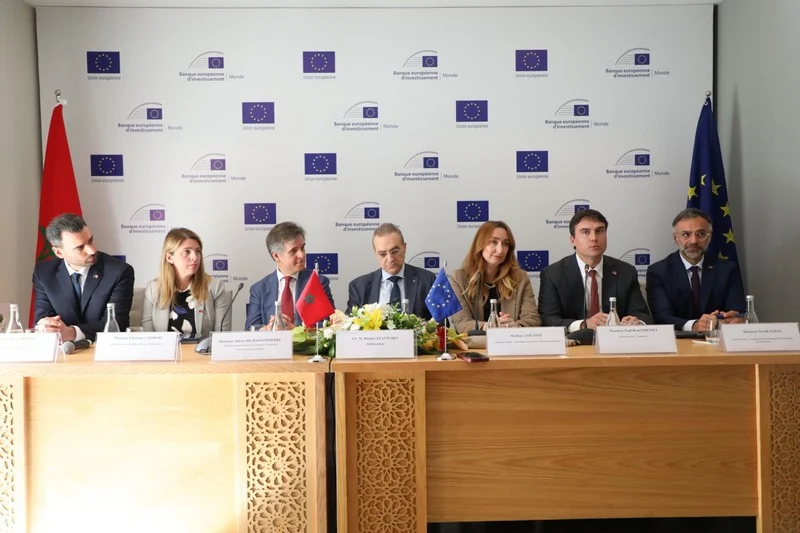
The European Union and Morocco on Tuesday outlined their strategic priorities for 2026, following a record year in bilateral trade and €740 million in financing from the European Investment Bank (EIB).
The announcement came during the EU delegation and EIB’s annual press briefing in Rabat, framed by the 15th EU-Morocco Association Council held in Brussels on Jan. 29 and the 30th anniversary of the EU-Morocco partnership agreement.
Officials pointed out the depth of the partnership, shared commitments to regional stability, sustainable development, and economic growth.
“The EU sees Morocco as a key partner in its southern neighborhood and one of the main beneficiaries of our funding in North Africa and the Middle East,” said Dimiter Tzantchev, EU ambassador to Morocco.
“Our cooperation is rooted in mutual trust and common interests. With the progress achieved during the last Association Council, the EU intends to continue deepening this partnership, notably through the New Mediterranean Pact and the Global Gateway initiative, supporting projects that deliver tangible benefits to citizens,” Tzantchev added.
In 2025, EU-Morocco cooperation reached MAD 3.5 billion Moroccan ($336 million) in technical and financial support.
The cooperation backed major reforms and infrastructural projects, including education, justice, human rights, public and private investments, youth programs, and environmental transition initiatives.
The EIB alone signed €740 million in financing last year, the highest level since 2012, supporting climate resilience, energy transition, water security, and post-earthquake reconstruction in Morocco’s Al Haouz region.
Adrien de Bassompierre, head of the EIB representation in Morocco, said the funding reflects a commitment to sustainable, inclusive development that directly benefits citizens.
Bilateral trade between Morocco and the EU also reached historic levels in 2024, hitting MAD 649 billion, five times the volume recorded when the partnership agreement took effect in 2000.
Morocco remains the EU’s top commercial partner in Africa, with more than two-thirds of Moroccan exports going to European markets, while over half of its imports come from the EU.
Morocco and the EU plan to expand cooperation in areas of strategic importance, including green transition, infrastructure, governance, and social development.







add your comment
Terms of publication : Not to offend the writer, people, sacred things, or attack religions or the divine self, and refrain from racist incitement and insults.