
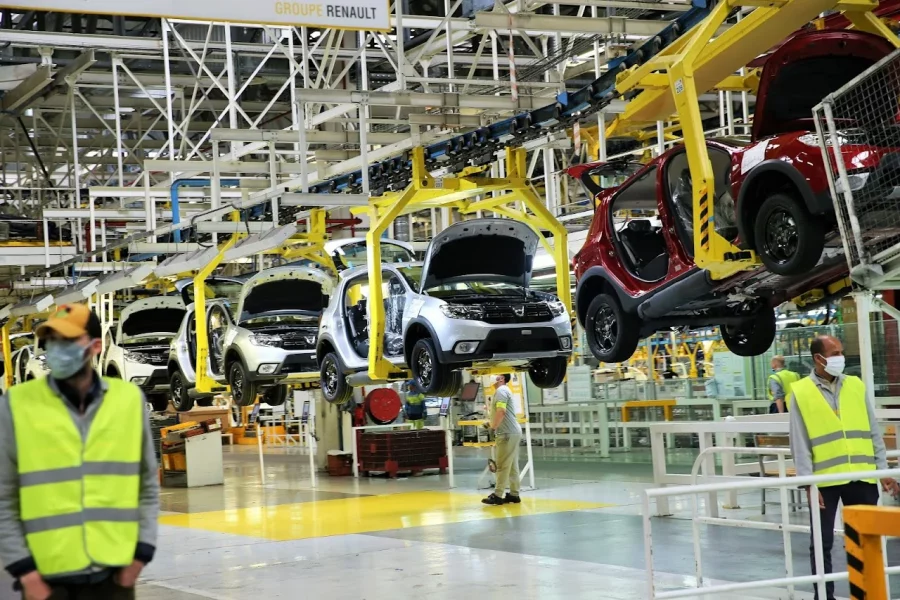
Chinese investment in Morocco’s automotive sector is undergoing a notable qualitative shift, moving beyond traditional manufacturing toward advanced fields such as automotive electronics, sensors and semiconductors, according to experts.
In recent months, several Chinese companies have announced plans to launch high-tech automotive projects in Morocco, signaling a departure from earlier investments that focused mainly on wiring systems and tires.
Jiangsu Yunyi Electric, a Chinese auto parts supplier, said earlier this week that its board approved the construction of a plant in Morocco dedicated to semiconductors and oxygen and nitrogen sensors, with an investment of about 609 million Moroccan dirhams ($60 million).
In August, Tianyouwei announced plans to establish a Moroccan subsidiary specializing in automotive electronics, with capital exceeding 683 million dirhams. The company said the unit would become one of its key overseas production facilities.
Earlier, in July, Bethel Automotive Safety Systems, which manufactures vehicle safety technologies, said it would invest $75 million to set up a wholly owned subsidiary in Morocco.
Skilled workforce and strategic position
Economist Rachid Sari said Morocco’s automotive industry has evolved significantly over the past two decades, allowing it to attract more sophisticated investments.
“Morocco’s automotive sector is no longer limited to wiring and basic components,” Sari said in a statement to Hespress AR. “It now includes advanced electronics and, increasingly, electric vehicle batteries.”
Sari attributed the shift to sustained investment in human capital, industrial infrastructure and a business-friendly environment that has helped draw foreign investors. He said Morocco’s local integration rate in automotive manufacturing has reached between 65% and 69%, with a target of 80% by 2030.
The country has also developed research laboratories linked to the automotive industry, including projects focused on electric vehicle batteries derived from phosphate, a resource in which Morocco holds global leadership, he added.
Sari said Chinese companies are increasingly viewing Morocco as a strategic platform to compete in U.S. and European markets, particularly in automotive electronics and batteries.
Electric transition and free trade access
Chinese political analyst Rong Huan, also known as Nader, said Morocco’s appeal lies in its skilled labor force, political stability and transition toward electric vehicle manufacturing.
He pointed to Morocco’s access to renewable energy, with about 40% of electricity generated from wind and solar, as well as its free trade agreements with the European Union and preferential access to the U.S. market.
“These factors make Morocco an important destination for Chinese automotive investment and a model for China-Africa economic cooperation,” Huan said.
Sari said Morocco is now attracting a diverse group of partners, including Chinese, Japanese and Brazilian firms, alongside traditional European investors. He added that the country is also pursuing a long-term goal of developing fully Moroccan automotive brands.





add your comment
Terms of publication : Not to offend the writer, people, sacred things, or attack religions or the divine self, and refrain from racist incitement and insults.