
A new study by the Carnegie Endowment for International Peace has shed light on the growing challenges faced by Amazigh nomadic herders from the Ait Khebbash community in Morocco’s Draa-Tafilalet region, citing climate change and social marginalization as major pressures deepening existing inequalities.
The report found that environmental shifts are not only creating new challenges but also intensifying longstanding disparities among the Ait Khebbash, a subgroup of the larger Ait Atta Amazigh confederation that traditionally lived between southeastern Morocco and western Algeria.
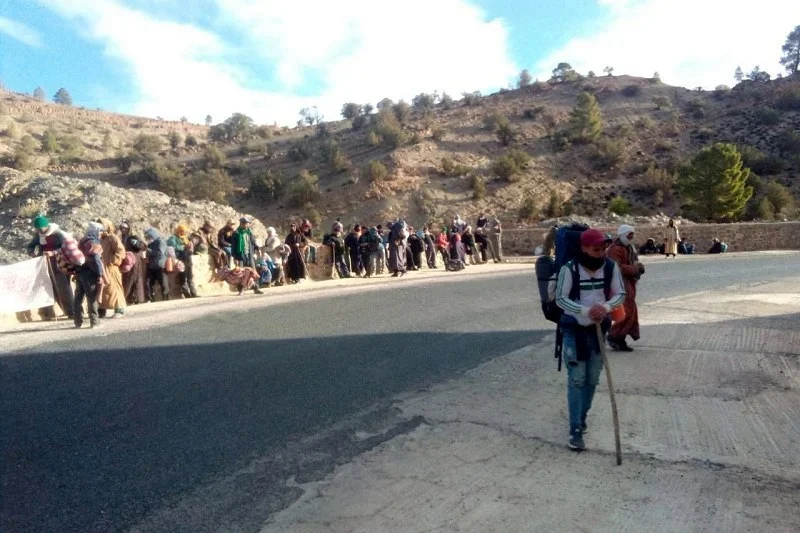
Over recent decades, many Ait Khebbash families have moved from nomadic herding along the Moroccan-Algerian border to settled life in villages such as Merzouga and Hassilabied, or to cities including Ouarzazate, Marrakesh, and abroad to France and Spain.
“Migration has been one of the key ways the Ait Khebbash have adapted to climate and economic pressures,” the study said, adding that the community has recently built a tourism industry from the ground up. This reflects both resilience and the limits of top-down climate policy frameworks that often overlook indigenous knowledge and informal adaptation strategies.
Decline of traditional herding
Historically, the Ait Khebbash’s livelihood centered on pastoralism. But recurring droughts, shrinking grazing lands, and water scarcity have rendered traditional herding less viable. Families increasingly sell livestock and migrate permanently to urban centers.
“Limited access to education, healthcare, and infrastructure in remote desert regions has also accelerated this shift,” the study said. Older generations recall a pastoral way of life, while younger members are drawn to urban aspirations shaped by education, tourism, and social media.
The report noted that restrictions on movement began as early as 1830, when French colonial authorities in Algeria curtailed cross-border grazing and caravan trade. These limits persisted after Moroccan and Algerian independence due to ongoing border tensions. Severe droughts during the 1970s through the 1990s further pushed families toward cities like Rissani and Erfoud.
Tourism as a form of adaptation
In recent years, many Ait Khebbash have turned to desert tourism, establishing seasonal camps near sand dunes and developing sustainable local businesses that create thousands of jobs. These projects, the report said, have helped maintain family cohesion and preserve cultural identity despite modernization pressures.
While the Draa-Tafilalet region hosts several major economic projects, it continues to struggle with weak infrastructure, limited public investment, and inadequate social services. Local NGOs have filled some gaps through oasis restoration and solar-powered well initiatives, but such efforts remain small in scale.
The report concluded that Draa-Tafilalet “illustrates the paradox of Morocco’s development trajectory: despite its mineral wealth and solar energy potential, it remains one of the country’s poorest regions, contributing less than 1% of national GDP.”
As climate impacts intensify, the study warned, relying solely on community resilience without structural support could deepen inequality and expose informal sectors to repeated shocks. It called for climate policies that move beyond centralized frameworks to actively engage marginalized communities as partners in adaptation, integrating participatory governance and stronger social protection measures.







add your comment
Terms of publication : Not to offend the writer, people, sacred things, or attack religions or the divine self, and refrain from racist incitement and insults.