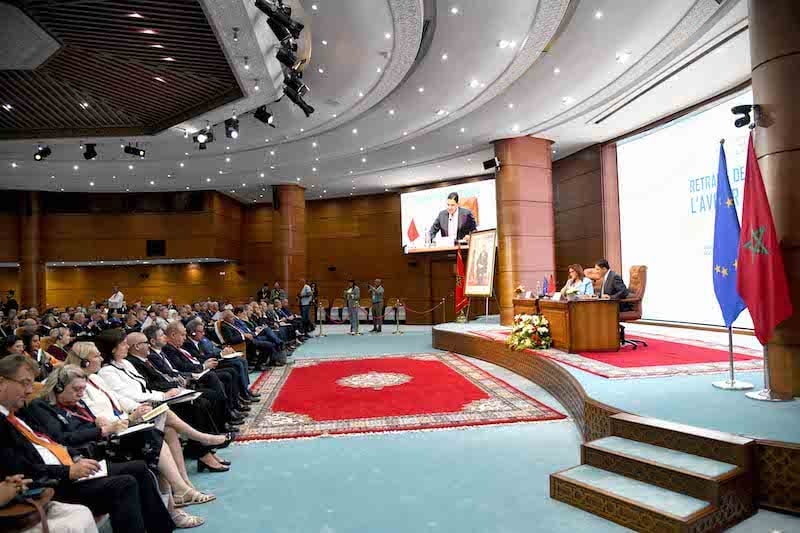
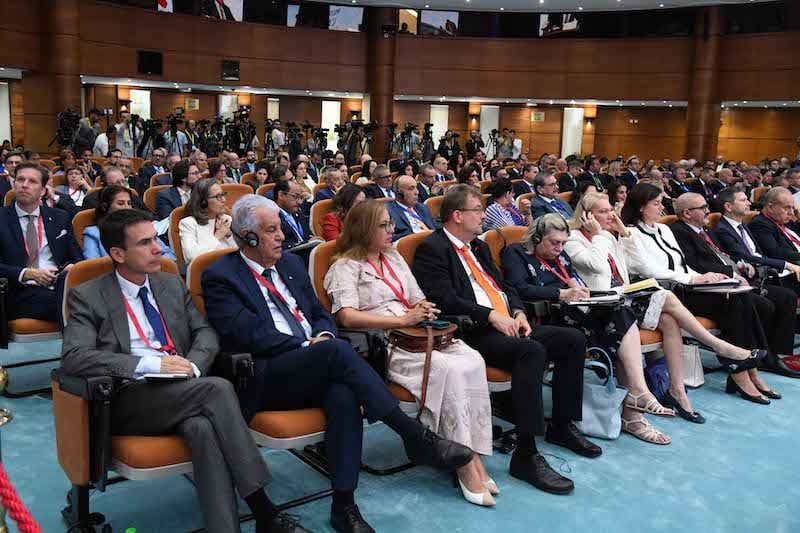
Morocco brought together senior officials, diplomats, and European leaders for a High-Level Retreat on the Future of Euro-Mediterranean Relations today, September 11, hosted by the Ministry of Foreign Affairs, African Cooperation and Moroccan Expatriates.
The gathering in Rabat aimed to reflect on 30 years of Euro-Mediterranean cooperation and chart a new course forward.
Foreign Minister Nasser Bourita called the retreat “an open and sincere space for dialogue,” saying the goal was to bring together not only political leaders but also economic players, academics, and civil society.
“The objective,” Bourita said, “is to talk openly about the challenges, ambitions, and constraints weighing on our partnership, in order to move forward together.”
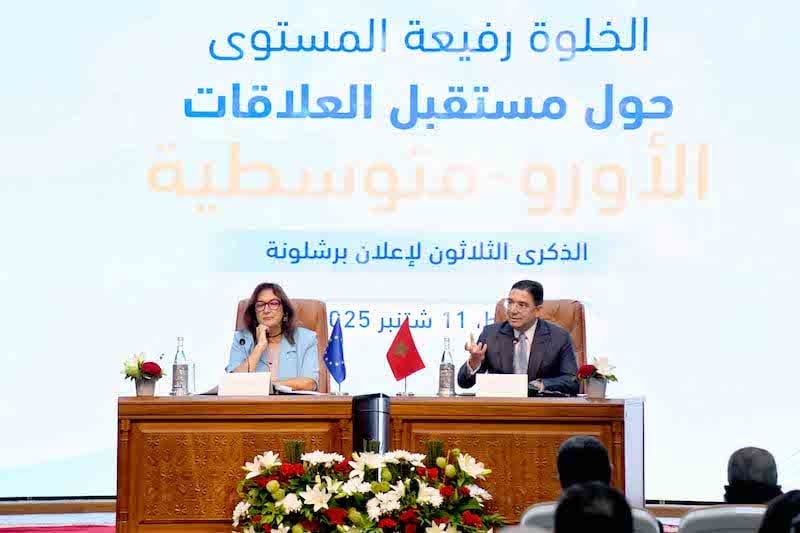
He said Morocco was a natural host for the debate, describing the country as a pioneer. “Morocco was the first to establish an advanced partnership with the EU, the first in the south to engage in a free-trade agreement, and the first to launch innovative cooperation in energy, mobility, security, and research,” Bourita said.
Morocco’s position, geographically between Europe and Africa and politically as a bridge-builder, made it the right place to rethink the Mediterranean’s future.
But Bourita also outlined five major shortcomings of the Euro-Mediterranean process so far: a lack of clear vision, asymmetry in priorities, growing geopolitical fragmentation, failure to respond to crises such as the pandemic and energy shocks, and a “deficit of legitimacy” that leaves citizens disconnected from the process.
“After more than 30 years of Euro-Mediterranean dialogue, we must recognize its limits,” Bourita said. For Europe, the focus has been stability and security. For the South, the priorities are development, mobility, and investment. “These priorities are not contradictory,” he added, “but they must be made complementary.”
He laid out three possible paths: a minimalist option of maintaining the status quo, a maximalist push for a true political community, or a pragmatic mix of ambition and realism.
Morocco, Bourita said, supports “an ambition that is transformation-driven, built pragmatically on concrete priorities.”
He identified three urgent areas for cooperation: securing strategic supplies in food and energy, connecting economies to build a real platform for co-production, and investing in human capital through education, mobility, and training.
Bourita added that the partnership must be rebuilt on four pillars: shared values, common security, deeper economic integration, and a knowledge-and-innovation space.
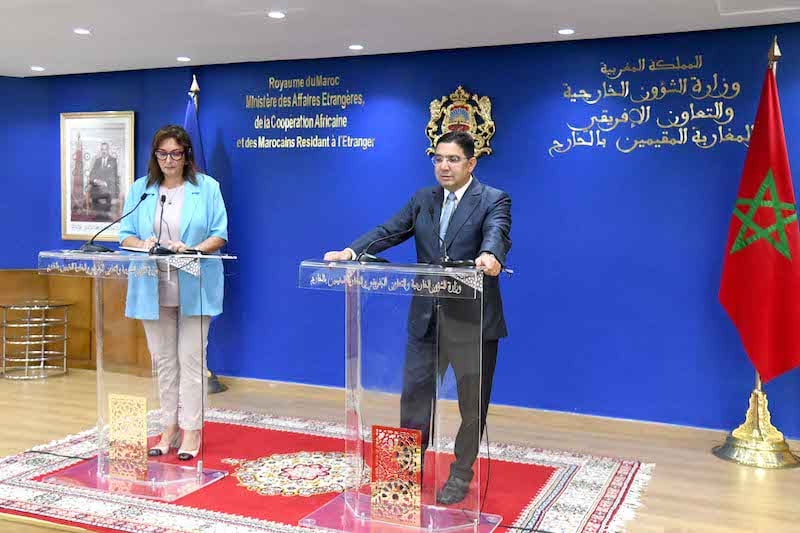
From the European side, Dubravka Suica, the European commissioner responsible for the Mediterranean, said Morocco is a key strategic partner for the European Union.
“Our partnership is unique and wide-ranging, and Morocco also serves as a vital bridge for cooperation with Africa,” Suica said.
She described the Mediterranean as “more than just a sea between continents. It has always been a cradle of culture, trade, and exchange.”
Suica praised Morocco’s leadership in organizing the retreat, noting its timing: “The timing of this retreat could not be better. In November we will celebrate the 30th anniversary of the Barcelona Declaration. That will be the occasion to reflect on our shared achievements and shortcomings, and to set the next milestone.”
She also confirmed that the EU is finalizing a New Pact for the Mediterranean, to be adopted in October and presented in November. This pact, Suica said, is “not just another strategy. It is a partnership of equals. It will be followed up and implemented through a joint action plan.”
The pact, she said, rests on three main pillars: putting people at the center—especially youth—through investment in education, training, jobs, cultural exchange, and sports; unlocking economic potential by diversifying supply chains, boosting intra-regional trade, and supporting innovation, with Morocco highlighted as a leader in renewables and digital connectivity; and strengthening cooperation on security, resilience, and migration management, including fighting trafficking, improving border systems, and working together on counterterrorism and organized crime.
Suica said the pact has been shaped by broad consultations involving governments, civil society, NGOs, and financial institutions, and that ideas raised at the Rabat retreat will feed into its final version.
She emphasized that the pact is meant to deliver concrete results and to show that the EU and the Southern Mediterranean are working as equals.


add your comment
Terms of publication : Not to offend the writer, people, sacred things, or attack religions or the divine self, and refrain from racist incitement and insults.