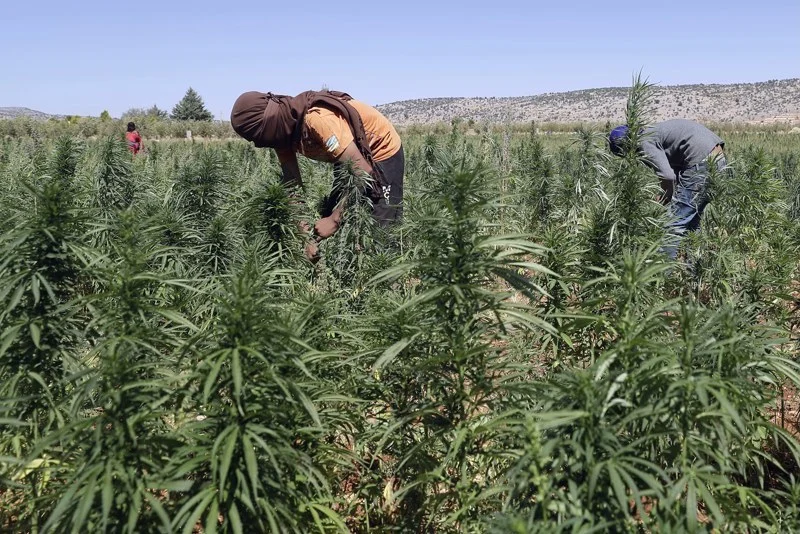
As the season for cultivating regulated cannabis nears its critical stage, Moroccan farmers in the legal cannabis-growing regions of Al Hoceima, Chefchaouen, and Taounate are preparing to receive imported cannabis seeds—locally dubbed “romia”—from licensed investors and suppliers.
The crucial phase of seedling preparation is set to start this week and must be completed before the end of April to ensure successful growth and optimal yields.
Industry sources told Hespress AR that the process of germinating and preparing the imported seeds will take approximately two weeks. Delays beyond April 20 would significantly reduce the effectiveness of this phase, potentially impacting the quality and productivity of the harvest.
Prices for the imported seeds are expected to remain stable compared to last year. “The cost is projected to hover around 150 dirhams per kilogram, or roughly 4 dirhams per seed,” said Khaled Ahrchi, a licensed seed supplier and president of the Rif BioKal cooperative in Al Hoceima.
He emphasized that investors are honoring agreements made with farmer cooperatives as part of Morocco’s broader legalization and regulation framework for cannabis cultivation.
Ahrchi added that these seeds are highly productive, with each plant yielding between 3.5 and 4 kilograms of cannabis, compared to under one kilogram from the traditional “baldiya” variety.
However, not everyone shares the same assessment. Farid Ahithour, head of the Tizi Ifri Coop cooperative in Sanhaja of the Rif region, offered a more cautious view. While confirming that imported seeds are being distributed to cooperatives this week, he stressed the urgency of beginning the germination process before April 20.
He also pointed out the high costs associated with this process, estimating that the total cost of preparing a single seedling reaches up to 46 dirhams—factoring in trays, fertilizers, and tractor use.
Ahithour disagrees with claims about superior yields, stating that each imported seed produces a maximum of 700 grams, which makes it less cost-effective than the local variety. “There’s a growing trend among farmers to return to cultivating the local strain,” he said, noting that traditional cannabis (baldiya) may occupy larger areas of cultivation this year due to its lower cost and familiarity.
As Morocco advances in its experiment with legal cannabis cultivation, these early-season dynamics underscore the challenges of balancing regulation, cost, and yield for both farmers and investors navigating the still-nascent industry.



add your comment
Terms of publication : Not to offend the writer, people, sacred things, or attack religions or the divine self, and refrain from racist incitement and insults.