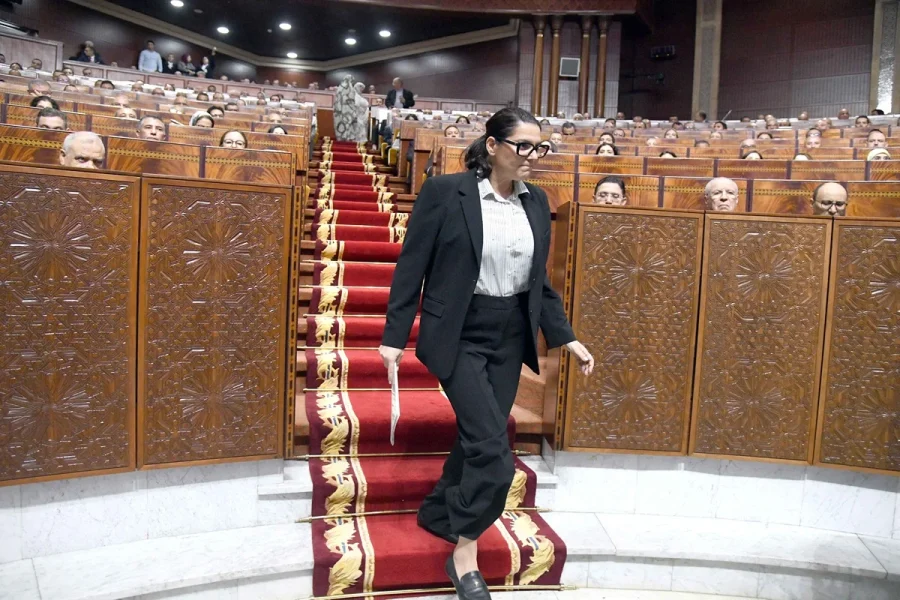
Morocco’s next government, led by Fatima Zahra Mansouri, is unlikely to break sharply with the country’s existing public policy direction, but its performance will depend on whether it can change priorities and deliver more tangible results, according to a policy paper by the Moroccan Institute for Policy Analysis.
In the paper, researcher in public law and political science Abdelrafie Zaanoun argues that the next administration will operate under commitments that narrow its room for maneuver without eliminating the possibility of policy changes.
The government’s added value will be measured against four key challenges: turning investments linked to the 2030 FIFA World Cup into a driver of development, linking investment to job creation, ensuring social protection produces measurable results, and improving public services in underserved areas.
Continuity with room for adjustment
Much of the program of Mansouri’s Authenticity and Modernity Party (PAM) builds on policies already underway, the paper says.
In water security, these include additional desalination plants, more water-efficient irrigation and tighter regulation of groundwater use.
In social protection, the party proposes increasing financial assistance, targeting beneficiaries according to actual household income and completing the expansion of health coverage.
The paper characterizes these measures as an expansion of existing systems rather than a fundamental shift in policy. It argues that meaningful change would require health care reforms that ensure people can access treatment in practice and social assistance that is linked to pathways toward economic integration.
Potential changes in purchasing power and employment
Zaanoun, a visiting professor at the Faculty of Legal, Economic and Social Sciences in Tetouan, identifies purchasing power and youth employment as areas where the government could make more substantial adjustments.
One proposal would prioritize domestic market supply when allocating agricultural support and establish regional distribution companies. This could reshape the relationship between domestic consumption and production for export, although its impact would depend on how existing production and marketing interests respond.
In employment policy, the proposed approach would link part of training funding to actual job placement and support the cost of hiring first-time workers. This would shift the emphasis from financing programs to assessing their results.
However, the paper warns that both approaches face obstacles, including established interests in production and distribution chains and the private sector’s ability to create stable jobs.
Five factors will shape the government’s ability to implement its commitments: available financing, overlapping decision-making powers and institutional responsibilities, political will, power dynamics within the governing majority, and the separation of public decision-making from private economic interests.
The paper also points to fiscal constraints. It cites International Monetary Fund projections for economic growth of 4.4% in 2026, alongside a deficit target of around 3% and public debt approaching 63% by 2029.
A crowded political and economic agenda
The government will face a demanding agenda, including the implementation of Morocco’s autonomy plan following U.N. Security Council Resolution 2797 and preparations for the 2030 World Cup.
The paper highlights several structural pressures, including energy dependence of 87.5%, intermediaries accounting for 34% of final prices, around 3.5 million insured people whose health coverage rights are inactive, and households paying nearly half of total health expenditure.
PAM estimates the cost of its program at 350 billion dirhams over five years. It is banking on annual economic growth of 5% to reduce unemployment from 10.8% to 7% by 2031.
The Independence Party, meanwhile, has proposed initiatives including “My Experience” and a program to develop 100,000 digital talents.
The paper concludes that the two parties differ mainly in their priorities and implementation tools rather than their underlying policy frameworks. It also notes that institutional reform and stronger accountability receive little attention in either party’s program.
Affordability will be a central test of the next government’s performance.
During the election campaign, Budget Minister Fouzi Lekjaa said around 280 billion dirhams had been mobilized to support purchasing power during the outgoing government’s term, while acknowledging that the impact had remained limited.
The paper estimates that agricultural subsidies and tax exemptions cost 76 billion dirhams without producing a comparable decline in prices. It warns that regional distribution companies will need to avoid becoming another layer of intermediaries.
Regional disparities remain a challenge
Three regions account for around 58.4% of Morocco’s gross domestic product, according to the paper, underscoring the concentration of economic activity.
In rural areas, access to drinking water stands at 54.6%, while sanitation coverage reaches just 9.6%.
A new generation of territorial development programs, worth approximately 210 billion dirhams over eight years, is expected to provide a framework for directing resources toward areas with the greatest needs.
Ultimately, Zaanoun argues, the government’s legacy should not be judged by the number of new projects it launches, but by its ability to redirect subsidy policies, reorganize distribution and allocate resources according to measurable needs.





add your comment
Terms of publication : Not to offend the writer, people, sacred things, or attack religions or the divine self, and refrain from racist incitement and insults.