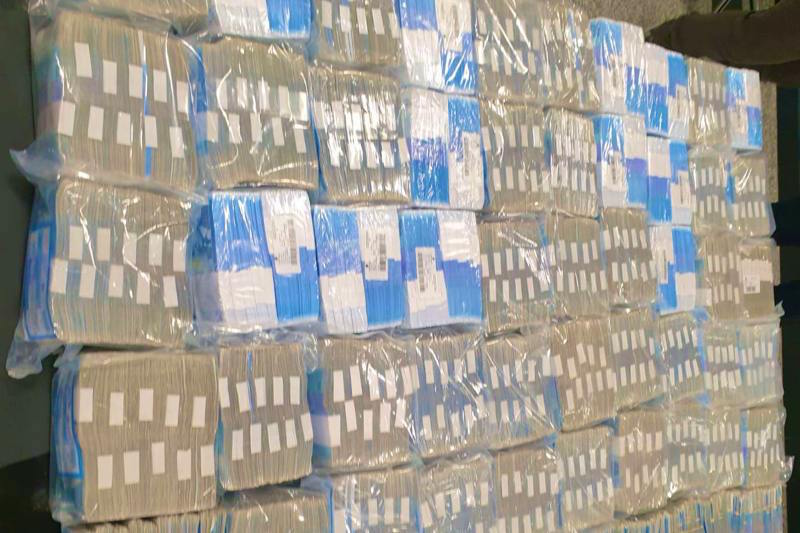
Moroccan financial intelligence authorities have escalated their investigation into an international money laundering network linked to drug trafficking. The scheme, uncovered through coordinated efforts between the National Financial Intelligence Authority and the General Directorate of Customs and Indirect Taxes, involves smuggling second-hand mobile phones and laptops from Spain and Italy into Morocco.
Preliminary findings reveal that the illicit goods were brought into the country in small, scattered shipments and stored in warehouses in working-class neighborhoods. The items were then distributed by an English teacher to retail traders in well-known markets, including Casablanca’s Derb Ghallef.
Investigators have traced large quantities of high-end electronic devices being funneled to small and medium-sized businesses in Casablanca using falsified invoices.
A financial audit of the distributor’s transactions revealed that he used bank accounts under his wife’s and mother’s names to collect payments, which were then withdrawn in installments before being handed over in cash to unidentified individuals in Tangier, Kenitra, and Casablanca. Authorities suspect that his teaching profession served as a front for illicit trade, which extended beyond electronics to include used cars.
Customs officials have provided financial intelligence officers with detailed records of seized phone and laptop shipments, revealing their suspected role in money laundering. Enhanced cooperation with counterparts in Spain and Italy aims to uncover additional links to traffickers operating within Morocco.
Officials noted that the distributor under investigation amassed over 3 million dirhams ($300,000) per month through these operations, with potential for higher figures as more valuable goods, such as professional cameras, were introduced into the market.
The National Financial Intelligence Authority has forwarded 71 cases related to money laundering and terrorist financing to prosecutors in Rabat, Casablanca, Fez, and Marrakech.
The number of cases referred to the judiciary surged by 31.48% between 2022 and 2023, with 38% involving fraud and falsification of bank statements, payment instruments, or other documents. Another 38% pertained to scams and financial fraud, while emerging trends included money laundering through online gambling, pyramid schemes, and cryptocurrencies.
Further investigations have uncovered luxury assets linked to the main distributor, including real estate and high-end vehicles, which appear inconsistent with his salary as an English teacher.
Authorities also discovered that he transferred newly acquired properties outside Casablanca to his wife and son. Border records indicate frequent short-term trips to Spain, suggesting possible coordination with international associates.
As authorities intensify their crackdown, efforts continue to dismantle the network and trace its financial operations both inside and outside Morocco.




add your comment
Terms of publication : Not to offend the writer, people, sacred things, or attack religions or the divine self, and refrain from racist incitement and insults.