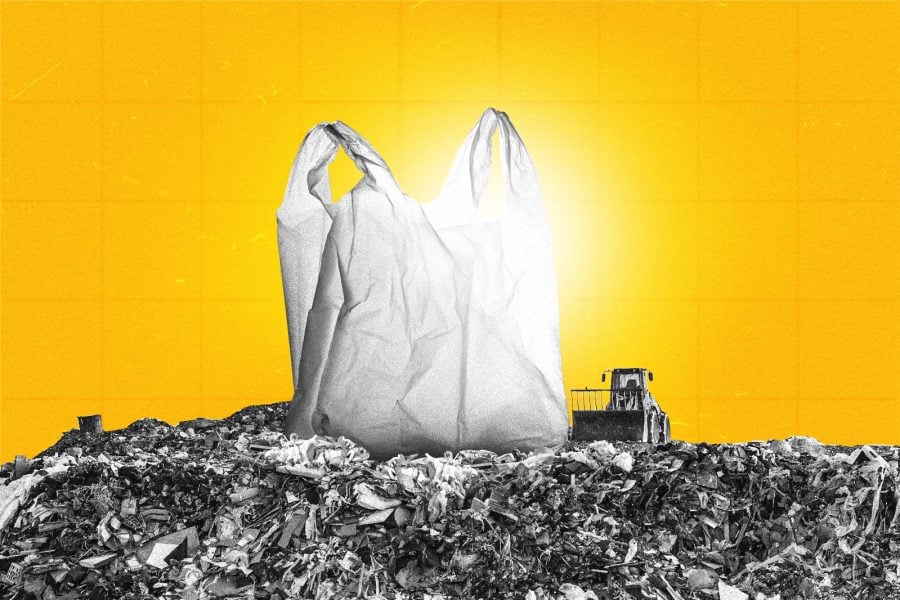
Powered by stolen electricity, black-market polyethylene, and misappropriated government funds, illegal plastic factories in the rural outskirts of metropolitan cities are quietly expanding, turning former agricultural buildings into hubs of unregulated production that worsen the country’s plastic pollution problem.
Their expansion has so much as doubled plastic bag production in Morocco, based on observations and assessments of environmentalists, who see that Morocco’s efforts to prevent the spread of plastic bags have flatlined, Ayoub Krir, an environmental researcher and the president of the Oxygen Association for Environment and Health told Hespress English.
The exact number and reach of these factories remain unclear, but one thing is certain: their modus operandi is always the same.
“Operators rent spaces licensed for agricultural purposes on the outskirts of Casablanca,” a source close to the manufacturers told Hespress EN, and “ then convert them into informal warehouses where they secretly manufacture plastic bags, often sourcing polyethylene from the black market.”
These areas, equipped with large electrical transformers intended for legitimate agricultural operations, are frequently misused by some unscrupulous farmers who lease them to individuals engaged in illegal plastic bag production.
Previous investigations revealed, that “operators of illegal plastic bag factories in Mediouna were stealing electricity and misusing agricultural subsidies intended for refrigeration units storing farm products to power their operations.”
These warehouses even included underground storage spaces built to install five-meter-tall production machines.
In December 2024 alone, nearly 10 tons of illegally manufactured plastic bags were seized in two separate crackdowns by authorities in Mediouna Province, a rural area on the outskirts of Casablanca.
The seizure is only a fraction of the plastic bags produced by the numerous clandestine factories operating illegally on the outskirts of Casablanca, despite the clear mandate of Law N°77.15, which came into force on July 1, 2016, outlawing the production, import, export, commercialization, and use of plastic bags.
While the Ministry of Industry told Hespress EN that monitoring clandestine factories is not directly within its purview, it has spent considerable resources and funds to track and control black-market polyethylene, the source material used to produce plastic bags.
The Ministry told Hespress EN that its regional offices have conducted over 7,700 inspections to monitor polyethylene flows and prevent illegal diversion, with violators facing permanent import bans.
It also announced a new information system that will require companies to electronically declare activity data, enabling automated inspections and helping address material flow irregularities
“Our regional offices have formed specialized teams to carry out regular inspections, leading to the seizure of over 742 tons of banned plastic bags at border crossings and more than 3,000 tons in commerce and industry since the law’s enactment in 2016.”
These efforts are a continuation of the 2016 ban which also saw the judiciary impose heavy penalties for the possession and commercialization of plastic bags:
- Article 10.1: Anyone, whether an individual or a company, found illegally possessing raw plastic materials, rolls, or recycled materials for manufacturing banned plastic bags can face fines ranging from 200,000 to 1,000,000 MAD.
- Article 11.4: Failure to declare business activities can result in fines of 100,000 to 200,000 MAD.
- Additional sanctions: Offending units may be immediately shut down by local authorities, with legal proceedings initiated in accordance with Law 77-15, as amended by Law 57-18.
The project initially showed massive success with a significant increase in demand for alternative products, and the supply chain quickly adapting.
Statistically, production of non-woven bags surged from 1.8 to 3.2 billion units, while woven bag production climbed from 1 to 1.2 billion units during this period.
As a result, two years after the adoption of Law 77-15, plastic bags have been permanently banned in medium and large retail outlets and convenience stores, with the same source noting that these establishments have shifted to practical alternatives calibrated to meet their specific needs.
But for Driss Sentissi, head of the Popular Movement’s Party, the project lacked strategic planning.
“Consumers in souks still prefer plastic bags because they’re free, while other types often come at a cost.”
To tackle this, he stressed “the need to offer affordable alternatives for lower-income groups, alongside tightening monitoring efforts to ensure greater compliance.”
Ayoub Krir, an environmental researcher says that while these clandestine factories are a major force behind the plastic bag resurgence, he rejects the notion that “such operations could persist without the awareness of relevant authorities.”
He attributes the resurgence of plastic bags to what he called “Morocco’s mismanagement of the issue and the authorities’ failure to take decisive, firm action against those fueling this environmental crisis.”
Salwa Bardai, a PJD parliamentarian, echoed this in a statement to Hespress EN. “When the law was first enacted, monitoring was strict, and plastic bags were used discreetly, almost cautiously. But now, they’re being used openly and without hesitation in countless stores.”
She says “Plastic alternatives should not make plastic bags seem like the more convenient or superior option,” suggesting that “the lack of widely available alternatives may be why enforcement and monitoring efforts have not been as effective as expected.”
For Sentissi, another key point is “to find alternative solutions for plastic producers and implement stricter measures against smuggled plastic products.”
“Plastic manufacturers requested alternative solutions to avoid bankruptcy and layoffs,” explaining that “the failure to provide these solutions likely contributed to the continuation of the industry, possibly in an unregulated and illegal manner.”
Meanwhile, the Industry Ministry’s website indicated that the government has allocated 200 million MAD to fund the conversion and support operators affected by Law No. 77.15.
The conversion support program helped 25 out of 29 eligible companies, according to old data, with a total of 65.4 million MAD in awards. This not only helped retain affected jobs but also created 600 new positions.
19 other companies received support from the Imtiaz Program for producing alternative solutions, with a total allocation of 52.4 million MAD.


add your comment
Terms of publication : Not to offend the writer, people, sacred things, or attack religions or the divine self, and refrain from racist incitement and insults.