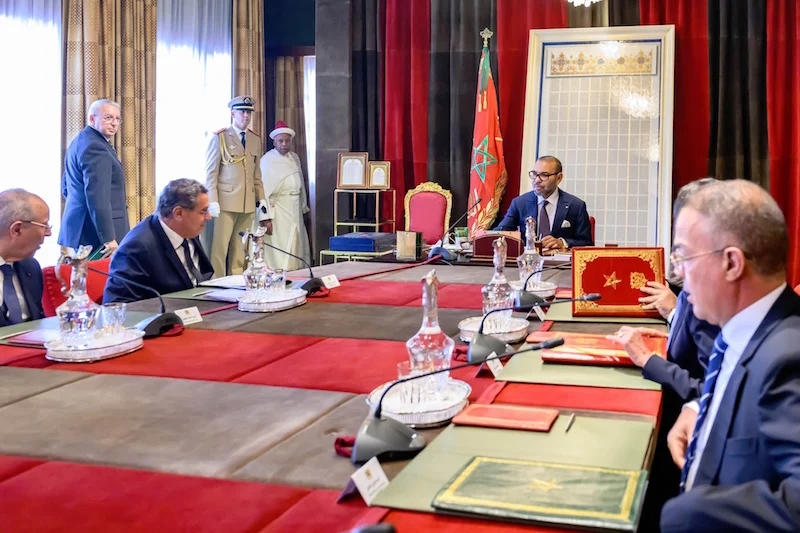
On Friday, King Mohammed VI presided over a Council of Ministers meeting at the Royal Palace in Rabat, devoted to examining the general guidelines of the Finance Bill for 2025.
The Council of Ministers also approved draft decrees in the military field, as well as several international agreements and a series of senior appointments, according to a press release issued by the Royal Palace spokesman. Here is the translation:
“His Majesty King Mohammed VI, may God assist Him, presided over a Council of Ministers this Friday, October 18, 2024, corresponding to 14 Rabii II 1446 H, at the Royal Palace in Rabat, devoted to examining the general guidelines of the Finance Bill for the year 2025 and approving draft decrees relating to the military field, as well as several international agreements and a series of appointments to senior positions.
At the start of the Council’s proceedings, and in accordance with the provisions of article 49 of the Constitution, the Minister of the Economy and Finance presented the King with an outline of the Finance Bill for 2025.
The Minister underlined that the preparation of this project takes place in a difficult international context, marked by continuing geopolitical tensions and the accentuation of climatic crises. Despite this situation, Morocco has been able, under the far-sighted leadership of the King, to pursue economic and social reforms, while maintaining a sustainable macro-economic balance, with growth set to reach 3.3% in 2024.
The Minister added that the Finance Bill is structured around four priorities, each acting as a lever to consolidate social cohesion, immunize economic sovereignty and create the conditions necessary for future generations to flourish. The first priority is to continue strengthening the pillars of the social State, notably through smooth and efficient implementation of the project to generalize social protection. After the introduction of compulsory basic health insurance, the direct social assistance scheme will be completed, with some 4 million households now benefiting from this scheme, in tandem with the ongoing reform of the healthcare system.
The implementation of the roadmap for the reform of the education system will also be pursued, as will support for social dialogue, in addition to the completion of the various worksites under the general reconstruction and rehabilitation program for areas hit by the Al Haouz earthquake, and the rehabilitation of areas affected by flooding in the south-east of the Kingdom.
Secondly: consolidating the investment and job creation dynamic, in line with the High Royal Instructions, by stimulating private investment and implementing the Investment Charter, with particular emphasis on speeding up the approval process for investment projects and continuously improving the business climate.
We will also support public investment and pursue the structuring projects currently underway, notably the Generation Green strategy, projects linked to the green hydrogen sector, the transition to clean energies and the roadmap for the tourism sector, while ensuring that the management of water resources is a top priority, accelerating the implementation of the national drinking water supply and irrigation program, and giving prime importance to the implementation of mega-projects linked to preparations for hosting the 2030 World Cup.
At the same time, we will be implementing a concrete roadmap for employment promotion, based on an integrated, multi-dimensional approach aimed at stimulating the investment dynamic, particularly in sectors with a high job creation impact, while strengthening support for very small, small and medium-sized enterprises and optimizing the impact of active employment programs, in addition to mitigating the effects of drought on employment in rural areas.
Third: continued implementation of structural reforms, led by the reform of the justice system, through the completion of legislative and regulatory frameworks related to the implementation of this reform, continued efforts to generalize family courts and modernize the judicial administration as well as its digital transformation.
We will also be pursuing the implementation of advanced regionalization and the reform of public establishments and companies, notably through the implementation of the strategic orientations of the State’s shareholding policy.
It is also a question of working to reform the organic law relating to the Finance Act and continuing to implement the law relating to tax reform. Fourth: preserving the sustainability of public finances, by putting in place the necessary measures to ensure the gradual restoration of financial equilibrium and the necessary financing of planned projects, while taking care to reduce the budget deficit and reconstitute the financial margins needed to cope with future risks and crises.
The Minister emphasized that the general guidelines of the Finance Bill are aimed at maximizing the impact of the strategies implemented on our country’s development process, and achieving a substantial economic rebound, with a growth rate of 4.6% by 2025 and an inflation rate limited to 2%. Following the Council of Ministers’ approval of the general guidelines of the 2025 Finance Bill, seven draft decrees relating to the military sector were adopted.
These are draft decrees amending the decrees laying down the conditions for applying the provisions of the special status of Auxiliary Forces personnel, the special status of Civil Protection personnel and doctors working for the General Directorate of Civil Protection and its external services, the salaries of military personnel on monthly pay in the Royal Armed Forces, and the system of pay, food and travel expenses for military personnel on special progressive pay in the FAR.
These four projects, which are part of the special attention paid by the King, Supreme Commander and Chief of the General Staff of the FAR, to promoting the social and material conditions of these Forces, aim to increase the salaries of members of the Auxiliary Forces, the Civil Protection, the Royal Armed Forces and the Royal Gendarmerie, in line with the increases decided for all civil servants as part of the social dialogue.
The other three draft decrees relate to the use of cloud service providers by entities or infrastructures of vital importance with sensitive information systems or sensitive data, as well as to the organization and operation of Royal Armed Forces hospital units, and to the dispatch allowance for certain military personnel.
As part of the drive to strengthen relations between Morocco and a number of sisterly and friendly countries, consolidate its position and implement its commitments at continental and international level, the Council of Ministers adopted nineteen international agreements, sixteen of which are bilateral and three multilateral.
The bilateral agreements cover the promotion and reciprocal protection of investments, the strengthening of cooperation in the fields of justice, maritime fishing, tourism, mutual administrative assistance in customs matters, international road transport and air services.
Thirteen of these bilateral international agreements are scheduled with six African countries as part of the Joint Commissions held in Dakhla, Moroccan Sahara.
The multilateral agreements concern the establishment of the permanent headquarters of the Pan-African Institute for Development (IPD) in Dakhla, the facilities and advantages of the North Africa Regional Office and the National Office of the Agence Universitaire de la Francophonie in Morocco, and the agreement relating to the United Nations Convention on the Law of the Sea and concerning the conservation and sustainable use of marine biological diversity in areas beyond national jurisdiction.




add your comment
Terms of publication : Not to offend the writer, people, sacred things, or attack religions or the divine self, and refrain from racist incitement and insults.