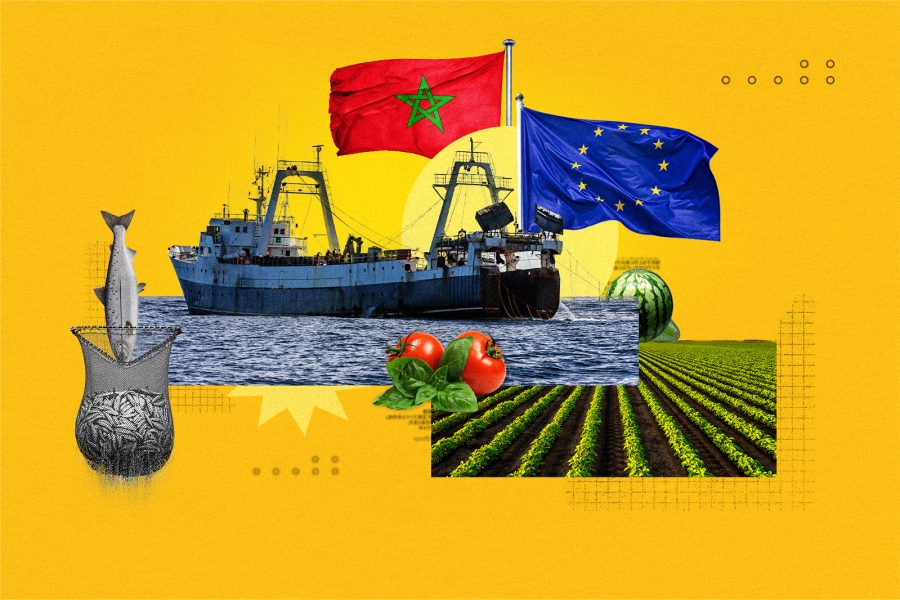
The European Court of Justice’s decision to annul agricultural and fisheries trade with Morocco has left a trade gap that both the EU and Morocco are scrambling to fill.
EU member states are legally obligated to follow the decisions of the European Court of Justice (ECJ) and the rules set by the European Union. This means they can’t make trade deals with Morocco that go against EU law or the ECJ’s rulings.
With this dilemma, Morocco appears to have two options: comply with the court’s decision and label products from the southern region as “Western Sahara,” or seek alternative trade partners to fill the void left by the EU agreements.
Kamal Sabri, head of Morocco’s North Atlantic Fisheries Chamber, said that labeling tomatoes and melons from the Sahara as such is unacceptable, as it undermines Morocco’s sovereignty.
“We won’t compromise our national sovereignty for economic gains. Any agreement must acknowledge that Western Sahara is 100% Moroccan territory,” he said.
Some experts believe the annulment of the agricultural and fisheries agreements could trigger a diplomatic and economic crisis between Morocco and the EU, as Morocco is unlikely to tolerate an agreement that excludes its southern territory.
In an interview with Hespress EN, Mohamed Jedri, an economist, reaffirmed this view, stating that the fisheries agreement, which offers Morocco €208 million in EU aid over four years, unfairly exploits Morocco’s natural resources at a low cost and has become a means of exerting pressure on Morocco.
The EU aid is considered relatively small, especially since Morocco’s seafood exports reached 778,000 tons in 2021, valued at $2.5 billion.
The expert added that Morocco can easily find more buyers for its agriculture and fish products, both domestically and internationally.
“To do this, we must diversify our trade partners. Unlike agricultural agreements, fishing agreements are easier to end as they revolve around the right to fish, not complex trade relationships,” the economist said.
Morocco already has fishing agreements with countries like Russia and Japan and free trade agreements with Egypt, Jordan, Tunisia, Turkey, and the United States of America. Britain, North America, China, and India are all potential customers for Morocco’s seafood and agricultural products.
As it stands, the EU, particularly Spain, stands to lose significantly from the termination of the fisheries agreements.
However, Morocco is expected to suffer even greater losses due to the annulment of the agriculture agreement, given the substantial number of jobs and financial benefits it derives from this deal.
The Fisheries Agreement
The initial fisheries agreement between the EU and Morocco was established in 1995, marking it as the most significant agreement of its kind at the time.
But negotiations to renew the agreement in 1999 were unsuccessful, leading to a gap in cooperation until the signing of a new fisheries partnership agreement in February 2007.
This agreement was followed by a more sustainable version that took effect in July 2019 and expired on 17 July 2023.
The Fisheries Partnership Agreement (FPA) grants EU fishing vessels access to Moroccan waters. In return, the EU provides financial compensation and supports Morocco’s fisheries sector.
Under the 2019 agreement, the EU paid Morocco approximately €208 million over four years. A portion of this funding was used to support sustainable fishing practices and develop infrastructure for coastal communities.
The FPA establishes quotas to protect fish stocks and local fishing industries and specifies fishing zones, including areas off the coast of the Sahara.
With the annulment of this agreement, the Spanish fishing industry will be the most impacted by the loss of access to Moroccan waters. This could result in economic losses and job insecurity in related sectors.
Spanish fishermen’s associations estimate that the Spanish fishing sector loses approximately €4 million per month during periods when the agreement is not in force, affecting the livelihoods of around 5,000 families who depend on it for their income.
The agreement allocated 138 fishing licenses to European vessels to operate in Moroccan waters. Spain alone received 92 licenses, roughly 66.7% of the total.
This allocation is crucial for Spain’s coastal fishing communities, especially in regions like Andalusia, the Canary Islands, and Galicia.
The remaining 46 licenses were distributed among other EU member states, including Portugal, France, Italy, and others.

While the EU’s fishing fleet’s total catch off the waters of the Sahara has fluctuated from year to year, the EU’s share has remained relatively stable.
In 2018, the EU’s fleet accounted for approximately 0.29% of the total catch in this area, capturing 56 tonnes out of a total of 19,320 tonnes.
This percentage increased slightly in 2019 to 0.44% and reached a high of 0.6% in 2021. However, it decreased slightly to 0.91% in 2022.
The EU-Morocco Agriculture and Fisheries Liberalization Protocol
When it comes to the annulment of the agriculture agreement, the potential economic consequences can be inferred from the significant benefits it has derived from it, particularly in terms of job creation and financial gains.
The EU-Morocco Agriculture and Fisheries Liberalization Protocol, signed on December 13, 2010, and entering into force on October 1, 2012, is part of the EU-Morocco Association Agreement.
This protocol focused on liberalizing trade in agricultural products, processed agricultural products, and fishery products.
The protocol reduced tariffs on Moroccan agricultural and fishery products exported to the European Union. It also enhanced market access for Moroccan agricultural products in the EU and facilitated increased access for European agricultural and processed goods into Morocco.
Since its implementation, agricultural exports have surged, particularly in the Dakhla-Oued EdDahab region. Tomato and melon production in this region increased by 10% in 2022 compared to 2021, with 85% of the total harvest exported to the EU.

While agricultural production in Laâyoune-Sakia El Hamra remained steady, the Sahara’s total agricultural exports to the EU reached €85.6 million in 2022, a 11% increase from the previous year. Tomatoes and melons accounted for the majority of these exports.
The agreement has also attracted large companies to set up farms in Sahara, focusing on exporting to Europe. These companies benefit from lower import taxes, enabling them to invest in improved farming methods.
READ ALSO: How Morocco’s virtual water trade is draining the country
The fishing industry has also thrived, with 1,098,000 tonnes of fish products caught and landed in 2022.
While only 1% of fresh fish is exported to the EU, a significant 129,200 tonnes of processed fish products were exported, worth €504 million.
Morocco estimates that approximately 60% of the Sahara’s seafood production is exported to the EU.

The EU-Morocco Agreement has created jobs in both the agricultural and fisheries sectors. In the Dakhla-Oued Ed-Dahab region, the agricultural sector has created up to 14,000 direct jobs.
The fisheries sector has also generated employment, with the number of direct and indirect jobs increasing by 54% between 2016 and 2022.

Despite the prospect of this loss, Morocco has dismissed the recent European Court of Justice ruling as irrelevant to its interests, stating that the case involves the EU and the Algeria-supported Polisario Front.
Farmers and exporters in Morocco’s southern region have also begun exploring alternative markets, such as Russia and the UK, which they believe are less influenced by political considerations.
The producers say that the European court ruling is based on false information and will primarily harm European consumers.
The producers and exporters believe that this ruling could jeopardize the food security of the EU as it heavily relies on Moroccan agricultural imports due to declining domestic production.








add your comment
Terms of publication : Not to offend the writer, people, sacred things, or attack religions or the divine self, and refrain from racist incitement and insults.