
It was the 1990s, and nothing was going to stop Morocco’s agricultural boom. French, Spanish, and other investors moved their agricultural machinery into the Kingdom’s soil-rich, abundant plains.
Today, these investments have transformed Morocco into a leading global exporter through a value chain that involves cultivation, fertilization, harvesting, and international distribution of fruits and vegetables.
Their successes, backed by the state, have over the years earned Morocco the trust of financial watchdogs, a reputation as a friendly business- partner, millions of jobs in rural communities, and introduced irrigation and other industries that have revolutionized how farming practices are set up in the country.
But in exporting these products, Morocco has also exported billions of cubic meters of water in what has come to be know as “the virtual water trade,” the hidden flow of water in food or other commodities such as fruits, vegetables and other non-agricultural goods.
Between 2000 and 2017 alone, Morocco exported 8.62 Gm³ of water—enough to fill over a million Olympic-sized swimming pools.
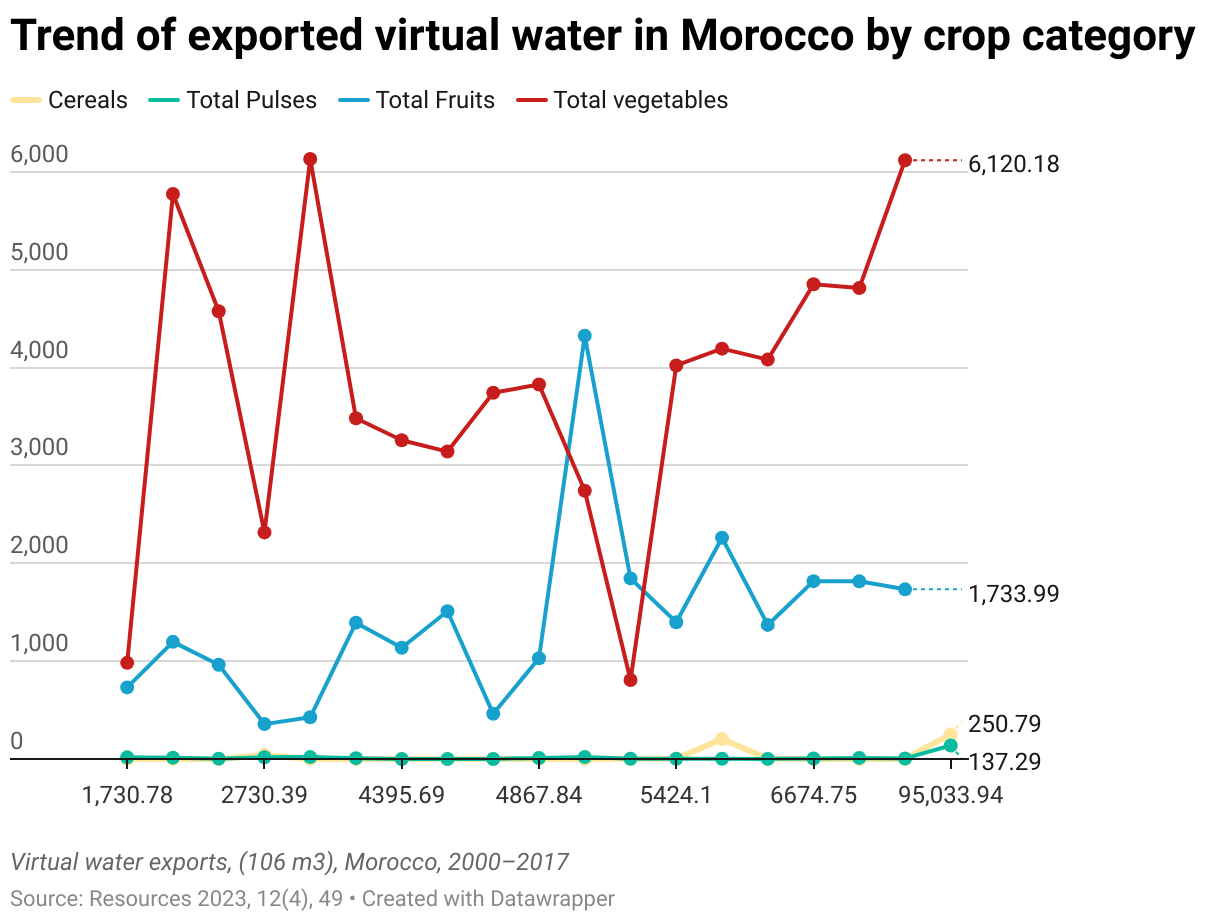
The discrepancy between Morocco’s water scarcity and its role as a virtual water exporter highlights a critical issue: It contradicts the principle of virtual water trade, which suggests that water-scarce countries should import water-intensive goods and focus on producing less water-intensive products domestically.
This, coupled with extended periods of drought and Morocco’s susceptibility to inconsistent rainfall, has led to declining groundwater and surface water resources and culminated in Morocco’s current water crisis.

Key figures, including the King, have repeatedly warned that Morocco’s severe water scarcity will worsen unless effective policy changes and conservation measures are implemented.
In his 25th address to the nation, an important milestone speech largely consecrated to water management, the King urged “coordination and consistency between the water policy and the agricultural policy, especially in periods of water scarcity.”
Agriculture is the largest water-consuming sector in Morocco. It absorbs more than 87% of total water consumption.
For farmer Hamid Achtouki this comes amidst a challenging reality. A country boy at heart, he ventured into agriculture and the agro-food business after finishing his university studies.
Thanks to small loans from family members and a state support for agricultural projects, he invested in a small plot of land in Sidi Allal El Bahraoui, in Morocco’s Khemissat region. He grew different kinds of fruits and vegetables while witnessing the growth in the small rural town and its surrounding farms in the 30 years he lived there.
“All of a sudden, the wells started drying up,” Achtouki told Hespress EN.
He said the cultivation of water-dependent crops such as watermelon and avocado depleted the region’s water resources, impacting both the farmer and neighboring communities.
Many of Achtouki’s neighbors eventually shifted their activities towards cattle and animal husbandry, “that was my cue to find a solution,” he said.
Achtouki decided to relocate and sell his farm after 30 years of building it up. Heading slightly north, he landed in a thriving area where groundwater was much more accessible and where opportunities for continuing his livelihood seemed promising.
A couple of years into his relocation to the Northern Gharb, a mega farm, with cutting edge water sourcing technologies and massive budgets set shop next door.
Achtouki and his fellow farm owners in the region told Hespress EN that what they witnessed in Sidi Allal El Bahraoui could easily be replicated in the Gharb, considering the ongoing nationwide drought and the growing attractiveness of Moroccan land.
The Moroccans’ new neighbors are Israel’s largest grower and exporter of agricultural goods, Mehadrin, who undertook avocado cultivation in Morocco and signed partnership agreements soon after the resumption of Moroccan-Israeli diplomatic relations in 2020, locals told Hespress EN.
With the help of a Moroccan partner, who reportedly holds a 49% stake in the joint venture, Mehadrin received a lease for the agricultural plot from the Moroccan government and began planting avocado trees in early 2024.
The operation is anticipated to produce up to 10,000 tonnes of avocados annually and marks Mehadrin’s first venture in fruit cultivation outside Israel.
According to Mehadrin CEO Shaul Shelach, the project covers nearly 500 hectares, and the Moroccan and Israeli partners will invest approximately $9 million over three years from 2021.
About 85% of the avocados will be exported to Europe, with the remaining 15% sold locally.
The megafarm could be seen alongside the main road, distinguished from neighboring properties with its out-of-place technology infrastructure and shiny accessories.
Mehadrin CEO noted, “Morocco was chosen for its favorable conditions for avocado cultivation, including suitable land, water, climate, and lower labor costs.”
The area where the farm is set up stands out for its relatively abundant water resources compared to other parts of the country. Spanning approximately 5,000 square kilometers, the region benefits from a network of rivers, including the Sebou river and its tributaries, which provide a significant water source for agriculture and industry.
The region’s extensive irrigation infrastructure, including major dams and canals, supports roughly 150,000 hectares of fertile farmland, making it a crucial area for Morocco’s agricultural production.
Recent Moroccan Ministry of Agriculture data shows that the Gharb region contributes approximately 30% of Morocco’s total agricultural output, underscoring its importance to the national economy.
The region’s main reservoir, the Al Wahda Dam, has a storage capacity of about 1.1 billion cubic meters, which is instrumental in regulating water supply during periods of scarcity. Although its water levels are dropping, they are still the highest in the country by June 2024.
Al Massira, the country’s second-largest dam, is critically low at 1% capacity in July. The dam supplies water to over 100,000 hectares of farmland in the Doukkala region
Gharb’s agricultural potential is much like Portugal’s Algarve where a burgeoning avocado industry has raised significant environmental concerns due to its high water consumption and associated costs.
Avocado fields in Algarve now cover about 1,600 hectares of land and require around four times more water than traditional crops like oranges, straining already scarce water resources in these regions.
Some avocado farms are reported to consume up to 4 million liters of water daily, exacerbating drought conditions and threatening local ecosystems.
The Bravura Dam, a key water source for the Algarve, is currently at just 18% capacity, with water levels critically low due to the high demands from agriculture.
The surge in avocado farming has worsened drought conditions in the Algarve. Water scarcity has led to restrictions and reduced availability for other agricultural and residential needs. Excessive irrigation for avocado crops has caused significant depletion of local aquifers, impacting long-term water sustainability and groundwater availability for other uses.
In response to these problems, the Gharb region has become home to many Portuguese farms, who, along with Spanish cultivators, are replicating their deadly formulas in the Kingdom.
Environmental expert and president of the “Minarets” ecological association, Benramel Mostafa for development and climate in Kenitra El Gharb says the Iberian scenario will be replicated in Morocco if no action is taken.
“In light of climate change’s highly fickle, unstable, and unpredictable path and the country’s current drought crisis, Morocco simply can’t afford to allow such cultivation without a long-term policy that outlines realistic and serious alternatives to the activity’s hydraulic costs.”
“Learning from the Spanish and Portuguese experience, especially with Avocado, we need to see that the Government and relevant bodies are honing in on land partition, irrigation regulation, and the generalization of new technologies for proper non-invasive agriculture.”
To Benramel, Morocco has already gotten a taste of the devastating result of predatory farming and virtual water export in the failure of the watermelon boom.
“In less than 10 years, mass cultivation of highly water-dependent fruit in disregard to water threats have devastated the area,” now considered one of the most affected by the persistent drought Morocco is experiencing.
In addition to the impact of water-intensive agriculture during droughts evident in the depletion of groundwater levels and the deterioration of water quality, Benramel warns that such practices could also affect Morocco’s reserves of drinking water.
Farmers, striving to maintain crop yields amidst erratic rainfall patterns, have intensified their reliance on groundwater pumping. This practice has exacerbated aquifer depletion, prompting concerns about the long-term sustainability of agricultural production in the region but also, the filling of the Kingdom’s vital dams.

“Environmental repercussions are significant,” explains the expert, considering “reduced river flows and stressed aquifers threaten the health of ecosystems dependent on reliable water supplies, not only for crops but for the region’s access to clean drinkable water as well.”

“Moreover, the concentration of pollutants in diminished water volumes poses risks to both environmental integrity and public health.”
According to a report by the Ministry of Agriculture and Fisheries, groundwater levels in key aquifers of the Gharb region have dropped by an alarming 30% over the past decade.

“This reduction is largely attributed to unsustainable extraction practices driven by the region’s intensive agriculture, which heavily depends on irrigation,” says Benramel.
Farmers, facing erratic rainfall patterns and seeking to maintain crop yields, have increasingly turned to groundwater pumping, exacerbating the depletion. With foreign farms sweeping the region, groundwater has become more common as resources for better, more efficient technologies grow.
“But also, the quality of groundwater in the Gharb region has also been compromised, with high concentrations of nitrates and other pollutants from agricultural runoff and industrial activities have been detected, posing risks to both human health and ecosystem integrity.”
Local communities are feeling the impact of these changes acutely. Though foreign farms in the Gharb region have contributed to reviving the rural local economy, the improvement “is insignificant considering the grand cost,” assures the expert.
This sentiment is shared by locals who, speaking to Hespress EN, say that though they have more work on new massive foreign farms today, news from relatives of dried-up wells in Sidi Allal El Bahraoui is worrisome.
“But we still have a few decades until we reach that point, so we’re okay for now,” one local said.








add your comment
Terms of publication : Not to offend the writer, people, sacred things, or attack religions or the divine self, and refrain from racist incitement and insults.