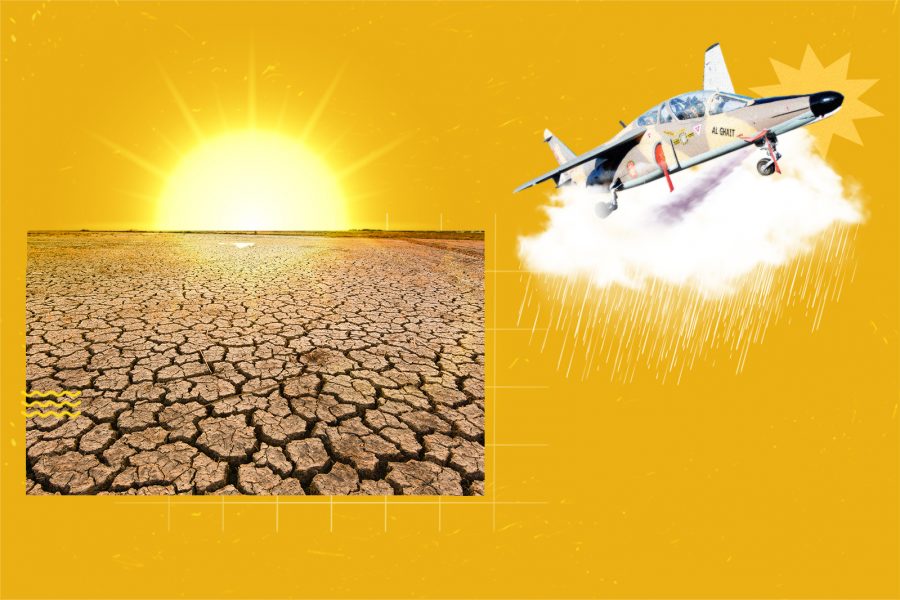
Morocco has taken a daring gamble on the weather as the country’s Al-Ghaith cloud seeding program, a decades-old endeavor, has recently escalated in intensity.
Cloud seeding, developed in the 1940s, gained popularity in the western U.S. during the 1960s, primarily to increase snowfall.
It has been used ever since for a variety of purposes, from mitigating environmental disasters to influencing military operations.
For example, it was employed to clear pollution during the 2008 Beijing Olympics and to divert radioactive clouds from Moscow after the Chernobyl disaster.
Cloud seeding was also used as a military tactic to hinder enemy movements during the Vietnam War, though such practices are now banned by the United Nations.
In simple terms, cloud seeding is a weather modification technique that involves introducing substances into clouds to alter their precipitation patterns.
This is typically done with the aim of increasing rainfall, but it can also be used to disperse fog or suppress hail.
Ali Charoud, a climate expert, told Hespress EN that cloud seeding doesn’t magically conjure water but requires existing clouds with moisture.
The process begins with meteorologists identifying suitable clouds for seeding. These are typically cumulus or cumulonimbus clouds, which are tall, towering clouds that often contain water droplets or ice crystals.
Once a suitable cloud has been identified, substances such as silver iodide, salt particles, or dry ice are introduced into the cloud.
These substances act as nuclei for the formation of ice crystals or water droplets, which can then grow larger and eventually fall to the ground as precipitation.
Morocco has been pouring millions into artificially increasing rainfall, hoping to alleviate its water crisis.
Since 2023, Morocco has allocated nearly €10 million to enhance rainfall in targeted areas by up to 15% through 20 separate cloud seeding projects.
Experts estimate that this technology could boost precipitation rates by 4%, with the potential to increase agricultural productivity by up to 20%.
This increased focus on weather modification comes as Morocco faces its sixth consecutive year of drought, with rainfall levels in January 2024 showing a stark 70% shortfall compared to the average over the past three decades.
But the country’s cloud seeding projects are not new; Morocco has been exploring climate geoengineering techniques since the 1980s, seeking to increase its water resources through weather modification methods.
Morocco’s Al-Ghaith program, a cornerstone of its water resource strategy, has conducted 49 artificial cloud seeding operations since 2021.
Morocco and the United States collaborated on the program from 1984 to 1989 to explore the possibility of increasing water supplies through weather modification.
A pilot project was then established in the upper Oum er Rbia basin, where promising clouds were treated with silver iodide released from aircraft and, later, ground-based generators.
Over five winters, clouds were seeded on 144 days. The project equipped Morocco with its first weather radar and airborne cloud physics data collection system.
Fear and apprehensions
While Morocco views cloud seeding as a vital tool to combat its water scarcity, this ambitious project has stirred controversy, particularly among its neighbor, Spain.
Spain, also facing its own water woes, fears that Morocco’s cloud seeding could lead to increased rainfall in areas unaccustomed to such conditions, which could trigger flooding, soil erosion, and other environmental issues.
There’s a particular concern for the southern regions and the autonomous cities of Ceuta and Melilla.
There are also concerns that cloud seeding might disrupt the atmospheric balance, potentially leading to droughts in other locations or causing intense, unmanageable downpours.
Charoud dispelled these misconceptions, explaining that while cloud seeding can induce rain, it typically doesn’t lead to heavy downpours or flooding on the scale that recently inundated the United Arab Emirates and cannot affect the weather of another country.
According to the expert, the torrential rain in the UAE cannot be a result of cloud seeding because the country doesn’t experience continuous rainfall throughout the year.
Scientists say that many who advocate for cloud seeding as a primary cause of heavy rainfall are also climate change deniers, attempting to shift focus from the real issue.
When discussing intense rainfall, climate change must be the central consideration because concentrating on cloud seeding is a distraction.
As the planet heats up, global rainfall patterns are intensifying due to the increased moisture-holding capacity of a warmer atmosphere.
Roslyn Prinsley, the head of disaster solutions at the Australian National University Institute for Climate, Energy, and Disaster Solutions, dismissed claims linking cloud seeding to floods as ‘conspiracy theories,’ stating that it’s highly improbable.
Opinions on cloud seeding are mixed. Some studies suggest that there is still insufficient scientific evidence to definitively prove its effectiveness, while others attest to its effectiveness.
A 2020 study demonstrated the effectiveness of cloud seeding, although researchers emphasized its limitations. By inecting clouds with silver iodide, they successfully induced precipitation at several locations, even causing snowfall in areas here it was previously absent.
In the case of Morocco, Charoud said that cloud seeding remains limited and the country should focus on proven strategies for water security, such as connecting water basins and expanding seawater desalination and wastewater treatment facilities.
These mixed opinions extend to the effects of cloud seeding.
While some critics say that the “use of silver iodide raises ecological concerns because it might be toxic to terrestrial and aquatic life, prompting exploration of less harmful alternatives,” others argue that cloud seeding is environmentally safe.







add your comment
Terms of publication : Not to offend the writer, people, sacred things, or attack religions or the divine self, and refrain from racist incitement and insults.