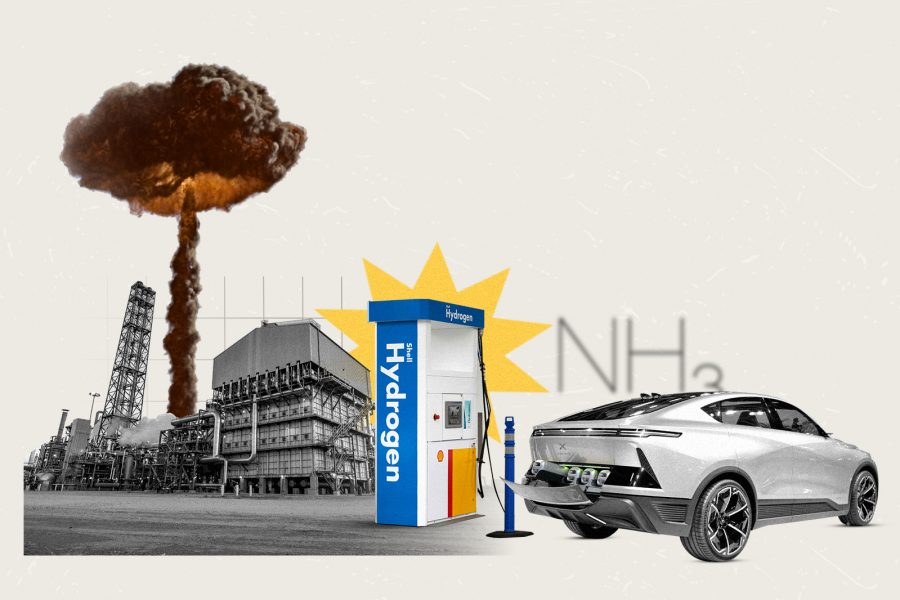
Hydrogen has generally been accepted as one of the main directions of future energy, but the hundreds of accidents it caused have shown the world that it cannot be taken lightly: naturally susceptible to leakage, it can light up immediately, cross distances far larger than natural gas in an unseen, scentless ball of flame that prompted a decade of research into safer and more reliable handling methods.
One such solution comes from Ismail Jebbour, a Moroccan energy researcher and innovator who says that a system he patented where ammonia is converted as an energy carrier for hydrogen could revolutionize transportation and handling.
What he proposes is a three-step process where green ammonia is first produced from hydrogen, transported by truck or ship to port terminals, and then converted back to hydrogen through a process called cracking in existing or new hydrogen refueling stations.
“This approach combines the advantages of efficient storage and transport of ammonia with the clean production of hydrogen, offering a viable and sustainable path to reduce carbon emissions and increase reliance on renewable energy,” said Jebbour, a 36-year-old professional with a background in water management and renewable energies.
For Abdessamad Faik, Director of Laboratories for Inorganic Materials research at Mohammed VI Polytechnic University (UM6P) this might just be the solution for Morocco’s hydrogen export plans.
“With existing global infrastructure for ammonia transportation, including storage and shipping capabilities, and our established import terminal in Jorf Lasfar, Mohammadia, we are well-positioned to transport green ammonia efficiently,” he said in a statement to Hespress English.
Researchers have found critical gaps in Morocco’s hydrogen roadmap. They say it’s too ambitious, too costly and hardly feasible by the 2050 target Morocco set to produce at least 115 TWh of hydrogen and export it especially that the country aims to produce much more green hydrogen than its current renewable energy capacity allows, while investments in infrastructure and technology add up costs.

“Building hydrogen infrastructure from scratch is a massive undertaking that requires significant investments,” said Jebbour in a statement to Hespress English. “Using ammonia allows us to overcome many of these hurdles, at least in the short and medium term.”
Morocco has already embarked on a push to become a major producer of green ammonia with OCP Group announcing in 2023 plans to invest $7 billion in an ammonia plant that uses green hydrogen, aiming to boost the production and export of low-carbon fertilizers and phosphates.
With a massive £850 million investment, the Hevo Ammonia Morocco project is set to produce a staggering 183,000 tons of green ammonia annually by 2026.
This ambitious venture will not only slash CO2 emissions by 280,000 tons but also transform Morocco into a green ammonia powerhouse.
A second flagship project is the Tarfaya Green Ammonia Project (TGA) which aims to produce 1 million tons of green ammonia annually by 2027, scaling up to 3 million tons by 2032. Powered by renewable energy, this project will significantly reduce OCP’s carbon footprint and contribute to Morocco’s clean energy goals.
What’s more, ammonia is generally less expensive than green hydrogen.
But ammonia-to-hydrogen conversion is already a mature technology deployed by European and U.S. firms. Jebbor’s innovation lies in manufacturing compact, high-pressure cylinder storage for ammonia—similar to medical oxygen tanks.
These cylinders are a “game changer” because not only do they allow for on-demand ammonia conversion into precise hydrogen quantities, eliminating waste and logistical risks, but they also reduce the inherent risks associated with transporting and handling large volumes of ammonia.
“Ammonia is a hazardous substance that requires stringent safety protocols,” warns Ilias Barrak, a tech hydrogen analyst, in a statement to Hespress English emphasizing the need for adopting advanced storage solutions and improved container technology to mitigate risks.
The UM6P professor echoed this sentiment but assured by noting that ammonia, like other hazardous substances such as diesel and butane gas, requires specialized handling.
Research reveals that the substance is toxic at high levels, but it’s reassuring to know that it can be smelled even at very low concentrations, as low as 5 parts per million. Plus, unlike hydrogen, ammonia burns more slowly and requires a higher ignition temperature, making it less likely to explode.
Jebbor is currently working with a Swiss non-profit to develop cylinder prototypes, commercialize and expand his project.









add your comment
Terms of publication : Not to offend the writer, people, sacred things, or attack religions or the divine self, and refrain from racist incitement and insults.