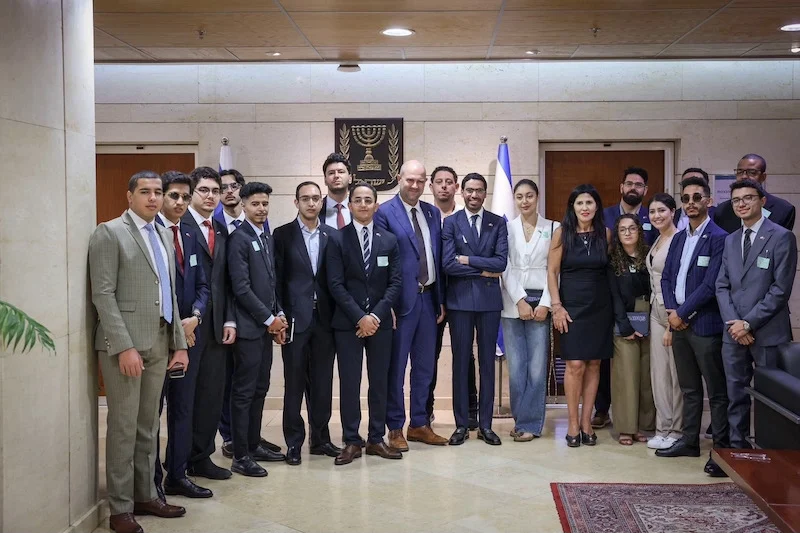
24 young Moroccans went on a visit to Israel, organized by the “Morocco of Coexistence” association in cooperation with the Tel Aviv-based “Sharaka” foundation and funded by the German government, sparking a fierce debate on social media.
The visit, which included meetings with Israeli officials such as Knesset Speaker Amir Ohana and former Israeli National Security Advisor Meir Ben-Shabbat, coincided with the ongoing war in Gaza, which is widely condemned by Moroccans who call for the end of normalization and the severing of ties with Israel.
The organizers of this visit, which continues until July 13th, defended it despite appearing in a video dancing at a concert alongside Israeli citizens in Jerusalem.
They consider it their right to express their personal beliefs and solidarity with a “friendly state” that recognizes Morocco’s sovereignty over its southern territories.
However, critics stressed that this visit is an anomaly from the popular position Moroccans have long expressed by taking to the streets to make their voices heard to the world.
These critics denounced Israel’s exploitation of these young people, saying they are being used to whitewash Israel’s image and cover up the crimes it commits against the Palestinians.
Faiçal Marjani, the founding president of the “Morocco of Coexistence” Association, who led the Moroccan youth delegation to Israel, stated that “this visit does not in any way represent the official or popular positions of Morocco.”
“Certain parties do not have the right to monopolize the representation of the kingdom at these levels, nor do they have the right to strip anyone of their nationality or accuse them of treason and collaboration for expressing their personal convictions,” he added.
Marjani went on to say that “the youth visit to Israel is part of contributing to the development of Moroccan-Israeli relations, which are historical and go beyond the signing of the Abraham Accords.”
In an interview with Hespress Ar, Marjani emphasized that “Morocco in the 21st century, under its constitution, embraces all voices, including those who advocate for closer ties with Israel and those who oppose them, stressing that “our constitution guarantees the right to freedom of expression.”
He added that “the group that visited Israel wanted to show support for a country that recognized Moroccan sovereignty over the Sahara during a difficult time with Hamas. This is in line with the principle of solidarity that guides international relations with friendly nations.”
The speaker noted that “those who today oppose the establishment of normal relations with Israel are in fact opposing Morocco’s strategic interests.”
Marjani argued that “the critics have never commented on the positions of Palestinian factions on the kingdom’s territorial integrity and on the suspicious relations of some of these factions with Iran, which the Moroccan Ministry of Foreign Affairs has acknowledged as playing a role in supporting separatism in Sahara.”
He said, “it is unfortunate that the issue of the kingdom’s territorial integrity, which is one of its fundamental principles, is considered a secondary matter by those who attack us. They remain silent when it is trampled upon by certain parties who build their distant causes on our strategic and developmental concerns as Moroccans.”
He added that “some of them have gone so far as to question the credibility of sovereign institutions and ministries to serve an agenda that seeks to outbid Morocco’s position on the conflict in Palestine, in which the kingdom has taken positions and initiatives more advanced than some countries in line with the aspirations of the Palestinians themselves.”
Aous Remmal, the president of the Unity and Reform Movement, found “the justifications given for these young people’s visit to Israel unacceptable.”
He stated that “this visit by these young people is, first of all, an anomaly compared to the quasi-unanimity of the Moroccan people on the issue of normalization with this occupying entity and on the need to sever all ties with it.”
Remmal added that “those who want to go to Israel do not need an excuse or to claim to be working to develop relations or other justifications. The proof is that these people were going to Israel even before normalization, but they were going in secret before it became public.”
The same speaker clarified that “the Moroccan popular decision is clear, which is the absolute rejection of establishing any relations with this entity.”
He pointed out that “some educated young people with advanced degrees have previously gone to Israel with the help of associations that facilitate their travel under attractive employment contracts, before finding themselves forced to work as spies from within the occupied Palestinian territories.”
The speaker noted that “the reception of the youth who visited Israel by senior leaders and politicians is actually an Israeli attempt to whitewash the occupation’s image, which has become tarnished in the eyes of nations and peoples due to the daily crimes and massacres committed against the Palestinian people.”







add your comment
Terms of publication : Not to offend the writer, people, sacred things, or attack religions or the divine self, and refrain from racist incitement and insults.