
A report by the Global Initiative Against Transnational Organized Crime (GI-TOC) said the number of irregular migrants crossing from northern Morocco to Spain in 2023 significantly decreased.
This route, which includes the land crossings to Ceuta and Melilla, saw a mere 467 arrivals compared to 2022’s figures, representing a remarkable 75% drop.
This decline is attributed to the enhanced security measures implemented by both Moroccan and Spanish authorities around the enclaves.
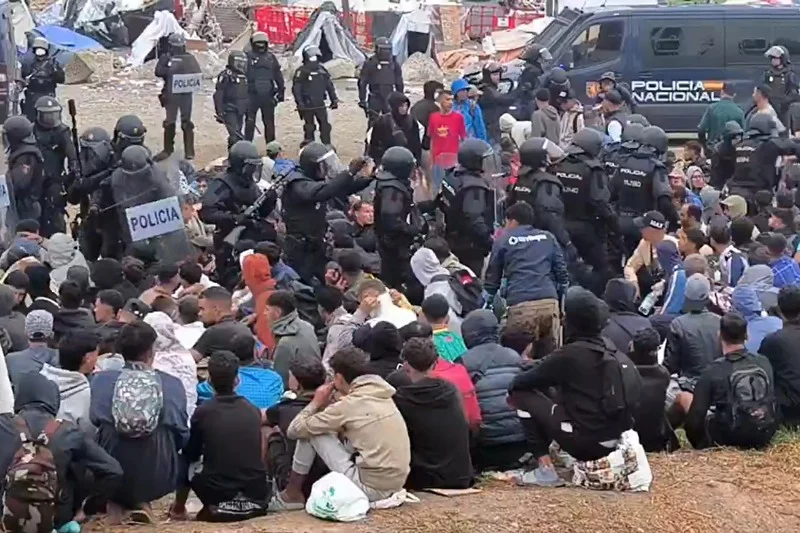
The Moroccan authorities have intensified their efforts to curb irregular migration, increasing checkpoints at entry points to northern towns near Ceuta and Melilla, particularly in Nador.
These security measures have effectively prevented the gathering of migrant groups near the enclaves.
Moroccan security forces have also ramped up patrols in rural areas and forests, traditionally used as staging grounds for migrants before attempting to cross the enclaves’ borders or organize mass entry operations.
The report noted the sustained focus on law enforcement and stricter implementation in Morocco’s northern regions over recent years.
The authorities initiated border closure measures and intensified coastal surveillance during the early stages of the COVID-19 pandemic.
These efforts were further bolstered by the rapprochement between Morocco and Spain following Spain’s shift in stance in support of Morocco’s position on the Western Sahara issue.
The report also notes the relocation of migrants from coastal towns and cities in northern Morocco, such as Nador, to inland cities like Beni Mellal, Tiznit, Settat, and Azilal.
While the primary departure points in northern Morocco have remained relatively stable, with Moroccan nationals typically departing from Nador and the Mediterranean coast between Hoceima and Bouarfa, as well as Tangier on the Atlantic coast, foreign migrants generally embark from Nador and Tangier.
Southward, a slight uptick in arrivals from Morocco to the Canary Islands was observed last year, following a nearly one-third decline between 2021 and 2022.
This increase was primarily driven by foreign migrants, while the number of Moroccan migrants remained relatively low at 5,817.
The report pointed out the adaptability of irregular migrants and human smuggling networks in response to Moroccan authorities’ intensified scrutiny.
Smuggling networks have countered the increased law enforcement efforts by shifting departure points and migrant hiding locations, and expanding their use of simultaneous departure operations to overwhelm security forces and reduce interception risks.
The cost of irregular migration journeys from Morocco varies depending on factors such as the departure point and type of vessel.
Infants and children are typically charged lower fares. Some migrants have reported incurring additional costs for water, food, and life jackets provided in safe houses.
The report also mentions that some migrants use self-smuggling methods, including jet skis, kayaks, and inflatable boats.
While this form of irregular migration was less prevalent in Morocco last year, it remains attractive due to its lower cost compared to smuggling networks. In some cases, migrant smuggling boats may be unknowingly laden with drugs.








add your comment
Terms of publication : Not to offend the writer, people, sacred things, or attack religions or the divine self, and refrain from racist incitement and insults.