
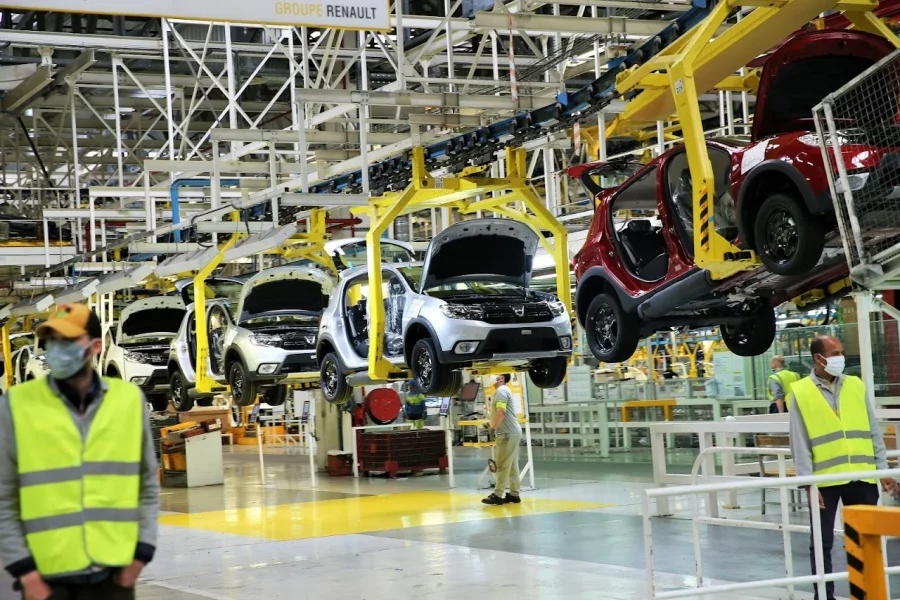
Morocco’s car production capacity is reaching 700,000 vehicles annually, with plans to reach a production capacity of 1 million cars per year by 2025, according to Industry and Trade Minister Ryad Mezzour.
In an interview with CNBC Arabia during the Thirteenth Ministerial Conference of the World Trade Organization in Abu Dhabi, Mezzour revealed that car exports have surpassed pre-pandemic levels, jumping from $10 billion to $14 billion in 2023.
Recognizing the global shift towards electric vehicles, Mezzour said that the development of charging infrastructure is currently a national priority.
This focus aligns with the European Union’s decision to ban the sale of new diesel and gasoline cars by 2035. Morocco is well-positioned to thrive in the evolving global automotive landscape by prioritizing electric car technology.
The available data reveals that despite a complex economic landscape, Morocco’s car market managed a slight increase in 2023, according to the Association of Vehicle Importers in Morocco (AIVAM).
New vehicle sales reached 161,504 units, marking a marginal 0.1% rise compared to 2022 (161,410 units).
The association attributed this modest growth to a combination of factors. While a challenging economic environment could have dampened demand, a gradual recovery in supply helped offset some of those effects. This resulted in the slight year-on-year increase in sales.
Despite contributing only 1.2% to the global automotive volume, Morocco has strategically positioned itself as a rising star in the industry, aligning itself with key players like South Africa, Algeria, and Egypt.
This success can be attributed to several factors including Morocco’s savvy investments in infrastructure, leveraging its proximity to Europe. This creates a strategic advantage for both European and Moroccan companies.
The country has not only been transitioning from simply assembling vehicles to production but it’s actively attracting global leaders in the automotive industry.
Giants like German Motor Distributors, Renault, and Stellantis have been drawn to Morocco’s business-friendly environment.
While the kingdon is actively attracting multinational corporations, It’s nurturing local contributions. This includes significant investments in infrastructure, the creation of tax-free zones, and leveraging Europe’s proximity.
Strategic initiatives like the 2014-2020 Industrial Acceleration Plan and the establishment of automotive hubs have played a crucial role in creating a thriving automotive ecosystem within Morocco.





add your comment
Terms of publication : Not to offend the writer, people, sacred things, or attack religions or the divine self, and refrain from racist incitement and insults.