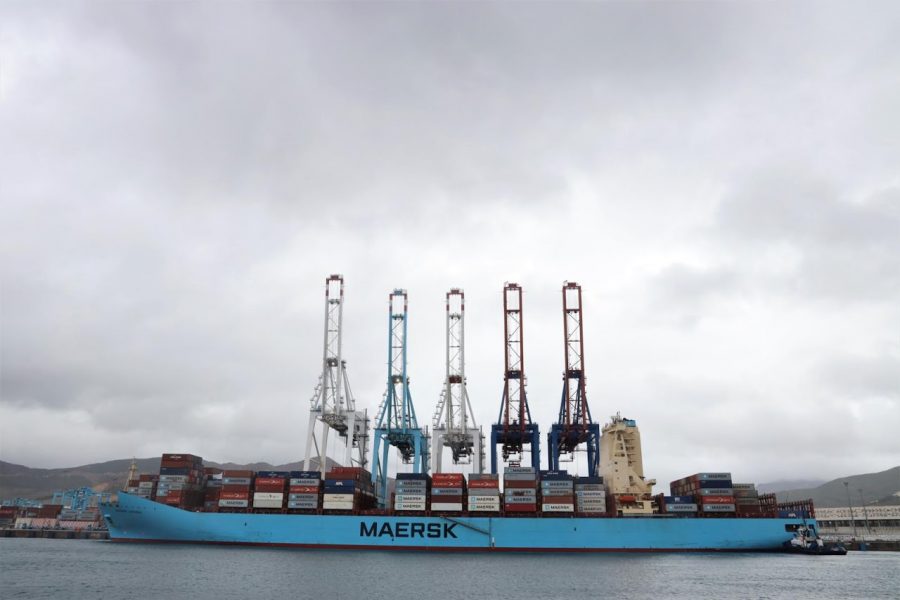
The new Emissions Trading System (ETS), which came into effect on January 1, 2024, intending to regulate and tax CO2 emissions from maritime transport, sparked serious concerns among Spanish authorities. They fear that this change could give an advantage to Tangier Med Port and “reduce the competitiveness of the European ports.”
“If traffic is redirected to other ports, it would negatively affect employment, port activity, and the resilience of logistics chains controlled by the European Union,” explained Gerardo Landaluce, President of the Port Authority of the Bay of Algeciras (APBA), in a statement to Europa Press.
He further highlighted that the new EU environmental regulations disadvantage European ports like Algeciras compared to other ports, such as those in Morocco, situated on the opposite side of the Strait.
The implementation of the new regulations hinders “the ability of Algeciras port to compete on equal terms with Tangier port,” complained the President of APBA.
In a complex geopolitical and geoeconomic landscape, Landaluce hinted at the collective commitment to enhance European ports and ensure their ability to meet the demands of the economy.
The President of APBA, along with other responsible parties from affected ports, has repeatedly called for a moratorium on the enforcement of these regulations, added the same source.
During a meeting in Algeciras, Southern European ports in Algeciras called for unified action on European regulations, urging the International Maritime Organization to extend measures to all Mediterranean ports to prevent carbon dioxide leaks and ensure fairness between European and third-country ports.
Despite supporting the European Green Pact and Fit for 55 targets, the President of APBA has been warning Algeciras port about the impact of the Emissions Trading System on European ports since 2020, voicing concerns about potential carbon dioxide leakage from European space.
He criticized the directive for failing to reduce emissions and contradicting the EU’s common goal.
Starting this year, the EU’s ETS has been expanded to include the maritime sector. It limits emissions by issuing allowances equal to one ton of CO2 or CO2 equivalent. Companies, thus, must buy allowances based on their emissions to reduce greenhouse gas emissions.
The goal of the expansion is to help the maritime industry minimize its environmental impact and accelerate the adoption of low-carbon fuels.
The EU ETS for shipping applies to all maritime services with at least one call within the EU, covering 100% of emissions between EU ports and 50% of emissions between EU and non-EU ports.
It has a three-year phase-in period, starting at 40% in 2024 and increasing to 70% in 2025 and 100% in 2026.



add your comment
Terms of publication : Not to offend the writer, people, sacred things, or attack religions or the divine self, and refrain from racist incitement and insults.